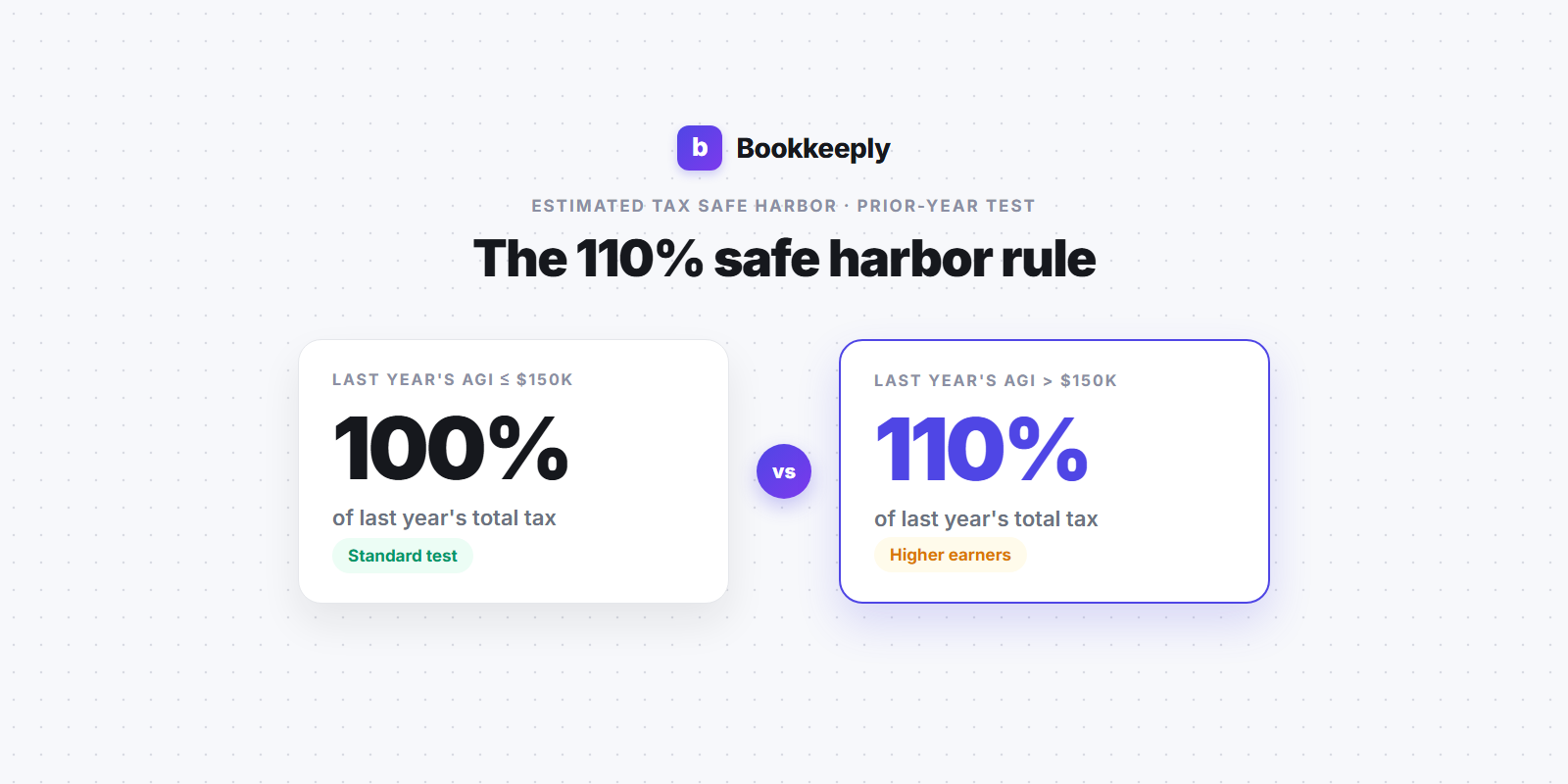
Most freelancers learn the safe harbor rule as "pay 100% of last year's tax and you can't be penalized." That's true for a lot of people, but not for everyone. Once your income crosses a certain line, the IRS raises the bar to 110%. Miss that detail and you can do everything else right, pay four even installments on time, and still end up with an underpayment penalty on Form 2210.
This guide explains the 110% safe harbor rule in plain English: who it applies to, which year's numbers you use, and how to turn it into a quarterly payment, with two worked examples.
What Is the 110% Safe Harbor Rule?
If you don't have enough tax withheld from a paycheck, the IRS expects you to pay estimated tax during the year. To avoid an underpayment penalty, your withholding plus estimated payments generally need to reach the smaller of:
- 90% of the tax shown on this year's return, or
- 100% of the tax shown on last year's return.
The 110% rule changes only the second test. According to the IRS instructions for Form 2210 and Form 1040-ES, if your adjusted gross income (AGI) for the prior year was more than $150,000 (more than $75,000 if your current-year filing status is married filing separately), you substitute 110% for 100%.
So for a higher earner, the safe harbor becomes the smaller of 90% of this year's tax or 110% of last year's tax. Everything else stays the same. If you want the full background on both tests and the $1,000 exception, start with our guide to the IRS safe harbor rule.
Who Has to Use 110% Instead of 100%?
The trigger is simple, but people get it wrong in three common ways.
It's based on last year's AGI, not this year's
For 2026 estimated payments, the IRS looks at your 2025 AGI, which is on line 11 of Form 1040. If that number was over $150,000, you use 110% of your 2025 tax for the prior-year test, even if you expect 2026 to be a slower year.
The reverse is also true. If your 2025 AGI was $120,000 and 2026 is shaping up to be a record year, you still get to use 100% of your 2025 tax. That's one of the most useful features of the rule for a growing business.
It's AGI, not gross revenue or net profit
AGI is your total income minus certain adjustments, such as the deduction for half of your self-employment tax and contributions to a SEP IRA or Solo 401(k). A freelancer who billed $190,000 can end up with an AGI below $150,000 after business expenses on Schedule C and those adjustments. Check the actual line on your return instead of guessing from your invoices.
"More than" means exactly $150,000 doesn't count
The threshold is AGI more than $150,000, so an AGI of exactly $150,000 still uses the 100% test. The $150,000 figure applies whether you file single, head of household, or married filing jointly. Only married filing separately has the lower $75,000 threshold.
How to Calculate Your 110% Safe Harbor Payment
Here's the process, step by step:
- Find last year's AGI (Form 1040, line 11). Over $150,000 ($75,000 if married filing separately)? Use 110%. Otherwise use 100%.
- Find last year's total tax. This is the total tax on your return (including self-employment tax), not the balance you owed when you filed.
- Multiply that tax by 110% (or 100%).
- Estimate this year's tax and take 90% of it. This is the other test.
- Use the smaller of the two as your required annual payment.
- Subtract expected withholding (for example, from a part-time W-2 job).
- Divide the rest by four and pay it by each due date.
For 2026, the Form 1040-ES due dates are April 15, 2026, June 15, 2026, September 15, 2026, and January 15, 2027. Our post on the Q4 estimated tax payment covers what to do if you're catching up late in the year.
Example 1: A High-Earning Consultant
Illustration only. The numbers are made up to show the math.
Jordan is a self-employed consultant. On the 2025 return, AGI was $180,000 and total tax was $36,000. Jordan expects 2026 to be a bigger year, with total tax of about $48,000, and has no withholding.
- 2025 AGI of $180,000 is over $150,000, so the prior-year test is 110%.
- 110% test: $36,000 × 110% = $39,600
- 90% test: $48,000 × 90% = $43,200
- Required annual payment (the smaller): $39,600
- Quarterly installment: $39,600 ÷ 4 = $9,900
If Jordan had used 100% by mistake, the quarterly payment would have been $9,000. That's $900 short every quarter, or $3,600 for the year, which is exactly the kind of gap that triggers a penalty even though every payment went in on time.
Note what safe harbor does and doesn't do. Paying $39,600 protects Jordan from the underpayment penalty, but the actual 2026 tax is still about $48,000. The remaining $8,400 is due when the return is filed. Safe harbor removes the penalty, not the bill, so it's smart to set that difference aside as you go.
Example 2: Just Under the Threshold
Illustration only.
Sam is a freelance developer. The 2025 return shows AGI of $148,000 and total tax of $27,000. Sam expects 2026 tax of $34,000.
- 2025 AGI is not over $150,000, so the prior-year test stays at 100%.
- 100% test: $27,000 × 100% = $27,000
- 90% test: $34,000 × 90% = $30,600
- Required annual payment: $27,000, or $6,750 per quarter.
Next year could be different. If Sam's 2026 AGI lands above $150,000, then 2027 estimated payments will need to use 110% of the 2026 tax. The threshold is checked fresh every year.
When the 90% Test Beats 110%
The 110% test isn't automatically the answer. If your income drops, 90% of this year's tax can be the smaller number.
Illustration: last year's tax was $40,000 with AGI over $150,000, so the 110% test is $44,000. This year you took a few months off and expect a $30,000 tax bill. The 90% test is $27,000, well below $44,000. Paying on the 90% test keeps a lot more cash in your business during the year.
The catch is that the 90% test depends on an estimate. If you underestimate this year's income, you can fall short. That's why many freelancers with lumpy income stick with the prior-year test: it's a fixed number you already know. Keeping your income and expenses up to date through the year makes the 90% route much less of a guess.
Details That Trip People Up
Payments have to be on time, not just in total
The penalty is figured separately for each installment period. Paying the full $39,600 in January doesn't erase a shortfall from April, June, and September. Generally, each installment should be one quarter of the required annual payment. (If your income is very uneven, the annualized income installment method on Form 2210 may reduce or remove a penalty. It takes more paperwork, so read the Form 2210 instructions or ask a tax pro.)
Withholding counts, and it's treated as paid evenly
If you or your spouse have a W-2 job, federal income tax withheld from those paychecks counts toward the safe harbor. Per the Form 2210 instructions, withholding is treated as paid one-fourth on each due date unless you show otherwise. That makes raising W-2 withholding late in the year a practical way to catch up on a shortfall.
No prior-year return, no prior-year test
If you didn't file a return last year, or last year's return covered less than 12 months, you can't use the 100% or 110% test. You'd be left with the 90% current-year test.
State rules are separate
Everything here is about the federal rule. States that collect estimated tax set their own safe harbor percentages and thresholds, so check your state's rules separately.
FAQ
Does the 110% rule apply if my AGI was exactly $150,000?
No. It applies when AGI is more than $150,000 (more than $75,000 for married filing separately). At exactly $150,000, the prior-year test is 100%.
Is the 110% based on last year's income or last year's tax?
Both, in different ways. Last year's AGI decides whether you use 110% or 100%. Then you apply that percentage to last year's total tax.
If I pay 110% of last year's tax, do I still owe more in April?
You might. Safe harbor protects you from the underpayment penalty. If your actual tax this year is higher than what you paid in, you still owe the difference when you file, just without the penalty.
Does the $1,000 rule still apply to high earners?
Yes. If what you owe after withholding and estimated payments is less than $1,000, there's generally no penalty, regardless of AGI.
What about farmers and fishers?
Qualifying farmers and fishers have their own special rules (for example, 66⅔% replaces 90% for the current-year test). See IRS Publication 505 if that's you.
The Bottom Line
The 110% safe harbor rule is a small adjustment with a real cost if you miss it. Check last year's AGI, use 110% if it was over $150,000, compare that against 90% of this year's estimate, and pay the smaller number in four on-time installments. Then set aside the rest of your real tax bill so April isn't a surprise. For help sizing that reserve, see how much a freelancer should set aside for taxes, or browse the rest of the Bookkeeply blog.
Sources: IRS Instructions for Form 2210 (2025), IRS Form 1040-ES (2026), and IRS Publication 505 (2026). This article is for general education only and isn't tax or legal advice. Bookkeeply is not a CPA firm. Tax rules change and your situation may differ, so check with a qualified tax professional before making decisions.
If you'd like your quarterly estimates tracked alongside your books, you can try Bookkeeply for free.
Stop guessing what you'll owe.
Track your bookkeeping and see your real tax estimate in minutes a day, free, no credit card required.
Get Started Free