Cash vs accrual accounting sounds like a question for companies with a finance department. It isn't. If you freelance, you already use one of these methods, even if you never chose it on purpose, and the one you use decides which tax year your income and expenses land in.
That matters most around December. Send an invoice on December 15 and get paid on January 10, and the method you use decides whether that money is taxed this year or next. This guide explains both methods in plain terms, shows the difference with a simple example, and covers what most freelancers actually need to know before picking one.
Cash vs Accrual Accounting: The Short Version
Both methods answer one question: when does a transaction count?
- Cash method: income counts when you receive it, and expenses count when you pay them. In the words of IRS Publication 538, you "generally report income in the tax year you receive it, and deduct expenses in the tax year in which you pay the expenses."
- Accrual method: income counts when you earn it, and expenses count when you owe them, whether or not money has moved yet. Publication 538 describes income being included in the year the "all events test" is met, meaning your right to the income is fixed and the amount can be determined with reasonable accuracy.
Put simply, cash accounting follows your bank account. Accrual accounting follows your invoices and bills.
How the Cash Method Works for Freelancers
Under the cash method, your books look a lot like your bank statement. A client pays you, you record income. You pay for software, you record an expense. Unpaid invoices sitting in your inbox are not income yet, and a bill you haven't paid is not an expense yet.
This is why the cash method is the default for so many sole proprietors and single-member LLCs. It's easy to understand, easy to reconcile against your bank account, and it never asks you to pay tax on money a client still owes you.
The catch: "constructive receipt"
The cash method isn't a loophole where income only counts once you touch it. Publication 538 explains that income is constructively received when it's credited to your account or made available to you without restriction. If a payment platform has the money ready for you in December and you simply wait until January to withdraw it, that's generally December income. You can't push income into next year just by not clicking "transfer."
Prepaid expenses have limits too
The same goes for the other direction. You can't prepay three years of software in December and deduct all of it this year. The IRS 12-month rule (also in Publication 538) generally lets a cash-method business deduct a prepaid expense in the year paid only if the benefit doesn't extend beyond the earlier of 12 months after it begins or the end of the following tax year. A one-year subscription usually fits. A multi-year prepayment usually doesn't.
How the Accrual Method Works
Accrual accounting records income when you've earned it and have a fixed right to be paid. For a freelancer, that's usually when the work is delivered and invoiced. Expenses are recorded when you're on the hook for them (the IRS calls this meeting the all-events test plus "economic performance"), not when the card is charged.
The upside is a truer picture of how your business is doing in a given month. If you finished $12,000 of client work in March but clients pay on net-60 terms, accrual books show March as a strong month. Cash books would show a quiet March and a surprisingly good May.
The downside for a small business is that you can owe tax on income you haven't collected. If a client pays late, or never, you've still reported the income in the year you earned it.
A Simple Example: One Invoice, Two Tax Years
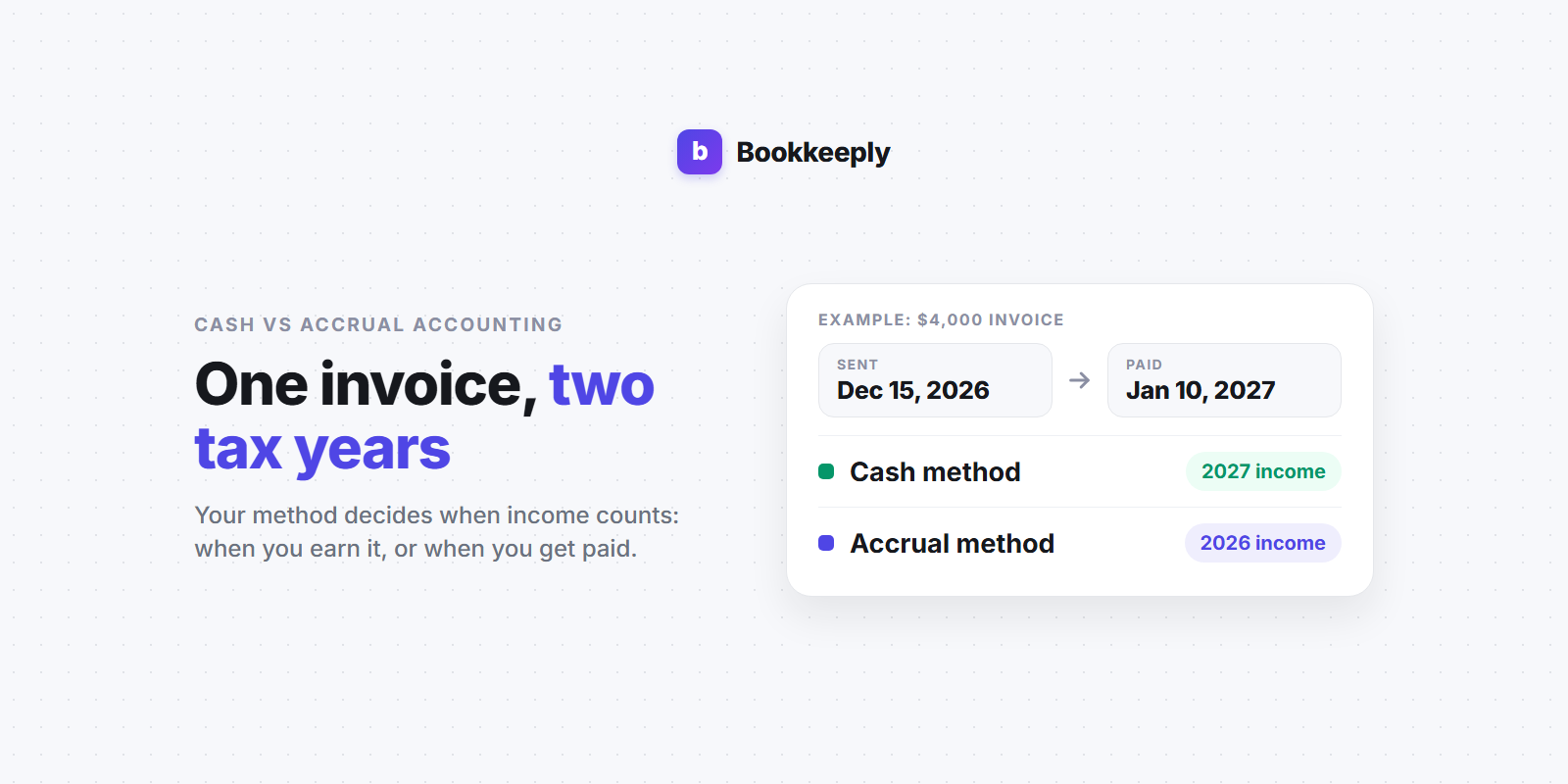
Illustration (our own example, not tax advice): Maya is a freelance designer. On December 15, 2026 she finishes a project and sends a $4,000 invoice. The client pays on January 10, 2027, and the money isn't available to her before then.
- Cash method: the $4,000 is 2027 income, because that's when she received it.
- Accrual method: the $4,000 is 2026 income, because she earned it and billed it in December.
Expenses work the same way in reverse. A bill Maya receives in late December but pays in January is generally a next-year expense on the cash method, and usually a this-year expense on the accrual method once the IRS timing tests are met.
Same work, same client, same money. The only thing that changes is which tax return the $4,000 shows up on. For a freelancer paying quarterly estimates, that can shift thousands of dollars of tax from one year to the next. If you're working on your final payment of the year, our guide to the Q4 estimated tax payment shows how to account for income that's still in transit.
Which Method Should a Freelancer Use?
For most service-based freelancers (designers, developers, writers, consultants, coaches), the cash method is the practical choice. Here's why.
Reasons the cash method usually wins
- You only pay tax on money you've collected. Late-paying clients don't create a tax bill before the cash arrives.
- It matches your bank account. Reconciling is simpler, and so is setting aside money for taxes, because you set aside a percentage of what actually came in.
- Bad debts are simpler. Under the cash method, an invoice that never gets paid was never income. The IRS notes in Topic 453 that cash-method taxpayers generally can't take a bad debt deduction for unpaid fees, but that's because the income was never reported in the first place.
- Less bookkeeping. No need to track receivables and payables separately for tax purposes.
When accrual might make sense
- You sell physical products and carry inventory. Inventory has its own rules, and Publication 538 has a section on how small businesses can handle it. This is a good point to talk to a professional.
- You need financial statements for a lender or investor who expects accrual reporting.
- Your business has grown into a structure that isn't allowed to use the cash method. Certain entities, such as C corporations, generally can't use it unless they pass the gross receipts test. For tax years beginning in 2026, that test is met with average annual gross receipts of $32 million or less over the prior three years, per Rev. Proc. 2025-32. That's far beyond where almost any freelancer operates.
What about a "hybrid" setup?
Plenty of freelancers file taxes on the cash method but still keep an eye on unpaid invoices. That's not a separate tax method, it's just good management: you track what you're owed so you can chase it, while your tax books stay cash-based. Publication 538 also notes that if you run two or more separate and distinct businesses, you can use a different accounting method for each one.
Choosing (and Changing) Your Method
You generally choose your accounting method when you file your first return for the business. The method you use on that return is your method going forward. If you later want to switch, Publication 538 says you'll need to file Form 3115, Application for Change in Accounting Method, to get IRS approval. Some changes qualify for automatic approval, but it's still a formal process, not something you flip from one year to the next.
So it's worth picking deliberately at the start. If you're filing Schedule C for the first time, you'll see a question near the top asking which accounting method you use. For most freelancers, the answer is cash.
Bookkeeping Tips for Either Method
- Record the date money actually moves. On the cash method, the payment date is what matters, not the invoice date. Keep both in your records anyway.
- Watch year-end timing. Payments that land in the last two weeks of December and the first two weeks of January are where mistakes happen. Check what hit your account on which date.
- Keep business and personal money separate. A dedicated business account makes the cash method almost automatic.
- Track every deductible expense when you pay it. Our self-employed tax deductions checklist covers what's worth recording.
- Don't prepay aggressively for tax reasons without checking the 12-month rule.
FAQ
Is cash or accrual accounting better for a sole proprietor?
For most service-based sole proprietors, the cash method is simpler and avoids paying tax on money you haven't collected. Accrual can make more sense if you carry inventory or need accrual-based financial statements.
Can I switch from cash to accrual accounting?
Yes, but generally not on your own. After your first return, a change usually requires filing Form 3115 with the IRS, as described in Publication 538.
If a client pays me in January for December work, which year is it taxed?
Under the cash method, it's generally income in the year you receive it (January, so next year), as long as it wasn't available to you in December. Under the accrual method, it's generally income in the year you earned and billed it.
Do I need accounting software to use the accrual method?
Not strictly, but accrual books require tracking what you're owed and what you owe, which is much harder in a spreadsheet. The cash method is far easier to keep by hand.
The Bottom Line
Cash vs accrual accounting comes down to timing. The cash method counts money when it moves, and the accrual method counts it when it's earned or owed. For most freelancers, the cash method keeps taxes tied to money you've actually collected and keeps your books simple. Whichever you use, stay consistent, watch year-end timing, and record payments on the date they really happen.
You can find more practical guides on the Bookkeeply blog.
This article is for educational purposes only and isn't tax, legal, or accounting advice. Bookkeeply is not a CPA firm. Tax rules change and depend on your situation, so check with a qualified tax professional before making decisions.
If you'd like your income and expenses tracked by the date money actually moves, you can try Bookkeeply for free.
Stop guessing what you'll owe.
Track your bookkeeping and see your real tax estimate in minutes a day, free, no credit card required.
Get Started Free