If you freelance from a spare room, a converted garage, or a corner of your apartment that is only ever used for work, the home office deduction can lower your taxable profit every single year. It is also one of the deductions people skip most often, usually because they have heard it is complicated or that it "triggers audits."
It is less complicated than it sounds. There are two tests your space has to pass and two ways to calculate the number. This guide walks through both, with a worked example, so you can see which method gives you the bigger deduction and what records to keep.
What Is the Home Office Deduction?
The home office deduction lets self-employed people deduct part of the cost of the home they work from. On a Schedule C, it reduces your business profit, which means it lowers both your income tax and your self-employment tax.
One important limit up front: it is for business owners, not employees. The IRS says plainly that "employees are not eligible to claim the home office deduction" (IRS newsroom). If you have a W-2 job and also freelance on the side, the deduction can only relate to your freelance business. Not sure which side of that line you are on? Our 1099 vs W-2 guide covers the difference.
Do You Qualify? The Two Tests
1. Regular and exclusive use
The space has to be used for business on a regular basis, and only for business. The IRS wording is that the deduction is allowed only if the space is "exclusively used on a regular basis for business purposes" (IRS, simplified option).
In practice:
- Usually passes: a spare bedroom set up as an office with a desk, monitor, and files, and nothing else.
- Usually fails: the dining table you clear off each morning, or a guest room where family sleeps when they visit.
- Can pass: a clearly defined part of a room (for example, a 10 by 12 foot section that holds only your work setup). It does not need walls or a door, but it does need to be used only for work.
There are two narrow exceptions to the exclusive-use rule: storing inventory or product samples when your home is your only fixed business location, and running a qualifying daycare (IRS Topic 509). Most freelance designers, writers, developers, and consultants will not fall into either one.
2. Principal place of business
Your home office generally has to be your principal place of business. That does not mean you can never work anywhere else. The IRS also counts a home office where you do your administrative or management work (invoicing, bookkeeping, scheduling) if there is no other fixed location where you do that work (IRS newsroom).
So a photographer who shoots on location but edits and invoices from home can still qualify. A separate structure on your property, like a detached studio or garage, can also qualify if it meets the regular and exclusive use tests.
Method 1: The Simplified Method
The simplified method is exactly what it sounds like. You multiply the square footage of your office by a flat rate:
- $5 per square foot
- Up to 300 square feet, so the maximum is $1,500 a year
Those figures come from the IRS page on the simplified option for the home office deduction. A few other rules from the same page:
- There is no depreciation deduction, and so nothing to "recapture" if you sell a home you own.
- If you own your home and itemize, mortgage interest and property taxes are still claimed in full on Schedule A, since none of them are split off to the office.
- The deduction cannot be more than your business's gross income minus other business expenses, and any excess cannot be carried to next year.
You make the entries directly on Schedule C instead of filling out a separate form (IRS Topic 509). If you want a refresher on where everything else goes on that form, see Schedule C for freelancers.
Method 2: The Regular Method
The regular method uses your actual costs. You work out what percentage of your home the office takes up, then deduct that share of your home expenses. Self-employed people filing Schedule C calculate this on Form 8829, Expenses for Business Use of Your Home (IRS Topic 509).
Step 1: Find your business-use percentage
Divide the office's square footage by your home's total square footage. A 200 sq ft office in a 1,600 sq ft home is 12.5%.
Step 2: Add up the indirect home expenses
These are costs for the whole home, which the IRS lists as including mortgage interest, insurance, utilities, repairs, maintenance, depreciation, and rent (IRS newsroom). Multiply the total by your business-use percentage.
Step 3: Add direct expenses
Costs that only affect the office itself (for example, painting just that room) can generally be deducted in full, not by percentage.
The regular method takes more work, but it has no $1,500 cap. And if the deduction is limited by your business income this year, the leftover amount can be carried forward and used in a later year when your income is high enough (IRS). If you own your home, remember that depreciation claimed under this method can be recaptured when you sell.
Worked Example: Simplified vs Regular
This is an illustration with made-up numbers, not a prediction of your deduction.
Maya is a freelance UX designer. She rents a 1,600 sq ft apartment and uses a 200 sq ft spare bedroom only as her office. Her yearly home costs:
- Rent: $2,000 a month, or $24,000 a year
- Utilities: $200 a month, or $2,400 a year
- Renter's insurance: $240 a year
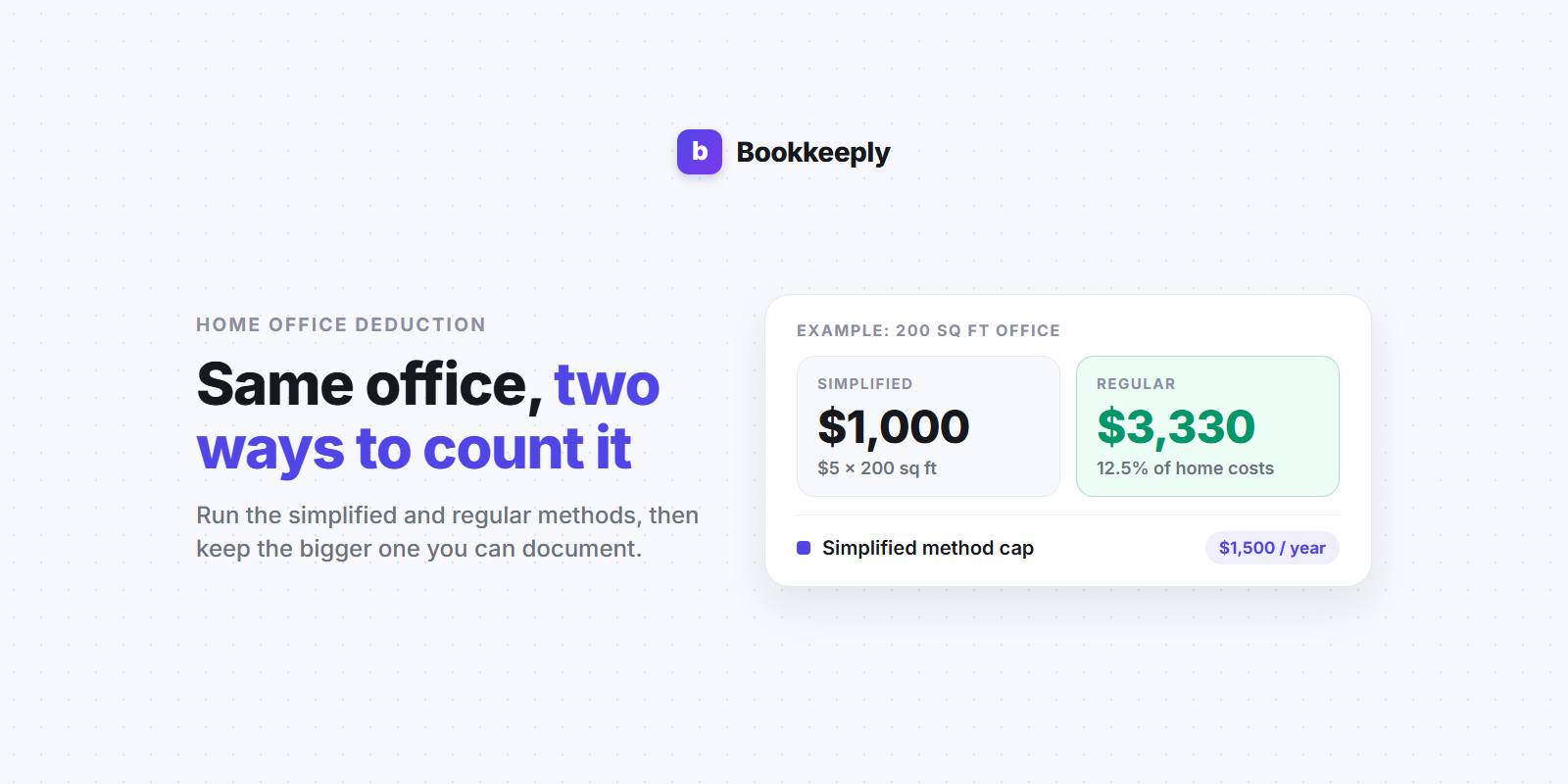
Simplified method: 200 sq ft × $5 = $1,000.
Regular method: her business-use percentage is 200 ÷ 1,600 = 12.5%. Her indirect expenses total $24,000 + $2,400 + $240 = $26,640. 12.5% of $26,640 = $3,330.
For Maya, the regular method gives a deduction more than three times larger. That is common for renters in higher-cost areas, because rent is a big number and all of it counts toward the calculation. Someone with a small office in a low-cost home might find the two methods land close together, and then the simplified method's lack of paperwork starts to look better.
To get a feel for what a deduction is worth in real money, remember that it reduces profit, not tax. A $3,330 deduction saves you your tax rate times $3,330, not the full amount. Our post on how much to set aside for taxes explains how those rates stack up.
Which Method Should You Use?
You can choose either method each year, but once you pick one for a given year, you cannot change it for that year (IRS). A simple way to decide:
- Lean simplified if your office is small, your home costs are low, you own your home and want to avoid depreciation recapture, or you simply do not want to track utility bills.
- Lean regular if you rent in a higher-cost area, your office takes up a meaningful share of your home, or the simplified number is capped at $1,500 and your actual share is clearly higher.
The best move is to run both numbers once, like the example above. It takes ten minutes and you only need to redo it when something changes, such as moving or resizing your office.
Records to Keep
Whichever method you use, keep proof that the space qualifies and that your numbers are right:
- Measurements: the office and the whole home, with a simple floor sketch.
- Photos: a few pictures of the office set up for work, taken during the year.
- Home expense records (regular method): lease or mortgage statements, utility bills, and insurance.
- Evidence of regular business use: your calendar, invoices, and client work show the office is where the business runs.
Tracking these in the same place as the rest of your business expenses makes tax time much easier. Our self-employed tax deductions checklist covers the other expenses worth logging alongside your home office.
FAQ
Can I claim the home office deduction if I rent?
Yes. Renters can use either method. Under the regular method, rent is one of the indirect expenses you multiply by your business-use percentage.
Can I use my kitchen table as a home office?
Usually not. A table that is also used for meals or family life does not meet the exclusive-use test.
I have a W-2 job and freelance on the side. Can I deduct my home office?
Only for your freelance business, and only if the space meets the regular and exclusive use and principal place of business tests for that business. The IRS says employees cannot claim the deduction for their employee work.
Can I switch methods from one year to the next?
Yes. You can pick either method each year. You just cannot change methods after you have filed for that year.
Does the home office deduction reduce self-employment tax?
Yes. It is taken on Schedule C, so it lowers your net profit, and self-employment tax is calculated from net profit.
The Bottom Line
If a part of your home is used regularly and only for your business, the home office deduction is worth claiming. The simplified method gives you up to $1,500 with almost no paperwork. The regular method takes more tracking but can be worth much more, especially for renters. Run both numbers once and pick the larger one that you can document.
This article is for educational purposes only and is not tax or legal advice. Bookkeeply is not a CPA firm. Tax rules change and your situation may differ, so check with a qualified tax professional before making decisions.
Want your office costs and other expenses tracked in one place? You can try Bookkeeply for free.
Stop guessing what you'll owe.
Track your bookkeeping and see your real tax estimate in minutes a day, free, no credit card required.
Get Started Free