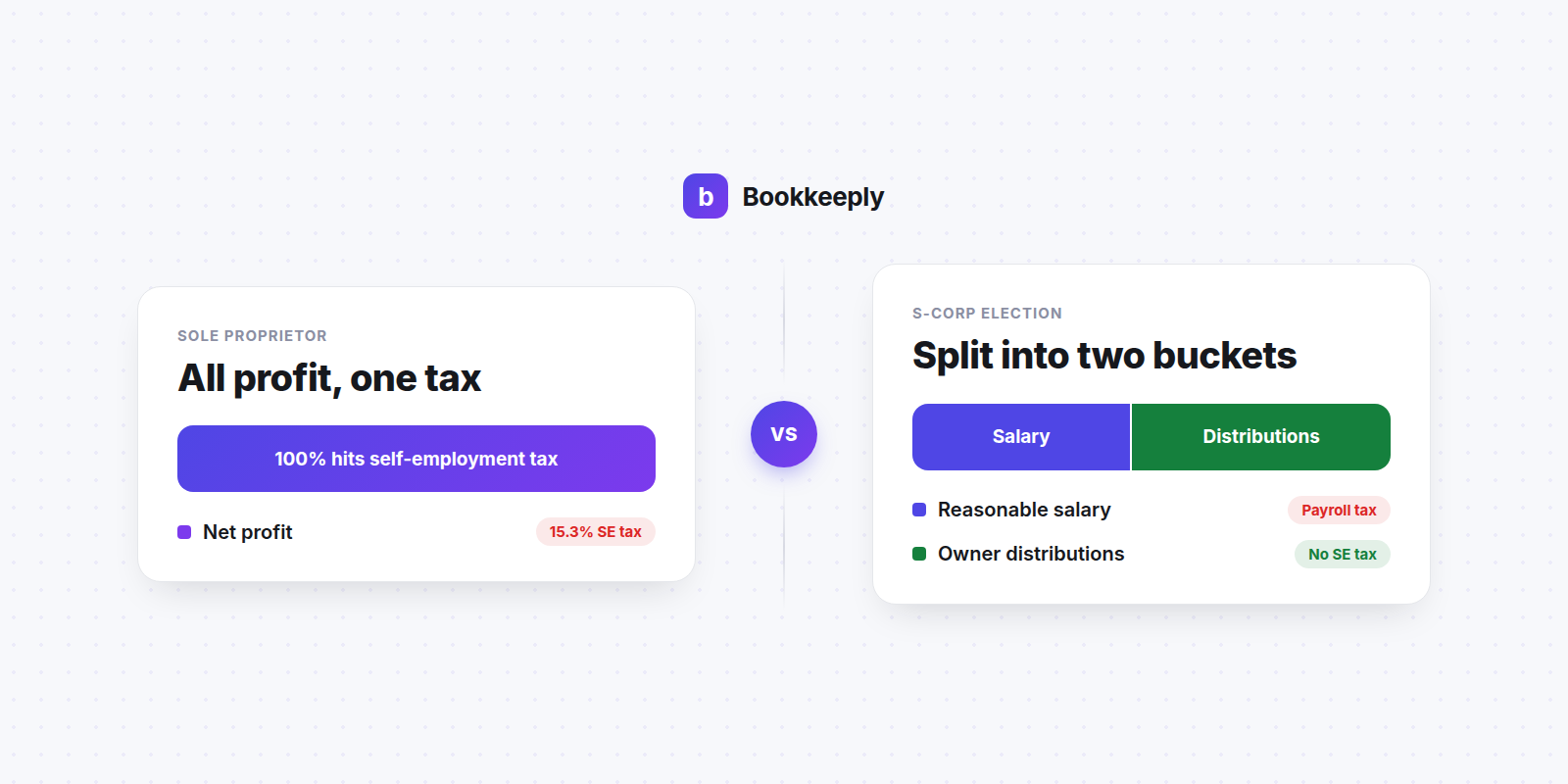
If your business profit is still under roughly $60,000 a year, the honest answer is: probably not yet. Above that, the tax savings from electing S-corp status usually start beating the extra cost of running one, but "usually" is doing a lot of work in that sentence, because the real answer depends on your actual numbers, not a rule of thumb from a blog post. Here's the mechanism, the math, and the catch that trips up almost everyone who does this without checking first.
The tax problem an S-corp election solves
As a sole proprietor, every dollar of net profit your business makes is subject to self-employment tax: 15.3%, on top of whatever income tax you owe. That 15.3% breaks into two pieces: 12.4% for Social Security (only on income up to the annual wage base, $184,500 for 2026) and 2.9% for Medicare, which has no cap at all. Cross certain income thresholds and an extra 0.9% Additional Medicare Tax kicks in on top of that.
The IRS doesn't care whether that profit came from you working 60 hours a week or from the business itself being valuable; as a sole proprietor, it's all "earnings from self-employment," and all of it gets taxed the same way. That's the specific problem an S-corp election is designed to get around.
What an S-corp election actually changes
Here's the part that surprises people: electing S-corp status doesn't create a new type of business. It's a tax election you file (Form 2553) on top of an existing LLC or corporation, telling the IRS to tax your business under a different set of rules. You don't dissolve your sole proprietorship and start an "S-corp" from scratch. You elect S-corp taxation for the entity you already have, or a new LLC that will hold your existing activity.
Once that election is in place, you become a W-2 employee of your own business. That's the whole trick: only your salary is subject to Social Security and Medicare tax (split as ordinary payroll tax, the same as any employee). Whatever profit is left after paying that salary can be taken as a distribution, and distributions aren't subject to self-employment or payroll tax at all.
That split is the entire savings mechanism. The bigger the share of your profit you can legitimately classify as a distribution rather than salary, the more payroll tax you avoid.
The part everyone tries to skip: reasonable salary
The IRS obviously noticed this incentive, so there's a catch: your salary has to be "reasonable compensation" for the work you actually do, not a token amount designed to shove as much money as possible into the tax-free distribution bucket. There's no published minimum or safe-harbor percentage. Instead, the determination looks at things like what a comparable employee would be paid for your role, your training and experience, hours actually worked, and how consistent your compensation methodology is year to year.
Get this wrong and the IRS can reclassify distributions as wages after the fact, which means back payroll taxes, a 20% accuracy penalty, and interest, on top of whatever it costs to fight it. The often-cited cautionary case is a CPA who paid himself a $24,000 salary while taking $203,651 in distributions; a court reset his reasonable salary to roughly $91,000 and reclassified the difference as wages. The lesson isn't "don't do this," it's "don't set your salary based on what minimizes your tax bill; set it based on what the job is actually worth, and be able to show your work."
The math, worked through
Numbers make this concrete faster than percentages do. Say your business nets $150,000 in profit for the year.
As a sole proprietor: $150,000 × 92.35% = $138,525 subject to self-employment tax. At 15.3% (comfortably under the Social Security wage base), that's roughly $21,194 in self-employment tax for the year.
As an S-corp, with a $70,000 reasonable salary: payroll tax applies only to the $70,000 salary: roughly $10,710 total (employee and employer share combined). The remaining $80,000 taken as a distribution owes no self-employment or payroll tax at all.
Payroll-tax savings: roughly $10,500 for the year.
That's a real number, and it's the reason S-corp elections are such a common piece of freelancer tax advice. But it's not the number you actually keep: two things eat into it before you get to compare it against a sole proprietorship.
The costs that have to beat that savings first
Running payroll for yourself isn't free, and it isn't optional once you're an S-corp employee. You have to actually process it, with real withholding and a W-2 at year-end, not just write yourself a check labeled "salary." Typical added costs:
Payroll processing: a basic payroll service runs somewhere in the neighborhood of $500-$1,200 a year for a one-person payroll.
A separate business tax return: Form 1120-S doesn't file itself, and it's a genuinely different return from a Schedule C: budget roughly $800-$1,500 more in prep fees than you were paying as a sole proprietor, more if your books need cleanup first.
State-level costs: many states charge an annual report fee or franchise tax for the underlying LLC or corporation, which can range from nothing to several hundred dollars depending on where you're registered.
More bookkeeping overhead in general: distributions, shareholder salary, and shareholder loans all need to be tracked correctly, since the IRS is watching this exact boundary.
Add it up and a reasonable planning estimate is somewhere around $2,000-$4,000 a year in added cost for a simple one-owner S-corp, before you've hired anyone else or brought in a more expensive advisory relationship.
The QBI wrinkle almost nobody mentions
There's a second, quieter cost. The Qualified Business Income deduction lets many pass-through business owners deduct up to 20% of their qualified business income, but wages you pay yourself as an S-corp employee are specifically excluded from that calculation, and they also reduce the pool of income the deduction applies to. In the example above, paying yourself a $70,000 salary shrinks the QBI-eligible income by that same $70,000, which can mean a meaningfully smaller QBI deduction than you'd get as a sole proprietor reporting the same $150,000 on a Schedule C. Depending on your bracket, that can quietly claw back a thousand dollars or more of the payroll-tax savings you just calculated.
None of this makes the S-corp election a bad idea at $150,000 in profit: in the example above, the payroll-tax savings are large enough to comfortably absorb both the added running costs and the smaller QBI deduction. It just means the simple "$10,500 saved" headline isn't the number that actually lands in your pocket, and the gap between the two shrinks faster than people expect as profit gets lower.
So where's the real break-even?
As a rough range: somewhere between $60,000 and $80,000 in net profit is where the payroll-tax savings typically start to outweigh the added administrative cost and the QBI trade-off, for a single-owner service business with modest overhead. Below that range, the math usually doesn't work: you're paying $2,000-$4,000 a year in extra complexity to save less than that in tax. Above it, the case gets stronger every additional dollar of profit, because the salary/distribution split gets more favorable while the fixed costs of running payroll and filing a second return don't grow nearly as fast.
That range moves depending on your filing status, what state you're in, how much of your income is already near the Social Security wage base from another job, and (this is the one people forget) what a legitimately "reasonable" salary looks like for what you actually do. If reasonable compensation for your role is close to your total profit, there's very little room left over for tax-free distributions, and the whole strategy loses most of its power regardless of your revenue.
How to actually decide, instead of guessing
This is exactly the kind of question that shouldn't be answered with a rule of thumb, because the honest answer depends on your specific income, filing status, and the salary a reasonable person would actually pay you for your work. Bookkeeply's Tax Planner runs this comparison directly against your real transaction history for the year: self-employment tax, Additional Medicare Tax, and the QBI deduction included on both sides, and shows the Sole Proprietor and S-Corp numbers side by side, with the actual savings called out. If you're close to the range above, it's worth running your real numbers before you file anything with the IRS, not after.
Every business's situation is different, and this isn't a substitute for a conversation with a CPA, particularly on the reasonable-salary question, where the "right" number is a judgment call the IRS can and does challenge after the fact. State-level rules on LLC and S-corp fees also vary enough that they can shift the break-even point on their own.
Tax information is provided for general educational purposes and is not tax, legal, or accounting advice. Your actual tax liability depends on your individual circumstances. Consider consulting a qualified tax professional for advice specific to your situation.
Stop guessing what you'll owe.
Track your bookkeeping and see your real tax estimate in minutes a day, free, no credit card required.
Get Started Free