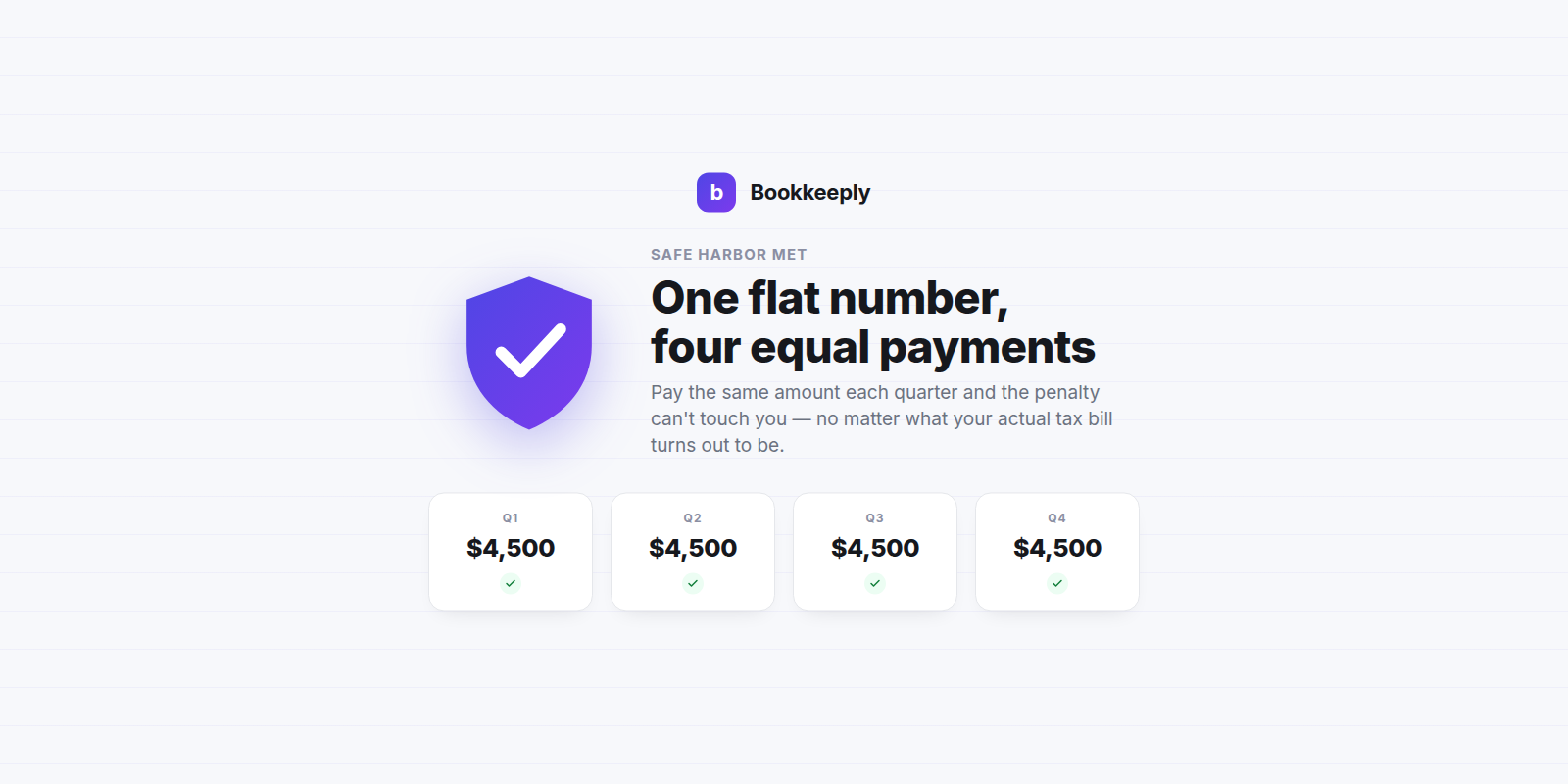
You don't have to correctly predict your tax bill four times a year to avoid a penalty. The IRS gives you a specific, calculable minimum called the safe harbor: pay at least that much each quarter and you're protected from an underpayment penalty, even if your actual tax bill ends up much higher. Most freelancers either overpay all year out of fear or underpay and get surprised in April; the safe harbor rule is the actual math that lets you avoid both.
Why quarterly taxes turn into guesswork
Nobody withholds tax from freelance or business income the way an employer withholds from a paycheck, so the IRS expects you to send in your own estimated payments four times a year. The problem is that "estimated" is doing real work in that phrase: you're forecasting a full year's tax liability using only partial information, often before you know how the rest of the year will go.
Guess too low and you owe a penalty on the shortfall. Guess too high and you've made an interest-free loan to the federal government until you file. Most people respond to that uncertainty by padding their payments upward "just in case," which is a reasonable instinct and also, most of the time, unnecessary. The safe harbor rule exists specifically so you don't have to do that.
What the safe harbor actually is
The IRS's underpayment penalty has two separate outs, and you only need to clear one of them.
The $1,000 free pass
If the balance you owe when you file, after subtracting withholding and any payments you already made, is under $1,000, there's no penalty at all, full stop. This mostly matters for people with modest side income or a part-time freelance gig layered on top of a W-2 job with real withholding.
The 90/100/110 rule
For everyone else, the safe harbor is whichever of these two numbers is smaller:
90% of this year's actual tax liability, or
100% of last year's total tax liability (from your filed return)
Pay at least the smaller of those two amounts across the year, roughly split into quarters, and you're in the safe harbor regardless of what your real tax bill turns out to be.
There's one adjustment for higher earners: if your prior year's adjusted gross income was over $150,000 (or over $75,000 if you filed Married Filing Separately), the prior-year test isn't 100%, it's 110%. The $1,000 exception and the 90% current-year test stay exactly the same either way; only the prior-year percentage moves.
The math, worked through
Say your business grew nicely this year. Last year your total tax bill was $18,000. This year you're on pace for something closer to $26,000.
90% of this year's estimated tax: $26,000 × 90% = $23,400 → $5,850 per quarter
100% of last year's tax: $18,000 × 100% = $18,000 → $4,500 per quarter
Your safe harbor: $4,500 a quarter, the smaller of the two, even though your real tax bill is meaningfully higher.
That's the whole point of the rule. You're allowed to pay based on last year's smaller, already-known number instead of this year's bigger, harder-to-forecast one, and still owe zero penalty. The catch is what it doesn't erase: you'll still owe the roughly $8,000 difference when you file, just without an underpayment penalty attached to it. Safe harbor protects you from the penalty, not from the bill itself.
For a higher earner, the same idea shifts slightly. If last year's AGI was $170,000 (over the $150,000 threshold) and last year's tax was $40,000, the prior-year test becomes 110% instead of 100%: $40,000 × 110% = $44,000, or $11,000 a quarter, instead of the $10,000 a flat 100% would have given.
Why the prior-year number is usually the easier target
The 90%-of-this-year test requires you to accurately forecast a number that doesn't exist yet. That's hard for anyone, and especially hard for a freelancer whose income isn't a smooth, predictable line. The 100%-of-last-year test requires nothing but arithmetic: you already know exactly what you owed, because you filed that return months ago.
That's why, for a growing business, the prior-year safe harbor is usually the more useful of the two: it lets you set a fixed, predictable quarterly number at the start of the year and stop re-forecasting every quarter. If your income is flat or shrinking, the 90% test might actually be the smaller (and therefore better) number instead, so it's worth checking both, not assuming one always wins.
What actually happens if you miss it
The underpayment penalty isn't a flat fee. It's interest, calculated separately for each quarter you were short, at the IRS's underpayment rate for that period. That rate moves with market interest rates and gets set quarterly; it's currently 7% per year, compounded daily, and unchanged through the end of 2026.
Because it's calculated quarter by quarter, a shortfall early in the year costs more than the same shortfall in the fourth quarter, simply because it accrues for longer. A $2,000 shortfall carried for one full quarter (roughly 90 days) at 7% works out to a genuinely small number (call it $35), but it compounds daily and adds up across a year of being short every quarter, and it's calculated automatically on Form 2210 whether you notice it or not. It's rarely catastrophic. It's also completely avoidable, which is the more relevant point: there's no reason to pay it when hitting the safe harbor number is just arithmetic.
The overpaying trap the safe harbor is meant to prevent
The mirror-image mistake is just as common and, in a way, more expensive: paying more than the safe harbor requires because a big refund feels safer than a possible penalty. If you send the IRS an extra $2,000 a quarter beyond what either test requires, you get all of it back, eventually, as a refund after you file, months later, with no interest paid on it in the meantime. That money could have stayed in your business, covered a slow month, or sat in an account actually earning interest.
The safe harbor number is a floor, not a target to beat by a wide margin. Once you've confirmed you're paying at least the smaller of the 90%/100%(110%) tests, adding meaningfully more doesn't buy you anything. It just moves cash out of your hands earlier than it needs to leave.
How the quarters actually break down
Estimated payments are due four times a year, and the spacing is irregular, not evenly every three months: roughly mid-April, mid-June, mid-September, and mid-January of the following year. If you're using the prior-year safe harbor, the simplest approach is to divide that number by four and pay it on schedule. If your income arrives in genuinely large, uneven bursts, a big project that lands entirely in one quarter, for instance, there's a separate annualized-income installment method that lets you match payments to when the income actually showed up rather than spreading it evenly; it's more paperwork, and worth a CPA's input if a single quarter is wildly out of proportion to the rest of your year.
Checking this against your real numbers
This isn't a calculation worth doing from memory once and then forgetting: it depends on last year's actual filed tax, this year's real income so far, and (for the 110% test) last year's actual AGI. Bookkeeply's Quarterly Estimated Payments tracker computes the real IRS safe-harbor basis automatically from your actual prior-year return when it's on file, picking the smaller of the 90% and 100%/110% tests for you, and shows which basis is currently in effect alongside whether each quarter's payment is on track. That's the whole exercise this post just walked through, done once and kept current instead of recalculated by hand every quarter.
Meeting the safe harbor guarantees no underpayment penalty. It doesn't mean no balance due at filing, and it doesn't cover every situation (farmers, fishermen, and a first year in business all have their own variations on these rules). If your income swings widely quarter to quarter or you're close to the $150,000/$75,000 threshold, it's worth a CPA's confirmation before you set your payments for the year.
Tax information is provided for general educational purposes and is not tax, legal, or accounting advice. Your actual tax liability depends on your individual circumstances. Consider consulting a qualified tax professional for advice specific to your situation.
Deja de adivinar cuánto deberás.
Lleva tu contabilidad y mira tu estimación real de impuestos en minutos al día, gratis, sin necesidad de tarjeta de crédito.
Empieza gratis