Making your first $100,000 as a freelancer feels like a huge milestone. And it is.
But there's one problem with looking at that $100,000 number:
It isn't necessarily $100,000 of money you can spend.
If you're self-employed, your revenue has to cover business expenses, taxes, and potentially other obligations before you can figure out what you actually made.
So if your business brought in $100,000 this year, how much is really yours?
The answer depends on your situation, but understanding the difference between revenue, profit, taxes, and take-home money is one of the most important parts of running a freelance business.
$100,000 in revenue isn't $100,000 in income
Let's start with the biggest misconception.
If you invoice clients $100,000 during the year, you've generated $100,000 in revenue.
But you probably had costs associated with earning that money.
For example, imagine you spent:
$10,000 on software and subscriptions
$5,000 on contractors
$3,000 on advertising
$2,000 on equipment, supplies, and other expenses
That's $20,000 in business expenses.
Your simplified business profit would be:
$100,000 revenue - $20,000 expenses = $80,000 profit
You're not being taxed simply because you crossed the $100,000 revenue mark. Your actual tax situation depends on your taxable income, deductions, filing status, and other factors.
That's why profit matters much more than revenue when you're trying to understand what you actually made.
Then come taxes
This is where things get a little more complicated for freelancers.
Unlike a traditional employee, you generally don't have an employer withholding federal taxes from every paycheck.
If you're self-employed, you generally need to account for both income tax and self-employment tax. The IRS says self-employed individuals generally use estimated tax payments to pay these taxes during the year.
Self-employment tax primarily covers Social Security and Medicare taxes. For 2026, the self-employment tax calculation uses a 12.4% Social Security rate and a 2.9% Medicare rate, subject to the applicable rules and limits.
And that's separate from federal income tax.
So the money sitting in your business bank account isn't necessarily money you can safely spend.
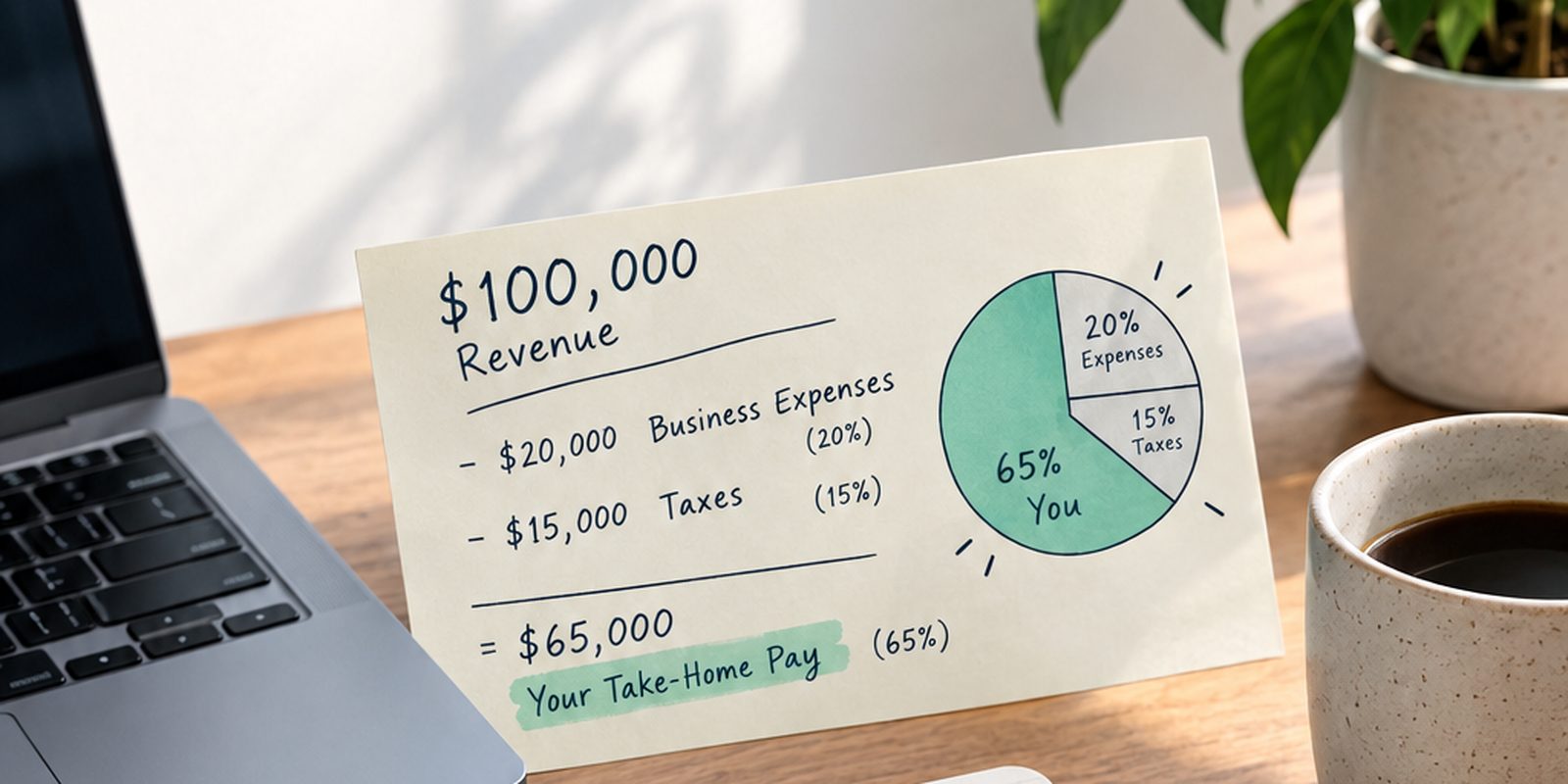
Let's use a simple $100,000 example
Suppose your freelance business generates: $100,000 revenue
And you have: $20,000 business expenses
That leaves: $80,000 profit
Now suppose, purely for illustration, that you reserve $15,000 for taxes.
You'd have:
$80,000 profit - $15,000 tax reserve = $65,000
In this simplified example, you'd have about $65,000 left after business expenses and the tax reserve.
That's very different from thinking:
"I made $100,000, so I have $100,000."
And it's exactly why freelancers need to keep an eye on their numbers throughout the year.
Important: The $15,000 tax figure above is an example, not a tax calculation. Your actual federal and state tax liability could be substantially different.
So what percentage is actually yours?
There isn't a universal percentage.
Your "take-home" amount depends on things like:
Your business expenses
Filing status
Total household income
Federal income tax
Self-employment tax
State and local taxes
Tax deductions and credits
Business structure
Other sources of income
Two freelancers can each generate $100,000 in revenue and end up with very different amounts of money after expenses and taxes.
That's why rules like "you keep 70%" or "you'll pay 30% in taxes" should be treated as rough planning shortcuts, not guarantees.
Revenue, profit, and take-home are three different numbers
If you only remember one thing from this article, remember this:
Revenue
The money your business brings in. Example: $100,000
Profit
What's left after your deductible business expenses. Example: $80,000
Take-home
What you ultimately have available for yourself after accounting for taxes and other relevant obligations. Example: $65,000 in our simplified scenario
These numbers answer completely different questions.
Revenue: How much did my business bring in?
Profit: How much did my business make?
Take-home: How much can I actually use for myself?
Why your bank balance can be misleading
Here's another common freelancer trap.
Imagine you've collected $20,000 from clients this month.
You look at your bank account and think:
"I have $20,000."
But maybe:
$4,000 belongs to upcoming business expenses
$4,500 needs to be reserved for taxes
$2,000 is money you owe a contractor
The remaining amount is what you can actually consider available
Your bank balance is still $20,000.
But your available money is nowhere near $20,000.
This is why bookkeeping isn't just about preparing for tax season.
It's about knowing what's actually happening with your money while you're running your business.
What happens if you don't track this?
You can have a surprisingly successful business and still feel broke.
You make more money.
You spend more money.
Your tax bill gets bigger.
Your expenses increase.
And because everything is sitting in one bank account, you don't really know how much is available to spend.
Then tax season arrives.
And suddenly you discover that the money you thought was yours wasn't entirely yours.
The IRS recommends that self-employed individuals estimate their taxes based on expected income, deductions, credits, and other factors, and adjust those estimates during the year when circumstances change.
The better way to think about your $100,000
Instead of thinking: "$100,000 is mine."
Think: "$100,000 came into my business. Now where does it go?"
A simple mental model is:
Revenue → Business Expenses → Profit → Taxes → Money Available to Me
Once you start thinking this way, your finances become much easier to understand.
You can also make better decisions.
Can you afford to hire someone?
Can you afford that new laptop?
Can you lower your rates?
Can you take a month off?
Can you safely increase your personal spending?
Those decisions are much easier when you know your actual numbers.
The $100,000 milestone is still a big deal
None of this is meant to make $100,000 in revenue sound less impressive.
It isn't.
Generating $100,000 from your own freelance business is a significant milestone.
The point is simply that revenue isn't the finish line.
What matters is how efficiently you turn that revenue into profit and how much of that profit ultimately becomes money you can actually use.
The goal isn't just to make $100,000.
It's to understand what that $100,000 is doing for you.
Know your numbers before tax season
You shouldn't have to wait until tax season to find out whether your business is actually making money.
Keeping your income and expenses organized throughout the year gives you a much clearer picture of your profit and helps you plan for taxes before the bill arrives.
That's one of the problems Bookkeeply is designed to solve.
Instead of trying to piece everything together from bank statements and spreadsheets, Bookkeeply helps freelancers keep their bookkeeping organized and understand what their numbers actually mean.
Because when you make $100,000, the important question isn't just: "How much did I make?"
It's: "How much is actually mine?"
Tax information is provided for general educational purposes and is not tax, legal, or accounting advice. Your actual tax liability depends on your individual circumstances. Consider consulting a qualified tax professional for advice specific to your situation.
Deja de adivinar cuánto deberás.
Lleva tu contabilidad y mira tu estimación real de impuestos en minutos al día, gratis, sin necesidad de tarjeta de crédito.
Empieza gratis