You filed on time, you paid what you owed in April, and a few weeks later the IRS sends a notice with an extra charge on it. For a lot of freelancers, that charge is the underpayment of estimated tax penalty. It isn't a fine for owing money at year end. It's a charge for paying too little, too late, during the year.
This guide explains how the IRS underpayment penalty works, how it's calculated on Form 2210, and the simple rules that keep you from owing it, with two worked examples.
What Is the IRS Underpayment Penalty?
The US tax system is pay-as-you-go. Employees cover this through paycheck withholding. Freelancers and solopreneurs usually don't have withholding on their business income, so the IRS expects them to send quarterly estimated tax payments instead.
If you don't pay enough by each quarterly due date, the IRS can charge a penalty on the shortfall. According to the IRS page on the underpayment of estimated tax penalty, the amount depends on three things:
- how much you underpaid,
- how long the underpayment lasted, and
- the IRS's published quarterly interest rate for underpayments.
So the penalty works a lot like interest. A small shortfall for a few weeks costs very little. A large shortfall that sits unpaid for most of a year costs more.
How the Penalty Is Calculated
The calculation happens on Form 2210, Underpayment of Estimated Tax by Individuals, Estates, and Trusts. You don't always have to fill it out yourself (more on that below), but it helps to know what it does.
Step 1: Find your required annual payment
Your required annual payment is the smaller of:
- 90% of the tax on this year's return, or
- 100% of the tax on last year's return (110% if last year's AGI was more than $150,000, or more than $75,000 if married filing separately).
This is the same test behind the IRS safe harbor rule. If the 110% version applies to you, our guide to the 110% safe harbor rule walks through it in detail.
Step 2: Split it into four installments
Under the regular method, the required annual payment is divided into four equal installments, one per due date. For 2026 tax, the due dates are:
- April 15, 2026
- June 15, 2026
- September 15, 2026
- January 15, 2027
If a due date lands on a weekend or legal holiday, it moves to the next business day.
Step 3: Compare what you paid by each date
For each installment, Form 2210 compares what was required with what you actually paid by that date (estimated payments plus any withholding). Any shortfall is the underpayment for that period. Extra payments carry forward and are applied to later installments, and a late payment is applied to the oldest unpaid installment first.
Step 4: Apply the interest rate for the days it was late
Per the Form 2210 instructions, the penalty for each installment is figured roughly like this:
Underpayment × number of days late × (annual rate ÷ 365)
The days run from the installment's due date until the date you paid it, or until the regular filing deadline the following April, whichever comes first. The penalty is figured as simple interest on each installment, not compounded.
What rate does the IRS use?
For individuals, the underpayment rate is the federal short-term rate plus 3 percentage points, and the IRS resets it every quarter. In its announcement for the fourth quarter of 2026, the IRS said the rate for individual underpayments stays at 7% per year for October 1 through December 31, 2026, the same as the third quarter. Rates for 2027 haven't been announced yet, so treat any future-dated math as an estimate.
Example 1: One Missed Quarter, Caught Up in January
Illustration only. The numbers are made up to show the mechanics, and they assume the 7% rate holds for the whole period.
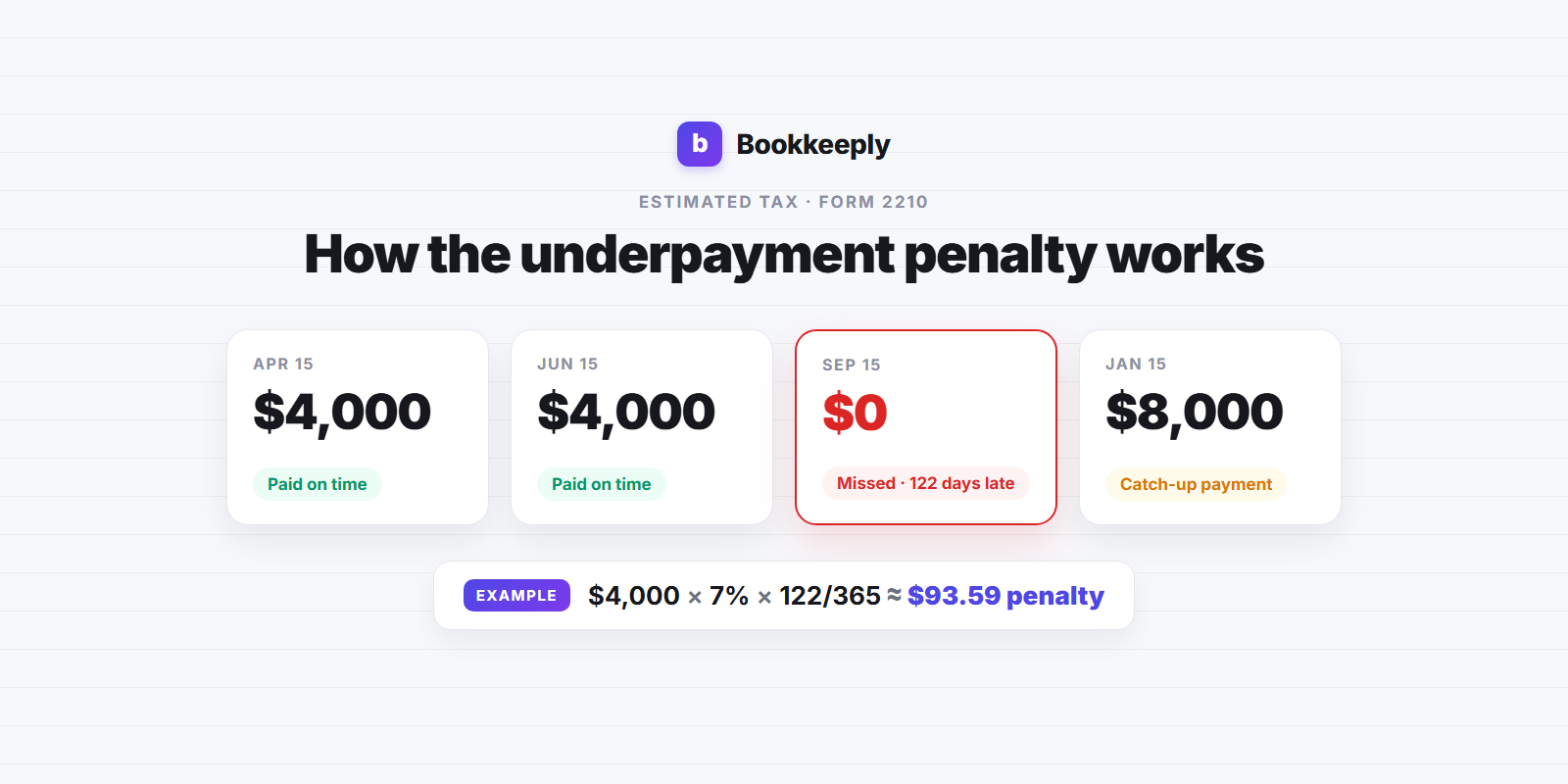
Maya is a freelance designer. Her required annual payment for 2026 works out to $16,000, so each installment is $4,000.
- April 15: pays $4,000 (on time)
- June 15: pays $4,000 (on time)
- September 15: pays nothing (a slow month, and the date slips by)
- January 15, 2027: pays $8,000 to catch up
The January payment first covers the missed September installment. That $4,000 was late from September 15, 2026 to January 15, 2027, which is 122 days.
$4,000 × 122 × (0.07 ÷ 365) ≈ $93.59
Annoying, but not catastrophic. The bigger lesson is that the penalty kept growing every day the payment was missing.
Example 2: Waiting Until April to Pay
Illustration only, same assumptions as above.
Now say Maya skips the September payment and doesn't catch up in January either. She pays the missing $4,000 when she files on April 15, 2027. That's 212 days late.
$4,000 × 212 × (0.07 ÷ 365) ≈ $162.63
And if she had also skipped January, the fourth installment would pick up its own penalty for the 90 days from January 15 to April 15. Each missed quarter adds its own charge.
Why You Can Owe a Penalty Even If You Paid in Full
This surprises people. Because the penalty is figured installment by installment, paying everything by the end of the year doesn't erase earlier shortfalls. If you paid nothing until December and then sent one big payment, the April, June and September installments were all late, and each one can carry a penalty.
Withholding is treated differently. By default, Form 2210 treats withholding as if it were paid in equal amounts on each due date, no matter when it actually came out of a paycheck. That's why people with a part-time W-2 job sometimes increase their withholding late in the year to cover a shortfall from freelance income. (You can elect to use the actual withholding dates instead if that helps you.)
How to Avoid the Underpayment Penalty
1. Owe less than $1,000 at filing
The IRS says you generally won't owe the penalty if the balance due on your return (after withholding and credits) is less than $1,000.
2. Hit a safe harbor
Pay at least the required annual payment from Step 1, spread across the four due dates. The prior-year test is the easiest to plan around because you already know last year's tax. Divide it by four and pay that amount each quarter.
3. Use the annualized income method if your income is lumpy
If most of your income arrived late in the year, equal installments can overstate what you owed early on. Schedule AI of Form 2210 (the annualized income installment method) lets you match each installment to the income you actually earned by that point. If you use it, you have to use it for all four periods and attach Form 2210 to your return.
4. Ask for a waiver when it fits
The IRS may waive the penalty if the underpayment was caused by a casualty, disaster or other unusual circumstance, or if you retired after reaching age 62 or became disabled during the year (or the year before) and the underpayment was due to reasonable cause and not willful neglect. You request a waiver on Form 2210.
5. Set money aside as you earn it
The simplest prevention is behavioral. If you set aside a percentage of every payment in a separate account, the quarterly payment is already sitting there when the due date arrives. Knowing roughly what your self-employment tax will be makes that percentage a lot easier to pick (our step-by-step self-employment tax example shows the math).
Do You Have to File Form 2210?
Often, no. The Form 2210 instructions say that if you aren't requesting a waiver, using the annualized income method, or using your actual withholding dates, you don't need to figure the penalty yourself. The IRS will calculate it and mail you a bill. Many people still let their tax software run Form 2210 so they can see the number before they file.
If you do get a bill and believe the IRS figured it wrong, or you qualify for a waiver, you can respond to the notice. A tax professional can help if the amount is large.
FAQ
Is the underpayment penalty the same as the late payment penalty?
No. The underpayment penalty is about estimated tax during the year. The failure-to-pay penalty applies when you don't pay the balance on your return by the filing deadline. They're separate charges, and you can owe one without the other.
Is the penalty a percentage of my total tax?
No. It's figured like interest on each late installment, so it depends on the amount and how many days it was late. A missed $4,000 installment at 7% costs about $0.77 per day (an illustration based on the formula above).
I missed the September payment. Should I pay now or wait until January?
Paying sooner stops the clock on that installment sooner. Waiting until January or April means more days of penalty. You can pay any time through IRS Direct Pay, EFTPS or your IRS online account.
Does the penalty apply if this is my first year freelancing?
It can. But if you had no tax liability for the prior year, you were a US citizen or resident for the whole year, and that prior year was a full 12 months, the IRS says you generally don't owe the penalty. Check the Form 2210 instructions for the exact conditions.
Disclaimer: This article is for educational purposes only and isn't tax, legal or financial advice. Bookkeeply isn't a CPA firm. Tax rules and IRS interest rates change, so check the current IRS guidance or talk to a qualified tax professional about your situation. Figures cited are from IRS.gov (the underpayment of estimated tax penalty page, the Form 2210 instructions, and the Q4 2026 interest rate announcement). Example numbers are illustrations.
Want a heads-up before each quarterly due date and a running estimate of what to pay? You can try Bookkeeply for free. More guides are on the Bookkeeply blog.
Stop guessing what you'll owe.
Track your bookkeeping and see your real tax estimate in minutes a day, free, no credit card required.
Get Started Free