When you work for yourself, nobody sets up a retirement plan for you. There is no HR department, no automatic payroll deduction, and no employer match. The good news is that the IRS gives self-employed people two strong options of their own: the SEP IRA and the Solo 401(k). Both let you put away far more than a regular IRA, and both can lower your income tax for the year you contribute.
They are not the same, though. At many freelance income levels one of them lets you save more than twice as much as the other. This guide compares them side by side, runs the numbers at two income levels using the 2026 limits, and walks through the deadlines that decide which one you can still open this year.
SEP IRA vs Solo 401(k): The Short Answer
If you want the simplest possible setup and your contribution goal is modest, a SEP IRA is hard to beat. If you want to save as much as possible at a moderate income, want a Roth option for your own contributions, or might want to borrow from the plan, a Solo 401(k) usually comes out ahead.
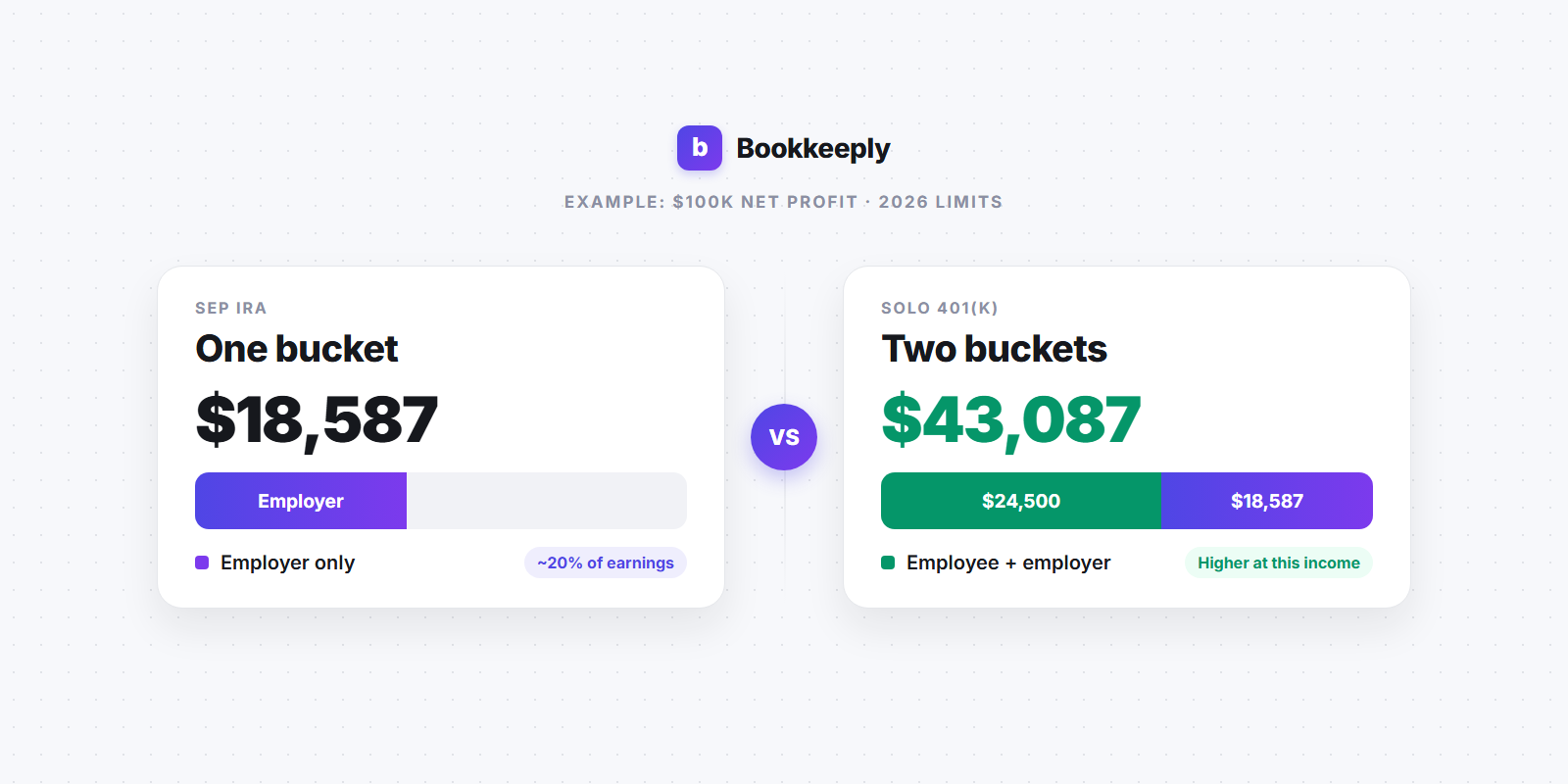
The reason comes down to one structural difference. A SEP IRA only allows employer contributions. A Solo 401(k) allows employer contributions plus employee contributions. As a freelancer you wear both hats, so the Solo 401(k) gives you two buckets to fill instead of one.
How a SEP IRA Works
A SEP (Simplified Employee Pension) is an IRA that your business contributes to. For 2026, the IRS says contributions cannot exceed the lesser of 25% of compensation or $72,000 (IRS: SEP contribution limits).
There is a catch for sole proprietors and single-member LLCs. Your "compensation" is not your full profit. The IRS defines it as your net earnings from self-employment minus half of your self-employment tax and minus the plan contribution itself (IRS: SEP plans). Because of that circular definition, IRS Publication 560 converts the 25% plan rate into an effective rate of 20% for self-employed people (IRS Publication 560).
What makes the SEP popular:
- Easy setup. Most brokerages open one with a short form, often based on the IRS model Form 5305-SEP.
- Late deadline. You can set up and fund a SEP for a year as late as your tax return due date, including extensions.
- Little paperwork. The IRS says employers generally have no annual filing requirement for a SEP, including Form 5500.
- Flexible funding. You do not have to contribute every year.
What holds it back: no employee contributions, no catch-up contributions for people 50 and older, and no plan loans.
How a Solo 401(k) Works
A Solo 401(k), which the IRS calls a one-participant 401(k), covers a business owner with no employees, or the owner and their spouse (IRS: One-participant 401(k) plans). You contribute in two roles:
- As the employee: elective deferrals up to $24,500 for 2026, or up to 100% of your compensation if that is lower. If you are 50 or older you can add a catch-up of $8,000, and the catch-up is $11,250 if you are 60 to 63 (IRS 2026 limits announcement).
- As the employer: the same profit-sharing contribution a SEP allows, which works out to about 20% of net earnings after the half-SE-tax deduction for a sole proprietor.
Together, the two pieces cannot exceed $72,000 for 2026, not counting catch-up contributions.
Many Solo 401(k) plans also let your employee deferrals go in as Roth contributions, and some allow loans. Whether you get those features depends on the plan document your provider uses, so check before you open one.
The trade-off is paperwork. Once plan assets reach $250,000 or more at the end of a year, you generally need to file Form 5500-EZ.
Worked Example: Same Profit, Different Totals
Here is an illustration using the 2026 limits. Assume a sole proprietor under 50 with no employees and no other retirement plan. These are simplified examples, not a substitute for the worksheets in Publication 560.
Example 1: $100,000 net profit
- Self-employment tax: $100,000 x 92.35% = $92,350. Then $92,350 x 15.3% = about $14,130. (Our guide on how to calculate self-employment tax walks through this step.)
- Half of SE tax: about $7,065.
- Adjusted net earnings: $100,000 minus $7,065 = $92,935.
- SEP IRA maximum: 20% of $92,935 = about $18,587.
- Solo 401(k) maximum: $24,500 employee deferral plus the same $18,587 employer contribution = about $43,087.
Same business, same profit, and the Solo 401(k) allows roughly $24,500 more.
Example 2: $50,000 net profit
- Self-employment tax is about $7,065, so half is about $3,532.
- Adjusted net earnings: about $46,468.
- SEP IRA maximum: 20% of $46,468 = about $9,294.
- Solo 401(k) maximum: $24,500 plus $9,294 = about $33,794.
At lower incomes the gap is even more dramatic in relative terms. The SEP is capped at a percentage of earnings, while the employee deferral in a Solo 401(k) is a flat dollar amount you can reach even on a smaller profit.
Where the two plans meet
The advantage shrinks as income rises. Under the same simple assumptions, a Solo 401(k) reaches the $72,000 overall cap once adjusted net earnings hit about $237,500 ($24,500 plus 20% of $237,500). A SEP needs adjusted net earnings of about $360,000 to reach $72,000 (20% of $360,000), which is also the 2026 compensation limit. Above that level both plans top out at the same $72,000, and the Solo 401(k) keeps only its catch-up and Roth advantages.
What the Contribution Does to Your Tax Bill
Traditional (pre-tax) contributions for yourself are deducted on Schedule 1 of Form 1040, not on your Schedule C. That detail matters: the deduction lowers your income tax, but it does not reduce your self-employment tax, because SE tax is figured from Schedule C profit.
As a rough illustration, if you are in the 22% federal bracket, a $10,000 pre-tax contribution would cut your federal income tax by about $2,200. Your actual savings depend on your bracket, state taxes, and whether you choose Roth contributions, which give you no deduction now in exchange for tax-free qualified withdrawals later.
If you pay quarterly estimated taxes, a planned contribution is worth factoring in when you size your payments, so you are not overpaying all year for a deduction you already know is coming.
Deadlines: Which Plan Can You Still Open?
Timing is often what decides the question in practice.
- SEP IRA: you can open and fund it up to your tax return due date, including extensions. That makes it the classic "I forgot to do this last year" option.
- Solo 401(k), ongoing years: Publication 560 says employee deferrals must be elected by the end of the tax year. Employer contributions can generally be made up to the return due date, including extensions.
- Solo 401(k), first year: the SECURE 2.0 Act added an exception for sole proprietors with no employees. For a brand-new plan's first year, you can set it up after year-end, up to your tax return due date (without extensions), and still make employee deferrals for that prior year. Confirm your provider supports this before relying on it.
The practical takeaway: if you want a Solo 401(k) for this year and have not opened one before, you have some breathing room. For any later year, make your deferral election before December 31.
How to Choose
A simple way to decide:
- Pick a SEP IRA if you want the least paperwork, you plan to contribute a modest percentage of profit, or you are past the Solo 401(k) deferral deadline for the year.
- Pick a Solo 401(k) if you want to save as much as possible on a small or mid-size profit, you want Roth contributions or catch-up contributions, or you may want the option of a plan loan.
- Think twice about both if you plan to hire. A Solo 401(k) only works while you have no common-law employees other than a spouse. A SEP generally requires you to contribute the same percentage for eligible employees that you contribute for yourself.
If you already operate as an S-Corp, the math changes because contributions are based on your W-2 salary rather than Schedule C profit. Our comparison of sole prop vs S-Corp covers how that salary is set.
FAQ
Can I have both a SEP IRA and a Solo 401(k)?
It is possible in some cases, but contributions to plans you maintain for the same business generally share the same overall limit, so having both rarely lets you save more. Most freelancers pick one. If you are considering both, talk to your plan provider or a tax professional first.
Can I contribute to a SEP IRA or Solo 401(k) if I also have a 401(k) at a day job?
Yes, you can have a plan for your side business. But the $24,500 employee deferral limit is per person, not per plan, so deferrals at your day job reduce what you can defer into a Solo 401(k). Employer contributions from your own business are figured separately.
Do I have to contribute every year?
No. Both plans let you skip years or change the amount, which suits freelancers whose income moves around.
Is a Solo 401(k) hard to maintain?
For most small accounts it is not. The main extra task is Form 5500-EZ, which the IRS generally requires once plan assets reach $250,000 at year-end.
The Bottom Line
Both plans are good. The SEP IRA wins on simplicity and its late deadline. The Solo 401(k) usually wins on how much you can save, especially at incomes below about $237,500 in adjusted net earnings, because it adds an employee contribution on top of the employer one. Knowing your real profit is the first step either way, since every limit in this article is based on it.
For a starting point on how much to hold back for taxes overall, see how much a freelancer should set aside for taxes, or browse more guides on the Bookkeeply blog.
This article is for educational purposes only and is not tax, legal, or investment advice. Bookkeeply is not a CPA firm. Contribution limits change each year and your situation may differ, so check with a qualified tax professional or plan provider before making decisions.
Want a clear view of your profit before you decide how much to contribute? You can try Bookkeeply for free.
Stop guessing what you'll owe.
Track your bookkeeping and see your real tax estimate in minutes a day, free, no credit card required.
Get Started Free