When Is the Q4 Estimated Tax Payment Due?
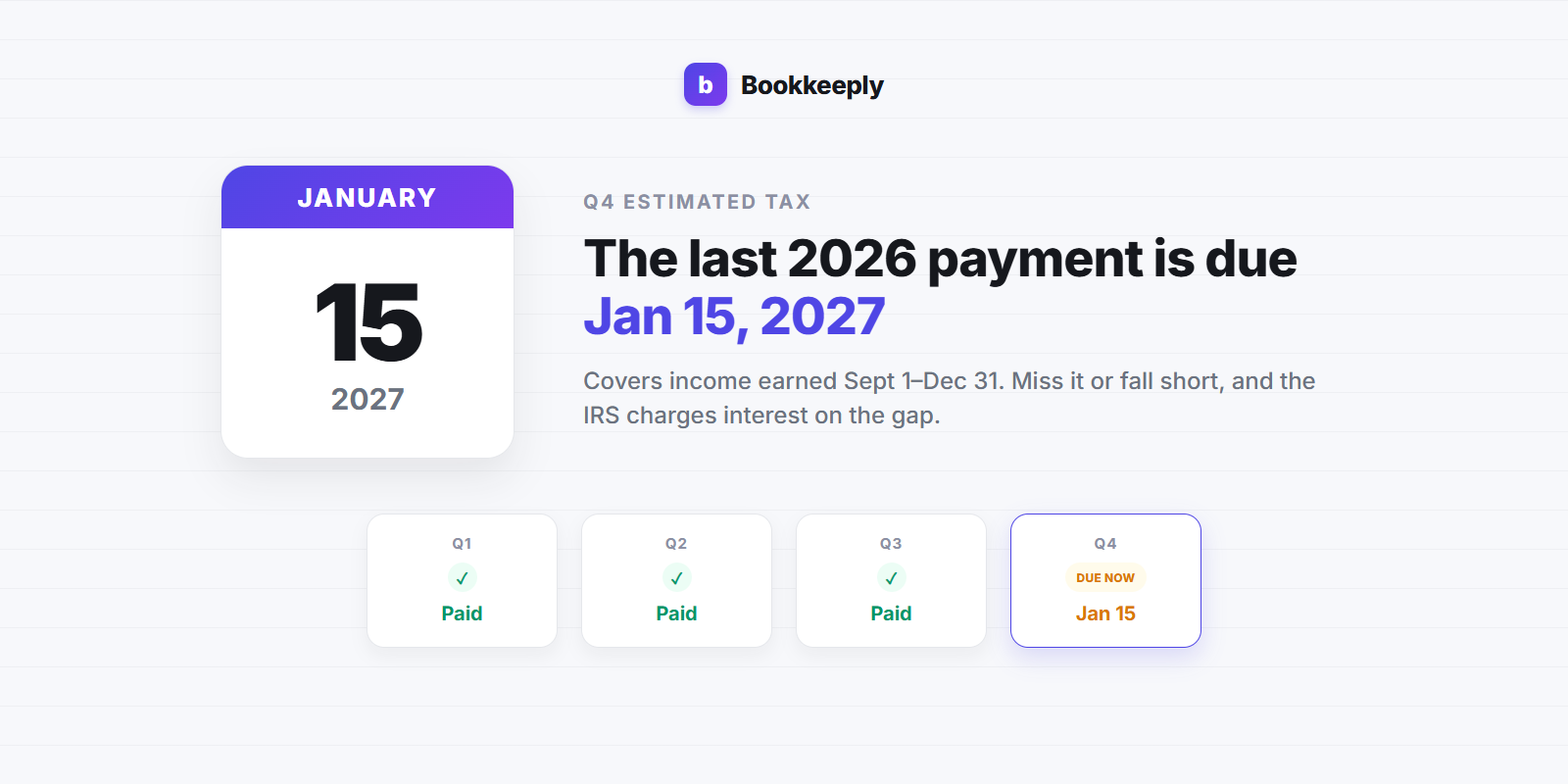
If you're self-employed, the IRS splits your year into four payment periods, and the last one is the one people forget about. The fourth-quarter estimated tax payment covers income earned from September 1 through December 31, 2026, and it's due January 15, 2027. Because January 15, 2027 falls on a Friday, the date doesn't shift — if a due date ever lands on a weekend or federal holiday, the IRS moves it to the next business day, but that's not a factor this cycle.
This is the schedule for all four 2026 payment periods, per the IRS:
- Jan. 1 – March 31 → due April 15, 2026
- April 1 – May 31 → due June 15, 2026
- June 1 – Aug. 31 → due Sept. 15, 2026
- Sept. 1 – Dec. 31 → due Jan. 15, 2027
One exception worth knowing: if you file your complete 2026 Form 1040 and pay your full remaining balance by January 31, 2027, you don't have to make this separate Q4 payment at all. In practice, few freelancers finish their return that fast, so most people still need to send the January 15 payment.
Who Needs to Make a Q4 Payment
If you're a freelancer, independent contractor, or sole proprietor and you expect to owe at least $1,000 in tax for 2026 after subtracting withholding and credits, the IRS expects you to pay tax as you earn it — not just once a year in April. That's true whether you've been paying quarterly all year or this is your first time. A few situations that specifically point to a Q4 payment:
- You had a strong fourth quarter — a big client project, a product launch, year-end bonuses from consulting work — and your withholding or prior payments won't cover it.
- You started freelancing partway through the year and haven't made any estimated payments yet.
- You underpaid in an earlier quarter and want to true up your total by year-end (though catching up in Q4 doesn't erase a penalty from an earlier missed quarter — more on that below).
If you also have a W-2 job and your employer withholds enough to cover your full tax bill, you may not need to make any estimated payments at all. The 1099 vs. W-2 guide covers how the two income types are taxed differently.
How to Calculate Your Q4 Payment
There are two common ways to land on a number:
Option 1: Base it on this year's actual numbers
Add up your 2026 net self-employment income so far, estimate what's left for the rest of the year, and calculate roughly what you'll owe in income tax plus self-employment tax on that total. Subtract what you've already paid through withholding and your first three estimated payments. What's left is roughly your Q4 payment. If you've already worked out your full-year self-employment tax, our self-employment tax calculation guide walks through the 15.3% rate step by step, and the Schedule C guide shows how your net profit is calculated in the first place.
Option 2: Use the safe harbor shortcut
Rather than calculating your exact 2026 liability, you can aim to pay at least as much as one of the IRS's safe harbor thresholds for the full year: 90% of your 2026 tax, or 100% of your 2025 tax (110% if your 2025 adjusted gross income was over $150,000), whichever is smaller. Hit either threshold across your four payments and the IRS won't charge an underpayment penalty, even if you owe more when you file. Our IRS safe harbor rule guide covers the full mechanics with examples.
A Simple Worked Example
The numbers below are an illustration only, not a real filing.
Say a freelance consultant's 2025 total tax bill was $14,000, and their 2025 AGI was under $150,000, so the 100% safe harbor applies. To stay penalty-safe, they need to pay at least $14,000 across all four 2026 estimated payments (plus any withholding), or $3,500 per quarter if paid evenly. If they already sent $3,500 in April, June, and September ($10,500 total), their Q4 payment to hit the safe harbor would be $3,500, due January 15, 2027.
How to Pay It
The fastest way is IRS Direct Pay, which lets you pay from a bank account with no fee and gives you an immediate confirmation. You can also pay through the Electronic Federal Tax Payment System (EFTPS), by debit or credit card through an IRS-approved processor (these charge a small fee), or by mailing a check with a completed Form 1040-ES voucher. Whichever method you use, keep the confirmation number or a copy of the mailed voucher — it's your proof of on-time payment if a mismatch ever comes up.
What Happens If You're Late or You Underpay
Missing a quarterly payment doesn't trigger a fee the way a late credit card payment does — it triggers interest-based underpayment penalties, calculated separately for each quarter you fell short. That per-quarter calculation matters: a payment you catch up on in December doesn't undo a shortfall from April, because that quarter already accrued its own penalty for the months it went unpaid.
For the quarter beginning October 1, 2026 (which covers the run-up to the Q4 deadline), the IRS underpayment rate for individuals is 7% per year, compounded daily, according to the IRS newsroom. That rate is set quarterly based on the federal short-term rate, so it can change; the IRS's quarterly interest rates page always has the current figure.
The good news: if you owe less than $1,000 after subtracting withholding and credits, or you meet one of the safe harbor thresholds above, no penalty applies at all — even if you pay the Q4 installment a few days late. And if the shortfall is small or came from a genuinely unusual circumstance, the IRS has a process for requesting a waiver, per Topic 306.
Common Mistakes Around the Q4 Deadline
- Forgetting a late-year windfall. A big Q4 client payment or a year-end 1099 project can push your total tax owed well past what your first three payments covered.
- Assuming April 15 filing "resets" the penalty clock. Paying everything you owe when you file in spring doesn't erase penalties already accrued on quarters you underpaid earlier in the year.
- Mailing a check too close to the deadline. A mailed Form 1040-ES payment is considered on time based on the postmark, but cutting it close risks a processing delay turning into a real one.
- Not adjusting for a income swing. If your income dropped in Q4 compared to your earlier estimate, recalculating (rather than just repeating the same payment) can free up cash you don't need to send the IRS yet.
FAQ
What if I can't pay my full Q4 estimated payment by January 15?
Pay what you can by the deadline to minimize the penalty, which accrues on the unpaid balance. The IRS also offers payment plans if you can't pay in full; applying doesn't remove the underpayment penalty but can prevent additional collection issues.
Does the Q4 payment cover income earned in December if I get paid in January?
Estimated tax generally follows when income is received, not when it's earned. A December invoice paid in January would typically fall into the next year's first-quarter period rather than Q4 2026 — timing matters here, so track payment dates, not invoice dates.
Do I still need to make a Q4 payment if I'm getting a refund?
If your withholding and prior payments already exceed what you owe for the year, you likely don't need to send anything further. The math only matters cumulatively across all four payments plus withholding, not on any single quarter in isolation.
Can I skip Q4 if I plan to file my return early?
Only if you file your complete 2026 return and pay the entire remaining balance by January 31, 2027. Filing early without paying in full doesn't satisfy this exception.
This article is for general education and isn't tax or legal advice. Estimated tax rules have exceptions that depend on your specific situation — talk to a qualified tax professional (a CPA or EA) before relying on any calculation here for your own filing.
Bookkeeply's tax planner tracks your income and estimated payments year-round so the Q4 deadline doesn't catch you off guard. Browse more freelance tax guides on the Bookkeeply blog.
Deja de adivinar cuánto deberás.
Lleva tu contabilidad y mira tu estimación real de impuestos en minutos al día, gratis, sin necesidad de tarjeta de crédito.
Empieza gratis