What Is Schedule C (Form 1040)?
If you freelance, consult, or run a one-person business as a sole proprietor, Schedule C is the form that turns your year of invoices and receipts into a single number the IRS cares about: your net profit or loss. You file it alongside your regular Form 1040, and whatever profit it shows gets added to your other income and taxed at your regular rate — plus self-employment tax, which we'll get to below.
Most freelancers find the form less intimidating once they see it broken into just a few parts: income, expenses, and (for some) the cost of goods sold. This guide walks through what goes in each section, with a simple worked example at the end.
Who Has to File It
You generally need to file Schedule C if you operated a business or worked as an independent contractor during the year and your goal was to make a profit. That covers most freelance writers, designers, developers, consultants, coaches, and gig workers — anyone who received 1099 income or was paid directly by clients rather than through a W-2. If you're not sure how 1099 work differs from W-2 employment for tax purposes, see our guide on 1099 vs. W-2: what changes for your taxes.
A single-member LLC that hasn't elected to be taxed as a corporation also files Schedule C by default, since the IRS treats it the same as a sole proprietorship for tax purposes.
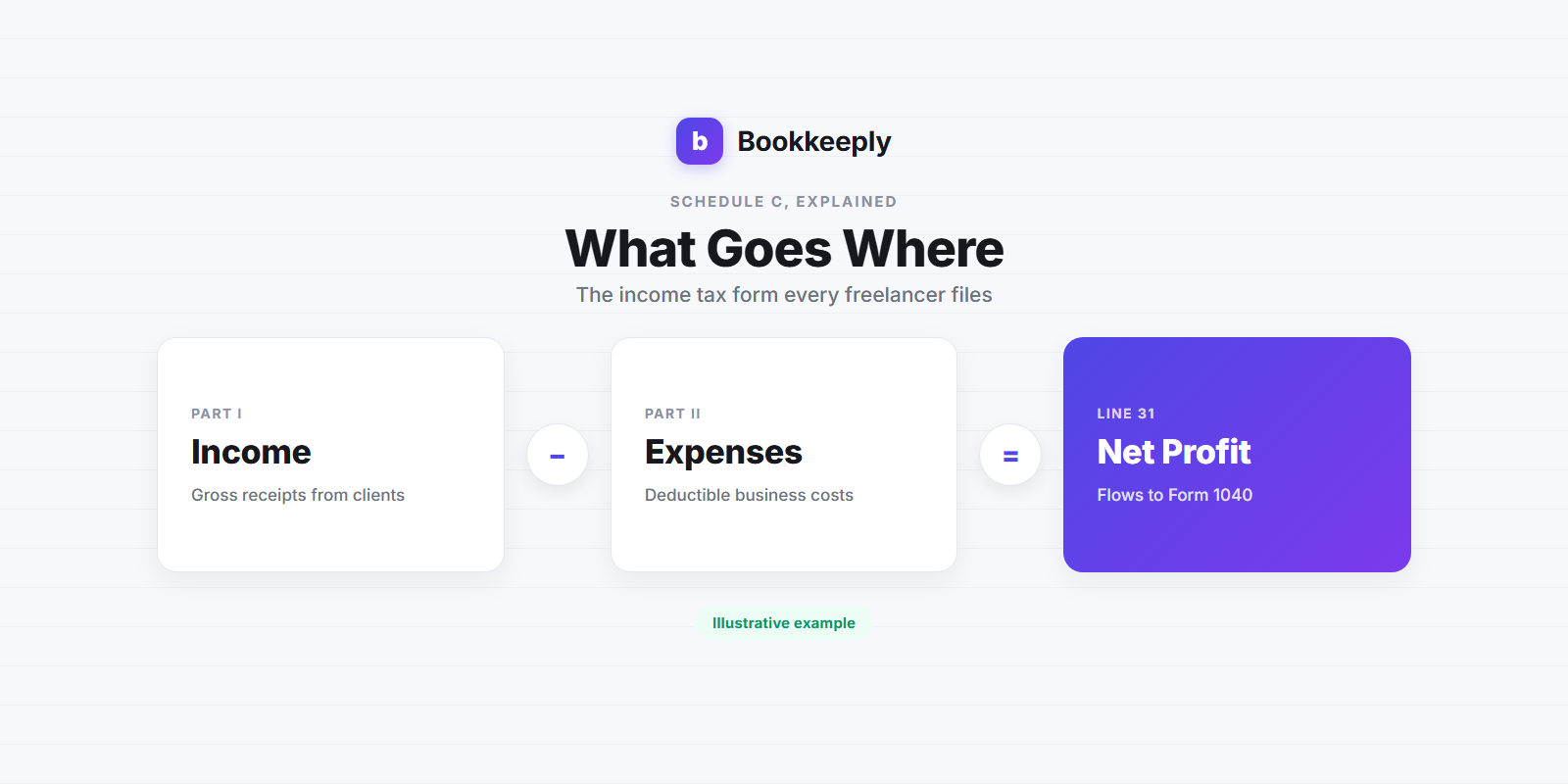
Schedule C, Part by Part: What Goes Where
The form has five parts. Here's what belongs in each one.
Part I — Income
This is your gross receipts: the total amount clients paid you before any expenses are subtracted. It includes income reported to you on 1099-NEC or 1099-K forms, plus any freelance income you received that wasn't reported on a 1099 at all (the IRS still expects you to report it). Part I ends with your gross profit.
Part II — Expenses
This is where most of the form's detail lives. The IRS gives you specific line items — advertising, contract labor, insurance, legal and professional services, office expense, rent, supplies, travel, utilities, and more — plus a line 27a for "other expenses" that don't fit a predefined category (those get itemized on Part V, see below). Common freelancer expenses that land here include:
- Software subscriptions and tools (line 27a, or "office expense" depending on how you categorize it)
- Business insurance
- Contractors or subcontractors you paid (line 11, contract labor)
- Business-related travel and a portion of meals
- A home office, if you use part of your home regularly and exclusively for work (line 30)
Subtracting total expenses from gross profit gives you your tentative net profit or loss.
Part III — Cost of Goods Sold
This section only applies if you sell physical products and carry inventory — think a freelancer who also sells merchandise or a maker selling goods alongside services. Most service-based freelancers (writers, designers, consultants, developers) leave this section blank.
Part IV — Information on Your Vehicle
If you claimed a car or truck expense in Part II, this section asks for details: when you placed the vehicle in service, your total, business, and personal mileage, and whether you have written evidence for your deduction. Freelancers who drive to client meetings, job sites, or for supply runs typically use the standard mileage rate here rather than tracking actual gas and maintenance costs, since it's simpler to substantiate. For 2026, the IRS standard mileage rate for business driving is 72.5 cents per mile.
Part V — Other Expenses
Anything that didn't fit a named line in Part II gets itemized here, then the total flows back up to line 27a. This is a common home for things like bank fees, continuing education, or a specific software tool you want to track separately.
A Simple Worked Example
The numbers below are an illustration only, not a real filing — they're meant to show how the parts connect.
Say a freelance graphic designer had the following year:
- Gross receipts (Part I): $62,000
- Software subscriptions: $1,200
- Contract labor (a subcontracted illustrator): $4,500
- Home office deduction: $2,000
- Business insurance: $600
- Vehicle expense (400 business miles at the 2026 standard mileage rate of 72.5 cents): $290
Total expenses: $8,590. Net profit (Part I minus total expenses): $53,410. That $53,410 is the number that flows to Schedule 1 of Form 1040 and into the self-employment tax calculation.
How Schedule C Connects to Schedule SE
Schedule C tells the IRS what you earned. Schedule SE tells the IRS what you owe in self-employment tax on that profit. If your net earnings from self-employment are $400 or more, you generally owe self-employment tax — 15.3% (12.4% for Social Security and 2.9% for Medicare), applied to 92.35% of your net profit, per the IRS. Using the example above, roughly $49,326 of that $53,410 profit would be subject to the 15.3% rate. For the full mechanics and a worked calculation, see our guide on how to calculate self-employment tax.
Because Schedule C profit drives both your income tax and your self-employment tax, it's also the number that should guide how much you set aside for quarterly estimated payments. If you haven't settled on a savings target yet, our post on how much a freelancer should set aside for taxes walks through a reasonable starting percentage.
Common Mistakes Freelancers Make on Schedule C
- Reporting only 1099 income. All business income counts, even client payments under $600 that never triggered a 1099.
- Mixing personal and business expenses. A dedicated business bank account or bookkeeping tool makes this much easier to avoid at tax time.
- Skipping the home office deduction out of fear of an audit. It's a legitimate deduction when you meet the regular-and-exclusive-use test; the fear is largely outdated.
- Forgetting Part IV vehicle details when a car or truck expense is claimed in Part II, which can flag the return for a mismatch.
FAQ
Do I need to file Schedule C if I only made a small amount freelancing?
Yes, in most cases. There's no minimum income threshold for reporting business income on Schedule C itself, though the $400 threshold determines whether you also owe self-employment tax.
Can I file Schedule C if I have a full-time W-2 job and freelance on the side?
Yes. Many people file a regular Form 1040 with W-2 income and attach a Schedule C for freelance or side income earned in the same year.
What if I had a loss instead of a profit?
You can still file Schedule C and report the loss, which may reduce your overall taxable income. If your business shows losses in most years, the IRS may look more closely at whether it's a genuine business versus a hobby.
Do I need separate Schedule C forms for different freelance gigs?
Generally, one Schedule C per distinct business activity. If you freelance as both a designer and a photographer, for example, those may need separate forms depending on how distinct the activities are.
This article is for general education and isn't tax or legal advice. Schedule C rules have exceptions and edge cases that depend on your specific situation — talk to a qualified tax professional (a CPA or EA) before filing if anything here doesn't clearly match your circumstances.
Bookkeeply's tax planner helps freelancers track income and expenses year-round so Schedule C isn't a scramble every April. Browse more freelance tax guides on the Bookkeeply blog.
Deja de adivinar cuánto deberás.
Lleva tu contabilidad y mira tu estimación real de impuestos en minutos al día, gratis, sin necesidad de tarjeta de crédito.
Empieza gratis