Self-employed tax deductions are the single biggest lever most freelancers have over their tax bill. Every legitimate business expense you record lowers your profit, and your profit is what both income tax and self-employment tax are calculated on. Miss a deduction and you pay tax on money you never really kept.
This guide is a practical checklist. It covers the business expenses that go on Schedule C, the deductions that live on the personal side of your return, what usually does not count, and how to keep records that hold up. Where a rule or number comes from the IRS, we link to the source.
How Self-Employed Tax Deductions Work
The IRS lets you deduct business expenses that are both ordinary and necessary. In the IRS's own framing, an ordinary expense is one that is common and accepted in your line of work, and a necessary expense is one that is helpful and appropriate for your business. It doesn't have to be indispensable to qualify (see IRS Publication 334).
Most of these expenses are reported on Schedule C, the form where sole proprietors and single-member LLCs report business income and costs. If you've never filled one out, our guide to Schedule C for freelancers walks through the layout.
A few deductions sit outside Schedule C, on Schedule 1 of your Form 1040. Those are covered in their own section below.
Why one deduction saves you more than you'd think
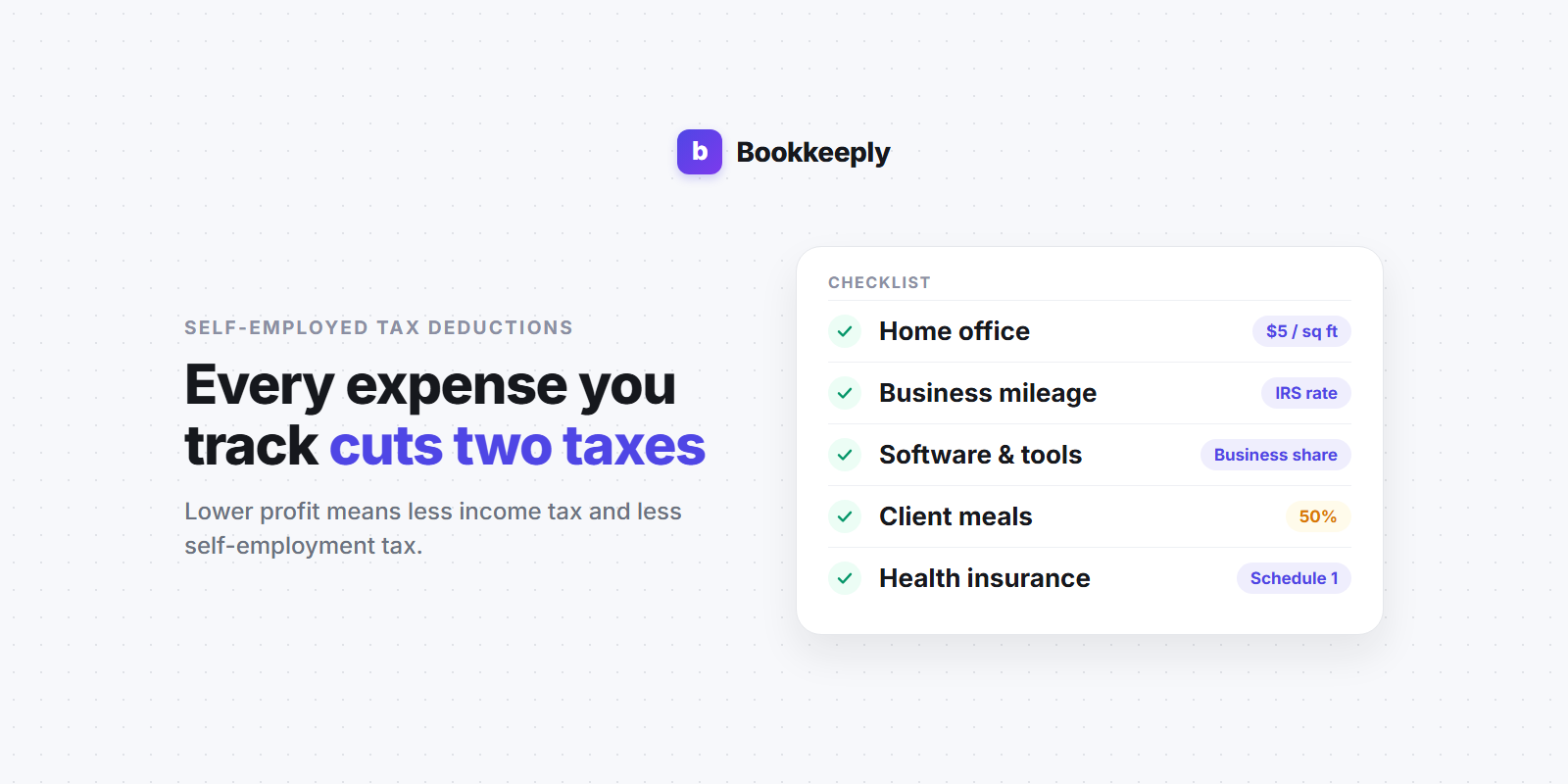
Schedule C expenses reduce your net profit, and net profit drives your self-employment tax (15.3% on 92.35% of net earnings, per the IRS) as well as your income tax. So a business expense usually cuts two taxes at once.
Illustration (our own arithmetic, simplified): say you record $1,000 of deductible expenses you would otherwise have missed, and you're in the 22% federal bracket.
- Self-employment tax saved: $1,000 × 92.35% × 15.3% ≈ $141
- Federal income tax saved: roughly $160 to $200, depending on how the half-SE-tax deduction and the qualified business income deduction interact with your numbers
- Total: roughly $300 to $350 on $1,000 of expenses, before any state income tax
Your real figure will differ, but the point holds: untracked receipts are expensive.
The Schedule C Deductions Checklist
Work through this list once a quarter, not once a year. It's much easier to find a missing receipt in October than in April.
1. Home office
If part of your home is used regularly and exclusively for business, you can deduct it. A desk in the guest room that doubles as a guest bed usually won't pass the "exclusive" test. The IRS offers two methods:
- Simplified method: $5 per square foot, up to 300 square feet, for a maximum of $1,500 (IRS). Example: a 200 sq ft office gives a $1,000 deduction.
- Regular method: you calculate the business share of actual costs (rent or mortgage interest, utilities, insurance, repairs) on Form 8829. More paperwork, sometimes a bigger deduction.
2. Car and mileage
Driving to client sites, to pick up business supplies, or to the post office to ship client work generally counts. Your regular commute from home to a permanent workplace generally does not. You can use actual expenses or the standard mileage rate. For 2026 the IRS set two business rates: 72.5 cents per mile from January 1 to June 30, and 76 cents per mile from July 1 to December 31 (IRS standard mileage rates).
Illustration: 2,000 business miles in the first half of 2026 and 1,500 in the second half works out to (2,000 × $0.725) + (1,500 × $0.76) = $1,450 + $1,140 = $2,590. A mileage log with dates, destinations, and purpose is what makes this deduction stick.
3. Software, apps, and subscriptions
Design tools, accounting software, cloud storage, project management apps, domain names, and website hosting. If you also use a subscription personally, deduct only the business share.
4. Equipment and computers
Laptops, monitors, cameras, and other gear you use for work. Larger purchases may need to be depreciated over several years, although in many cases small businesses can choose to deduct the cost in the year of purchase. The rules depend on the item and its cost, so this is a good one to confirm with a tax professional or the Form 4562 instructions.
5. Phone and internet
Deduct the business-use percentage. If about 60% of your phone use is for work, 60% of the bill is a reasonable starting point, as long as you can explain how you estimated it.
6. Professional services
Fees for a CPA or enrolled agent, legal advice, and bookkeeping help for your business.
7. Advertising and marketing
Paid ads, business cards, portfolio sites, sponsored posts, and marketing tools.
8. Contractors you pay
If you hire a subcontractor, designer, or virtual assistant, their fees are deductible. Separately, you may need to file a Form 1099-NEC for them: for payments made in 2026, the reporting threshold rose from $600 to $2,000 per person per year (IRS instructions for Forms 1099-MISC and 1099-NEC).
9. Business insurance
Professional liability (errors and omissions), general liability, and equipment coverage for the business.
10. Travel and business meals
Travel away from your tax home overnight for business (flights, lodging, and local transport) is generally deductible. Business meals with a client, customer, or similar business contact are generally 50% deductible, as long as you're present and the meal isn't lavish (IRS Publication 463). Keep a note of who you met and why.
11. Education and training
Courses, books, and workshops that maintain or improve skills you use in your current business. Education that qualifies you for a new line of work generally doesn't count.
12. Fees and supplies
Payment processor fees (a very commonly missed one), business bank account fees, coworking memberships, printer ink, paper, and postage.
Deductions on the Personal Side of Your Return
These don't go on Schedule C, but they are just as real. They appear as adjustments on Schedule 1 of Form 1040 or on their own forms.
- Half of your self-employment tax. You can deduct the employer-equivalent portion of your SE tax when figuring adjusted gross income. It lowers income tax, not the SE tax itself (IRS).
- Self-employed health insurance. Premiums for medical, dental, vision, and qualified long-term care insurance for you, your spouse, and dependents may be deductible. You can't take it for any month you were eligible for a subsidized employer plan, including a spouse's (Form 7206 instructions).
- Retirement contributions. Contributions to a SEP IRA or a solo 401(k) can reduce taxable income. Contribution limits change yearly and depend on your net earnings, so check the current IRS figures before you contribute.
- Qualified business income (QBI) deduction. Eligible sole proprietors may deduct up to 20% of qualified business income, subject to income-based limits (IRS). It's claimed on Form 8995 or 8995-A.
What Usually Doesn't Count
- Your normal commute to a regular workplace.
- Entertainment, such as concert or game tickets with a client. Under current law, entertainment expenses generally aren't deductible, even when business is discussed.
- Personal meals, groceries, and everyday clothes (even if you wear them to client meetings).
- Fines and penalties, including IRS late-payment penalties.
- The personal share of anything mixed-use (phone, car, internet).
Keep Records That Hold Up
A deduction is only as good as its paper trail. For each expense, keep the receipt or invoice, the date, the amount, and a one-line business purpose. The IRS generally says to keep records for 3 years from the date you file, with longer periods in some situations (IRS: How long should I keep records?).
A simple habit that works: a separate business bank account and card, a weekly 10-minute session to categorize transactions, and receipts photographed the day you get them. Tracking deductions as you go also makes your quarterly estimated payments more accurate, and it changes how much you need to set aside for taxes.
FAQ
Can I take business deductions and the standard deduction?
Yes. Schedule C business expenses reduce your business profit and are separate from the choice between the standard deduction and itemizing on your personal return.
Do I need a receipt for every expense?
You need records that prove the amount, date, and business purpose. Bank and card statements help, but a receipt or invoice plus a note on the purpose is the safest approach, especially for meals, travel, and mileage.
Can I deduct expenses if my business had a loss?
Generally, yes. Legitimate expenses are still deductible, and a Schedule C loss can often offset other income, although some limits apply. The IRS self-employed tax center notes that losses are limited in some situations.
What if I forgot a deduction on last year's return?
You can usually file an amended return (Form 1040-X) to claim it, within the time limits the IRS allows. A tax professional can tell you whether it's worth it.
This article is for general education and isn't tax or legal advice. Bookkeeply is not a CPA firm. Deduction rules have exceptions that depend on your situation, so talk to a qualified tax professional (a CPA or enrolled agent) before relying on anything here for your own return.
If you'd like your expenses categorized and your tax estimate updated as you go, you can try Bookkeeply for free. More guides are on the Bookkeeply blog.
Deja de adivinar cuánto deberás.
Lleva tu contabilidad y mira tu estimación real de impuestos en minutos al día, gratis, sin necesidad de tarjeta de crédito.
Empieza gratis