You formed an LLC, clients are paying the business, and money is sitting in the business bank account. Now what? There is no payroll department and no paycheck arriving on Friday. You have to decide how and when to move money to yourself, and the right method depends less on the LLC itself and more on how the LLC is taxed.
This guide walks through the three ways LLC owners usually pay themselves, explains why the amount you take out is not the amount you are taxed on, and runs a simple example so you can see how it plays out for a typical freelancer or solopreneur.
How to Pay Yourself From an LLC: The Short Answer
How you pay yourself follows your LLC's tax classification:
- Single-member LLC (default tax treatment): you take an owner's draw. You transfer money from the business account to your personal account whenever you need it. No payroll, no W-2.
- Multi-member LLC (default tax treatment): members take draws (distributions) and, if the members agree to it, guaranteed payments for the work they do.
- LLC that elected S corporation tax status: you pay yourself a reasonable salary through payroll and can take additional profit as distributions.
If you are a solo freelancer with an LLC and you never filed a special election with the IRS, you are almost certainly in the first group.
Why the LLC's Tax Classification Decides Everything
An LLC is a legal structure created under state law. For federal taxes, the IRS does not have a separate "LLC" category. It slots each LLC into an existing one.
According to the IRS, a single-member LLC is treated as a disregarded entity by default, meaning it is not separate from its owner for income tax purposes unless it elects to be treated as a corporation. The owner reports the business on their personal return, usually on Schedule C. The IRS also says a domestic LLC with at least two members is classified as a partnership by default.
An LLC can change its classification. Filing Form 2553 lets an eligible LLC be taxed as an S corporation, and per the Form 2553 instructions, an eligible entity that makes that election does not also need to file Form 8832. That election is what opens the door to paying yourself a salary.
Method 1: The Owner's Draw (Single-Member LLC)
An owner's draw is exactly what it sounds like: you draw money out of the business for personal use. In practice that usually means a transfer from your business checking account to your personal checking account.
How it works day to day
- You can take a draw on any schedule you like: weekly, monthly, or when a big invoice clears.
- There is no payroll to run, no withholding, and no W-2.
- In your books, a draw is recorded as a reduction in owner's equity. It is not a business expense, so it does not lower your profit.
How draws are taxed
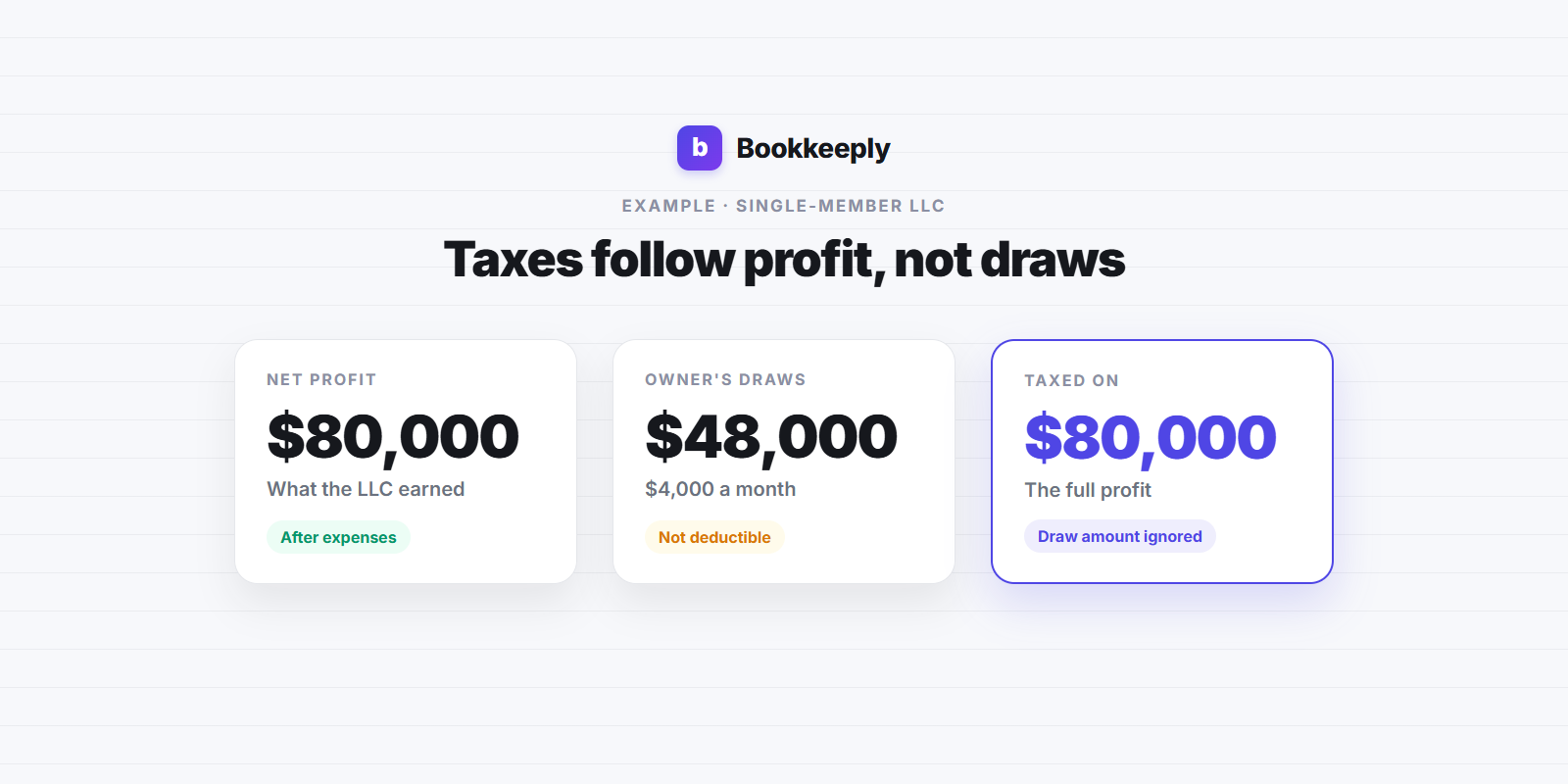
This is the part that surprises many new LLC owners. You are not taxed on what you draw. You are taxed on the business's net profit, whether you take that money out or leave it in the account.
The IRS states that the owner of a single-member LLC that runs a trade or business owes self-employment tax on those earnings in the same way as a sole proprietor. Because nothing is withheld from a draw, you are responsible for paying income tax and self-employment tax yourself, typically through quarterly estimated payments. If you want the details of that calculation, see our guide on how to calculate self-employment tax.
A Simple Example: Draws vs Taxable Profit
Here is an illustration with made-up round numbers, not a real client or a tax calculation.
Maya is a freelance designer with a single-member LLC and no tax elections. During the year:
- Her LLC brings in $100,000 from clients.
- She spends $20,000 on business expenses (software, a laptop, contractors).
- That leaves $80,000 of net profit.
- She transfers $4,000 a month to her personal account, so she draws $48,000 for the year.
Maya's taxable business profit is still $80,000, not $48,000. The extra $32,000 she left in the business account is taxed this year too. And if she had drawn $90,000 by dipping into savings from last year, her taxable profit would still be $80,000. The draw amount and the tax bill are two separate numbers.
The practical lesson: before you decide how much to draw, set aside money for taxes from the profit. Our guide on how much a freelancer should set aside for taxes covers a simple way to size that reserve.
Method 2: Draws and Guaranteed Payments (Multi-Member LLC)
If your LLC has two or more members and no election, it files as a partnership. Members generally pay themselves in two ways:
- Distributions (draws): money taken out of the business, usually according to the operating agreement.
- Guaranteed payments: IRS Publication 541 describes these as payments to a partner that are determined without regard to the partnership's income. A common use is paying a member a fixed amount for the work they do, even in a slow month.
The IRS is clear that partners are not employees and should receive a Schedule K-1, not a W-2, for distributions or guaranteed payments. Like single-member owners, partners are generally taxed on their share of the business income whether or not they take it out. Multi-member setups get complicated fast, so this is a good place to involve a tax professional.
Method 3: Salary Plus Distributions (LLC Taxed as an S Corp)
Once your LLC elects S corporation status, you become an employee of your own business. That changes how you get paid:
- Salary through payroll. The business pays you wages, withholds income tax, Social Security, and Medicare, and issues you a W-2.
- Distributions. Profit beyond your salary can be paid out as distributions, which are not subject to employment taxes.
The "reasonable compensation" rule
The IRS requires S corporations to pay shareholder-employees reasonable compensation for their services before taking non-wage distributions. It also has the authority to reclassify distributions as wages if the salary is set too low. In its guidance on the topic, the IRS lists factors courts have considered, including your training and experience, your duties, the time you devote to the business, and what comparable businesses pay for similar services.
In other words, you cannot pay yourself a token salary and take everything else as distributions. The potential tax savings of an S corp come from the gap between a reasonable salary and your total profit, and those savings have to be weighed against payroll costs, extra filings, and bookkeeping. We break down when the switch tends to make sense in Sole Prop or S-Corp? How to Tell When the Switch Actually Saves You Money.
Timing of the election
Per the IRS instructions for Form 2553, the election must be filed no more than 2 months and 15 days after the start of the tax year it should take effect, or at any time during the prior tax year. If you are considering it for next year, you do not need to wait until January.
How Much Should You Pay Yourself?
There is no IRS formula for how much to draw from a default-taxed LLC. A practical order of operations many freelancers use:
- Know your real profit. Track income and expenses monthly so you know what the business actually earned, not just what hit the bank account.
- Set aside taxes first. Move a percentage of each payment into a separate tax savings account before you draw anything.
- Keep an operating buffer. Leave enough in the business account to cover a month or two of expenses, especially if client payments are irregular.
- Pay yourself a steady amount. A fixed monthly draw smooths out lumpy freelance income and makes personal budgeting easier. Top it up with an extra draw after a strong quarter.
Bookkeeping Tips for Paying Yourself
- Use a separate business bank account. Mixing personal and business money makes it hard to prove what is a deductible expense and can weaken the liability protection an LLC is meant to provide.
- Label every transfer. Record each draw as an owner's draw (equity), never as an expense.
- Do not pay personal bills from the business account. Draw the money first, then pay personal bills from your personal account.
- Review monthly. Compare what you drew to what the business earned. If draws consistently exceed profit, you are spending down savings, not earnings.
If you are still deciding which method of tracking income suits you, our post on cash vs accrual accounting for freelancers is a good next read.
FAQ
Can I pay myself a salary from a single-member LLC?
Not in the payroll sense while it is taxed as a disregarded entity. You take owner's draws instead. To pay yourself W-2 wages, the LLC would generally need to elect corporate or S corporation tax treatment.
Are owner's draws tax deductible?
No. A draw is a transfer of profit to the owner, not a business expense. It does not reduce the LLC's taxable profit.
Do I pay tax on money I leave in the LLC?
For a default-taxed LLC, yes. You are taxed on the business's net profit for the year, whether you draw it or leave it in the business account.
How often can I take an owner's draw?
As often as you like. There is no required schedule, though a regular monthly draw makes budgeting and bookkeeping simpler.
Do I need to issue myself a 1099 or W-2 for draws?
No. Owners of a default-taxed single-member LLC do not issue themselves a 1099 or W-2 for draws. The profit flows to your personal return.
The Bottom Line
How you pay yourself from an LLC comes down to how the LLC is taxed. Most solo freelancers with an LLC take owner's draws, and the key thing to remember is that taxes follow profit, not draws. An S corp election adds a salary and distributions, with more paperwork and a reasonable-compensation requirement. Whichever path you are on, clean books are what make the right draw amount obvious. For more guides like this, visit the Bookkeeply blog.
This article is for educational purposes only and is not tax or legal advice. Bookkeeply is not a CPA firm. Rules depend on your LLC's tax classification, state, and personal situation, so check with a qualified tax professional before making decisions.
Want to see your real profit before you decide how much to draw? You can try Bookkeeply for free.
Stop guessing what you'll owe.
Track your bookkeeping and see your real tax estimate in minutes a day, free, no credit card required.
Get Started Free