If you work for yourself and made a profit last year, there is a good chance your tax return includes a one-page form called Schedule SE. It is where your self-employment tax is actually calculated, the Social Security and Medicare tax that an employer would normally split with you. The form looks intimidating at first, but for most freelancers only a handful of lines matter.
This guide walks through Schedule SE line by line using the 2025 version of the form (the one you file in 2026), then runs two complete examples so you can see exactly where each number comes from.
What Is Schedule SE?
Schedule SE (Form 1040) is the IRS form self-employed people use to figure their self-employment tax. It takes your net profit from your business, adjusts it, and applies the Social Security and Medicare rates. The result flows to your Form 1040 as part of your total tax, and half of it comes back to you as a deduction.
It works hand in hand with Schedule C. Schedule C tells the IRS how much profit your business made. Schedule SE uses that profit to calculate the self-employment tax you owe on it. If you want the concept behind the math first, our guide on how to calculate self-employment tax covers it in plain English.
Who Has to File Schedule SE?
According to the IRS instructions for Schedule SE (2025), you generally need to file it if either of these applies:
- Your net earnings from self-employment (line 4c of the form) are $400 or more.
- You had church employee income of $108.28 or more.
Line 4c is not the same as your raw profit. It is your profit multiplied by 92.35%, which you will see below. So a freelancer with a very small side business may end up under the threshold even if their Schedule C profit is slightly above $400.
Schedule SE Line by Line (Part I)
Part I is where almost every freelancer does all of their work. Here is what each line does, based on the 2025 form.
Lines 1a and 1b: Farm income
Line 1a is net farm profit from Schedule F or farm partnerships. Line 1b is for certain Conservation Reserve Program payments if you receive Social Security benefits. Most freelancers, consultants, and online sellers leave both blank.
Line 2: Your business profit
This is the important one. Enter your net profit or loss from Schedule C, line 31, plus any self-employment earnings from a partnership K-1 (box 14, code A). If you have more than one Schedule C, you combine them here.
Line 3: Combine
Add lines 1a, 1b, and 2. For a typical freelancer, line 3 simply equals line 2.
Lines 4a, 4b, and 4c: The 92.35% adjustment
Line 4a multiplies line 3 by 92.35% if it is more than zero. It mirrors the fact that employees are not taxed on their employer's share of these taxes. Line 4b is only used if you elect one of the optional methods in Part II. Line 4c adds 4a and 4b. If line 4c is under $400, the form tells you to stop: you do not owe self-employment tax (unless you have church employee income).
Lines 5a and 5b: Church employee income
Only relevant if you worked for a church that elected out of paying employer Social Security taxes. Most people skip these.
Line 6: Your self-employment tax base
Add lines 4c and 5b. This is the number the tax rates are applied to.
Line 7: The Social Security wage base
This line is pre-printed. On the 2025 form it is $176,100, the maximum amount of combined wages and self-employment earnings subject to Social Security tax for that year. For 2026 the Social Security Administration set it at $184,500, so expect that figure on next year's form.
Lines 8a through 8d: W-2 wages
If you also had a job with Social Security wages, enter them on line 8a (boxes 3 and 7 of your W-2s). Lines 8b and 8c cover unreported tips and certain misclassified-worker wages. Line 8d adds them up. This matters because the Social Security cap is shared between your job and your business. If your W-2 wages already hit the cap, your business profit owes no additional Social Security tax.
Line 9: Room left under the cap
Subtract line 8d from line 7. If the result is zero or less, enter zero here and on line 10.
Line 10: Social Security portion (12.4%)
Multiply the smaller of line 6 or line 9 by 12.4%.
Line 11: Medicare portion (2.9%)
Multiply line 6 by 2.9%. There is no cap on the Medicare portion.
Line 12: Your self-employment tax
Add lines 10 and 11. This is your self-employment tax. The form tells you to carry it to Schedule 2 (Form 1040), line 4, which then feeds into the total tax on your 1040.
Line 13: Deduction for half of self-employment tax
Multiply line 12 by 50% and carry it to Schedule 1 (Form 1040), line 15. This deduction lowers your adjusted gross income, and with it your income tax. It does not reduce the self-employment tax itself.
Part II: The Optional Methods
Part II lets some people report more net earnings than their actual profit, usually to keep earning Social Security credits in a low-income year. The nonfarm optional method on the 2025 form is only available if your net nonfarm profits were less than $7,840 and also less than 72.189% of your gross nonfarm income, and you had at least $400 of net self-employment earnings in 2 of the prior 3 years. It can be used no more than five times.
Example 1: A Full-Time Freelancer
Illustration only, using the 2025 form. Maya is a freelance designer with no other job. Her Schedule C, line 31, shows a net profit of $70,000.
- Line 2: $70,000
- Line 3: $70,000
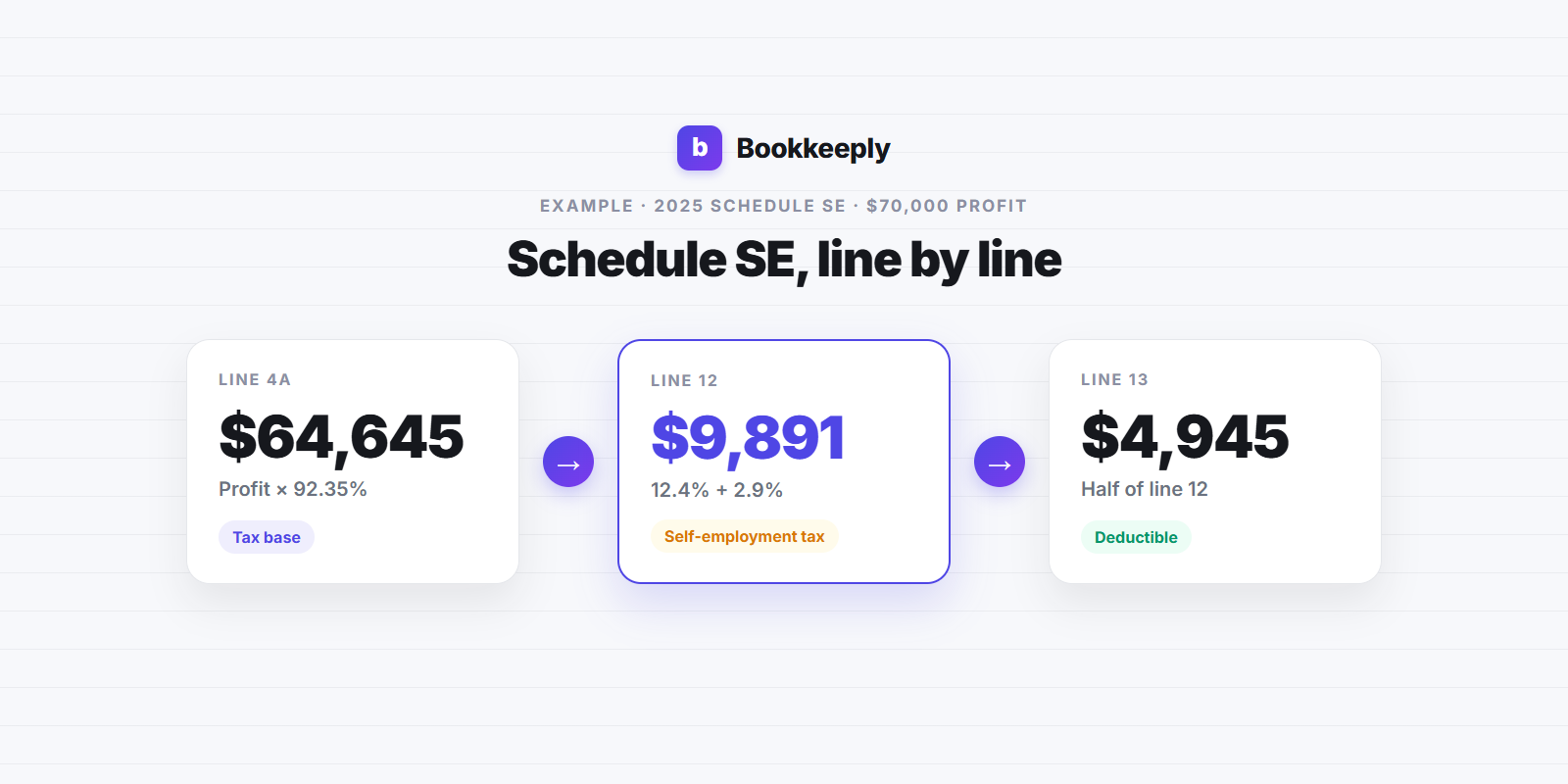
- Line 4a: $70,000 × 92.35% = $64,645.00
- Line 4c and line 6: $64,645.00
- Line 7: $176,100 (pre-printed)
- Lines 8a to 8d: $0 (no W-2 job)
- Line 9: $176,100
- Line 10: the smaller of $64,645.00 or $176,100, times 12.4% = $8,015.98
- Line 11: $64,645.00 × 2.9% = $1,874.71
- Line 12: $8,015.98 + $1,874.71 = $9,890.69 self-employment tax
- Line 13: $9,890.69 × 50% = $4,945.35 deduction (rounded)
So Maya owes about $9,891 in self-employment tax on top of her income tax, and she gets to deduct about $4,945 when figuring her adjusted gross income. (The IRS lets you round to whole dollars on your return.)
Example 2: A Side Business Plus a Day Job
Illustration only, using the 2025 form. Sam earns $150,000 in W-2 Social Security wages at a full-time job and also has a consulting side business with a $40,000 net profit.
- Line 2 and line 3: $40,000
- Line 4a, 4c, and line 6: $40,000 × 92.35% = $36,940.00
- Line 8a and 8d: $150,000
- Line 9: $176,100 − $150,000 = $26,100
- Line 10: the smaller of $36,940.00 or $26,100, so $26,100 × 12.4% = $3,236.40
- Line 11: $36,940.00 × 2.9% = $1,071.26
- Line 12: $4,307.66 self-employment tax
- Line 13: $2,153.83 deduction
Because Sam's job already used most of the Social Security cap, only $26,100 of the side income owes the 12.4% portion. The 2.9% Medicare portion still applies to the full $36,940.
Common Schedule SE Mistakes
- Applying 15.3% to the full profit. Skipping the 92.35% step on line 4a overstates the tax.
- Forgetting the line 13 deduction. Half of the tax belongs on Schedule 1, line 15. Leaving it off means paying more income tax than necessary.
- Ignoring W-2 wages on line 8a. If you have a job too, the shared Social Security cap can lower your self-employment tax.
- Looking for the 0.9% Additional Medicare Tax here. Higher earners may owe it, but it is figured on Form 8959, not Schedule SE.
- Waiting until April to think about it. Self-employment tax is part of what your quarterly estimated payments should cover. Our post on the IRS safe harbor rule explains how to size those payments to avoid a penalty.
How to Make Schedule SE Easy Next Year
Schedule SE is only as accurate as the profit you put on line 2, and that number comes straight from your bookkeeping. A few habits make the form almost automatic:
- Track income and expenses as you go, not in a spreadsheet marathon in March. Every missed expense raises line 2 and your tax with it. Our self-employed deductions checklist helps you catch the common ones.
- Estimate your self-employment tax during the year using the same steps as the form: profit × 92.35% × 15.3% (as long as you are under the Social Security cap).
- Set money aside with every payment you receive. If you are not sure how much, see how much a freelancer should set aside for taxes.
- Remember that draws do not change the math. If you have a single-member LLC, the tax follows profit, not what you pay yourself. We cover that in how to pay yourself from an LLC.
FAQ
Do I file Schedule SE if I had a loss?
If line 4c is less than $400, including a loss, you do not owe self-employment tax and the form tells you to stop. Some people still file it to use the optional methods and earn Social Security credits, so check the instructions if that applies to you.
Is Schedule SE the same as Schedule C?
No. Schedule C reports your business income and expenses and arrives at your profit. Schedule SE takes that profit and calculates the self-employment tax on it. Most freelancers file both.
Where does the Schedule SE total go?
On the 2025 form, line 12 goes to Schedule 2 (Form 1040), line 4, and the line 13 deduction goes to Schedule 1 (Form 1040), line 15.
Does an S corp owner file Schedule SE?
Generally not for S corp income. S corp owners pay Social Security and Medicare through payroll on their salary instead. See our comparison of sole prop vs S corp for how that trade-off works.
The Bottom Line
Schedule SE turns your business profit into your self-employment tax in a few steps: take your Schedule C profit, multiply by 92.35%, apply 12.4% up to the Social Security cap and 2.9% on everything, then deduct half of the result. Once you have walked through it once, the form stops being mysterious. For more guides like this one, visit the Bookkeeply blog.
This article is for educational purposes only and is not tax or legal advice. Bookkeeply is not a CPA firm. Figures are based on the 2025 Schedule SE and its IRS instructions, and your situation may differ, so check with a qualified tax professional before filing.
Want your Schedule C profit ready before tax season? You can try Bookkeeply for free.
Stop guessing what you'll owe.
Track your bookkeeping and see your real tax estimate in minutes a day, free, no credit card required.
Get Started Free