If clients pay you through PayPal, Venmo, a marketplace or a card reader, you may get a Form 1099-K in January. A lot of freelancers have been confused about this form, because the reporting threshold changed several times in the last few years. The good news is that the rule is now settled again.
This guide explains what Form 1099-K is, the current $20,000 and 200-transaction threshold, why card payments work differently, and how to handle the form on your return without paying tax twice on the same income (or paying tax on fees and refunds you never kept).
What Form 1099-K is
Form 1099-K is an information return that reports payments you received for goods or services during the year. According to the IRS page Understanding your Form 1099-K, it's sent by two kinds of companies:
- Payment card companies, for payments you accepted by credit or debit card.
- Payment apps and online marketplaces, which the IRS calls third party settlement organizations (TPSOs). PayPal and Venmo goods-and-services payments fall here.
The company sends a copy to the IRS and must send you a copy by January 31. If you take payments on more than one platform, you can get more than one Form 1099-K.
This is a different form from the 1099-NEC, which a client may send when they pay you directly (for example, by check or bank transfer). If you're still getting your bearings on 1099 work in general, our guide to 1099 vs W-2 covers the basics.
The 1099-K threshold: $20,000 and 200 transactions
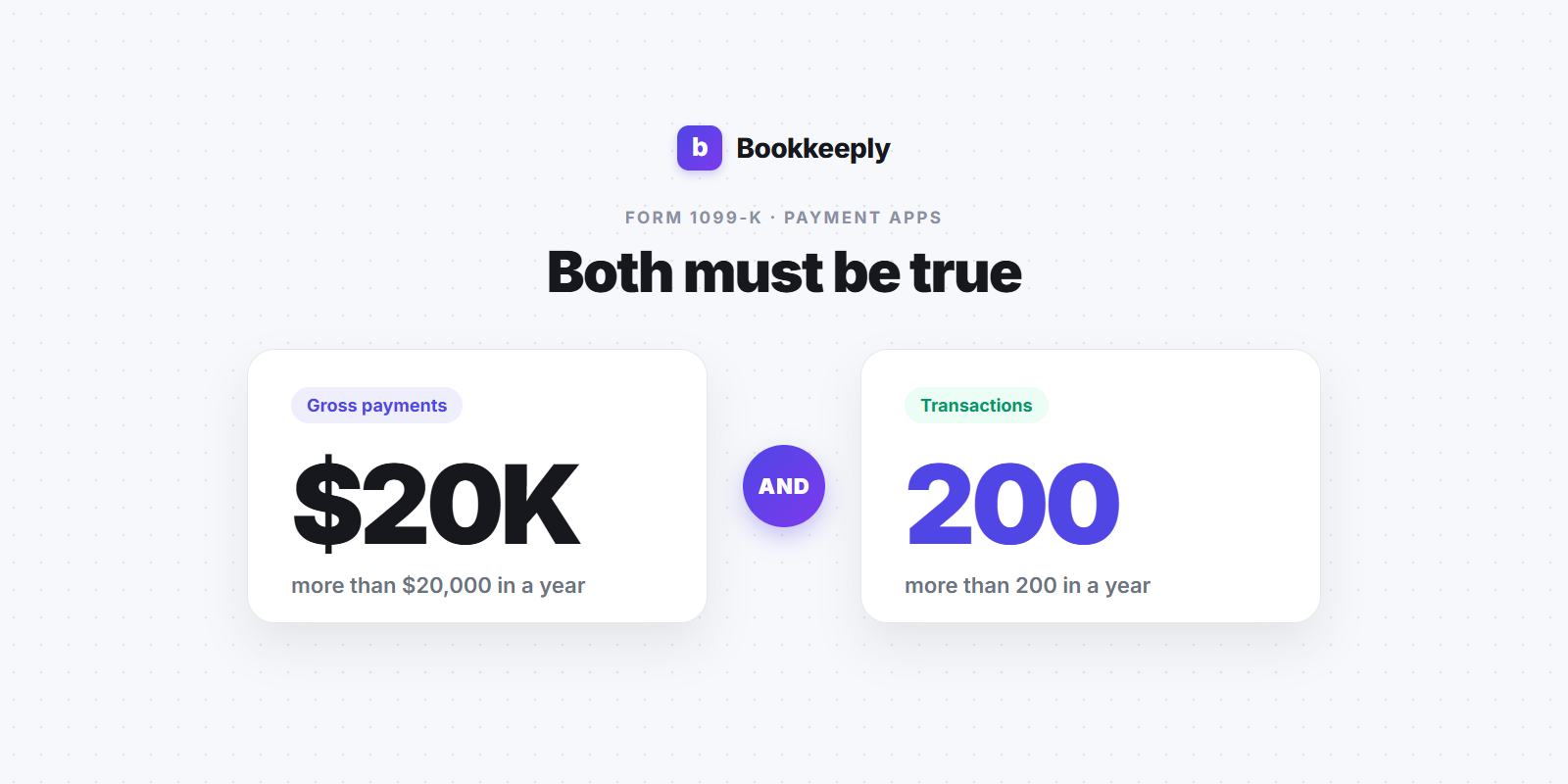
For payment apps and marketplaces, the threshold is back to where it was before 2022. In IR-2025-107 (October 2025), the IRS explained that the One, Big, Beautiful Bill retroactively reinstated the older rule. A TPSO doesn't have to file a Form 1099-K for you unless both of these are true for the year:
- your gross payments are more than $20,000, and
- you had more than 200 transactions.
Both conditions have to be met. That replaced the $600 threshold from the American Rescue Plan Act of 2021, along with the planned phase-in steps ($5,000 for 2024 and $2,500 for 2025) that you may still see in older articles. If a guide tells you that Venmo will report you at $600, it's out of date.
Card payments have no minimum
The $20,000 and 200 rule applies to payment apps and marketplaces. Payment card transactions are different. The IRS Form 1099-K FAQs say there's no threshold for card payments, so even a single small card payment can be reported. If you run client cards through a merchant account or card reader, expect a 1099-K regardless of volume. How a specific processor classifies your account can vary, so check the tax documents section of each platform you use.
Personal payments shouldn't be on it
Money from friends and family for gifts, a shared dinner, or your half of the rent isn't income and shouldn't be reported on a 1099-K. Payment apps rely on how each payment is tagged, though. Keeping business payments in a business account (or marking them as goods and services) and personal ones as personal makes your form much easier to trust.
Below the threshold? The income is still taxable
This is the part people miss. The threshold only decides whether the platform has to send a form. It doesn't change what you owe. The IRS is clear that you must report all your income, whether or not you receive a Form 1099-K, including cash and payments that never show up on any form.
So if you made $12,000 through Venmo this year from 150 client payments, you probably won't get a 1099-K, but that $12,000 still belongs on your return as business income, and it still counts toward self-employment tax.
Why the 1099-K amount is often higher than your income
Form 1099-K reports gross payments. That number usually includes things that aren't really income to you, such as:
- platform and card processing fees taken out before the money reached you
- refunds you gave back to clients
- shipping charged to customers, discounts and similar adjustments
The IRS guidance on what to do with Form 1099-K tells you to compare the gross amount against your own records and account for items like fees, refunds and shipping. In other words, the form is your starting point, not your answer.
Example: one freelancer, two platforms
The numbers below are an illustration, not real client data.
Maya is a freelance illustrator filing as a sole proprietor. In 2026 she gets paid in three ways:
- PayPal: $24,000 in gross payments from 230 client transactions. PayPal kept $850 in fees, and Maya refunded one client $600.
- Venmo business profile: $6,000 from 80 transactions.
- Bank transfers: $5,000 from one agency client.
Here's how it plays out:
- PayPal is over $20,000 and over 200 transactions, so Maya should expect a 1099-K showing $24,000 gross.
- Venmo is under both limits, so there's likely no 1099-K. The $6,000 is still income.
- The agency paid by bank transfer. For payments made after 2025, the Form 1099-NEC instructions set the reporting threshold at $2,000, so Maya would typically get a 1099-NEC for the $5,000.
On her Schedule C, Maya's gross receipts are $35,000 ($24,000 + $6,000 + $5,000). She records the $600 refund as returns and allowances, and deducts the $850 of PayPal fees as a business expense. Her income isn't counted twice, and she isn't taxed on money she never kept. If you want to see which lines these land on, our Schedule C guide walks through it.
Can the same payment show up on two forms?
It shouldn't. The 1099-NEC instructions say payments made by credit card or through third party network transactions are reported on Form 1099-K by the payment company and are not subject to reporting on Form 1099-NEC. So a client who pays you through PayPal goods and services generally shouldn't also send you a 1099-NEC for that amount.
Mistakes happen anyway. If a client does send a 1099-NEC for money that's also inside a 1099-K total, report the income once and keep a record showing which payments overlap (invoice numbers and payment dates are enough). Don't add both forms together blindly.
What to do if your 1099-K is wrong
According to the IRS, you should contact the issuer, not the IRS. The issuer is listed as the "Filer" in the top left corner of the form. Ask for a corrected form, and keep copies of the original, the correction and your messages. The IRS notes it can't correct a 1099-K for you.
You don't have to wait for the corrected form to file. If it reports personal payments, like reimbursements from a roommate, or duplicates another form, ask the issuer for a corrected form showing zero. The IRS page linked above explains how to account for an incorrect amount on your return if the correction doesn't arrive in time.
Simple habits that make 1099-K season painless
- Separate business and personal payments. Use a business profile or account for client money, and keep personal transfers out of it.
- Record income from your own invoices, not just platform totals. Then reconcile each platform once a month so fees and refunds are already accounted for when the form arrives.
- Track fees as expenses. Processing fees are a normal cost of doing business. Our self-employed deductions checklist covers more of these.
- Set money aside as you get paid, whether or not a form is coming. See how much a freelancer should set aside for taxes.
FAQ
What is the 1099-K threshold for 2026?
For payment apps and online marketplaces, it's more than $20,000 in gross payments and more than 200 transactions in the year. Both must be exceeded. Payment card transactions have no minimum.
Will Venmo or PayPal send me a 1099-K for $600?
Not under the current rule. The $600 threshold was repealed retroactively. You'd need more than $20,000 and more than 200 goods-and-services transactions on that platform.
Do I have to report income if I don't get a 1099-K?
Yes. All business income is reportable, whether or not you receive any form.
Is the threshold per platform or combined?
Each platform files its own form based on the payments it processed for you, which is why you can receive more than one 1099-K. Your total income across platforms is what goes on your return.
Do I pay tax on the gross amount shown?
Not necessarily. Fees, refunds and similar items can bring the taxable amount down. You're taxed on your actual business profit, which is why accurate records matter.
Disclaimer: This article is for general education and isn't tax or legal advice. Rules depend on your specific facts and can change. For decisions about your own return, check the IRS sources linked above or talk to a qualified tax professional.
Want your income, fees and tax estimates in one place? You can try Bookkeeply for free, or browse more guides on the Bookkeeply blog.
Deja de adivinar cuánto deberás.
Lleva tu contabilidad y mira tu estimación real de impuestos en minutos al día, gratis, sin necesidad de tarjeta de crédito.
Empieza gratis