If you freelance, drive for a platform, or run a small business on your own, your tax bill has a piece that surprises almost everyone the first time: self-employment tax. It is separate from income tax, and it is calculated with its own short formula. The good news is that the formula is simple once you see it laid out.
This guide walks through how to calculate self-employment tax step by step, with two worked examples you can adapt to your own numbers.
What self-employment tax actually is
When you work for an employer, Social Security and Medicare taxes are split between you and the company. When you work for yourself, you pay both halves. The IRS describes the self-employment tax rate as 15.3%, made up of two parts:
- 12.4% for Social Security (old-age, survivors, and disability insurance)
- 2.9% for Medicare
You generally owe it if your net earnings from self-employment were $400 or more. It applies to sole proprietors, independent contractors, and partners, and it is on top of regular federal income tax. If you are still sorting out how this differs from a regular paycheck, our guide on 1099 vs W-2 covers the big picture.
The formula in four steps
Here is the sequence the IRS uses, in plain language. It is calculated on Schedule SE, which attaches to your Form 1040.
Step 1: Find your net earnings from self-employment
Start with your business income and subtract your business expenses. On a Schedule C, that result is your net profit. Everything after this point depends on this number, which is why tracking expenses accurately matters: every legitimate expense you record lowers both your income tax and your self-employment tax.
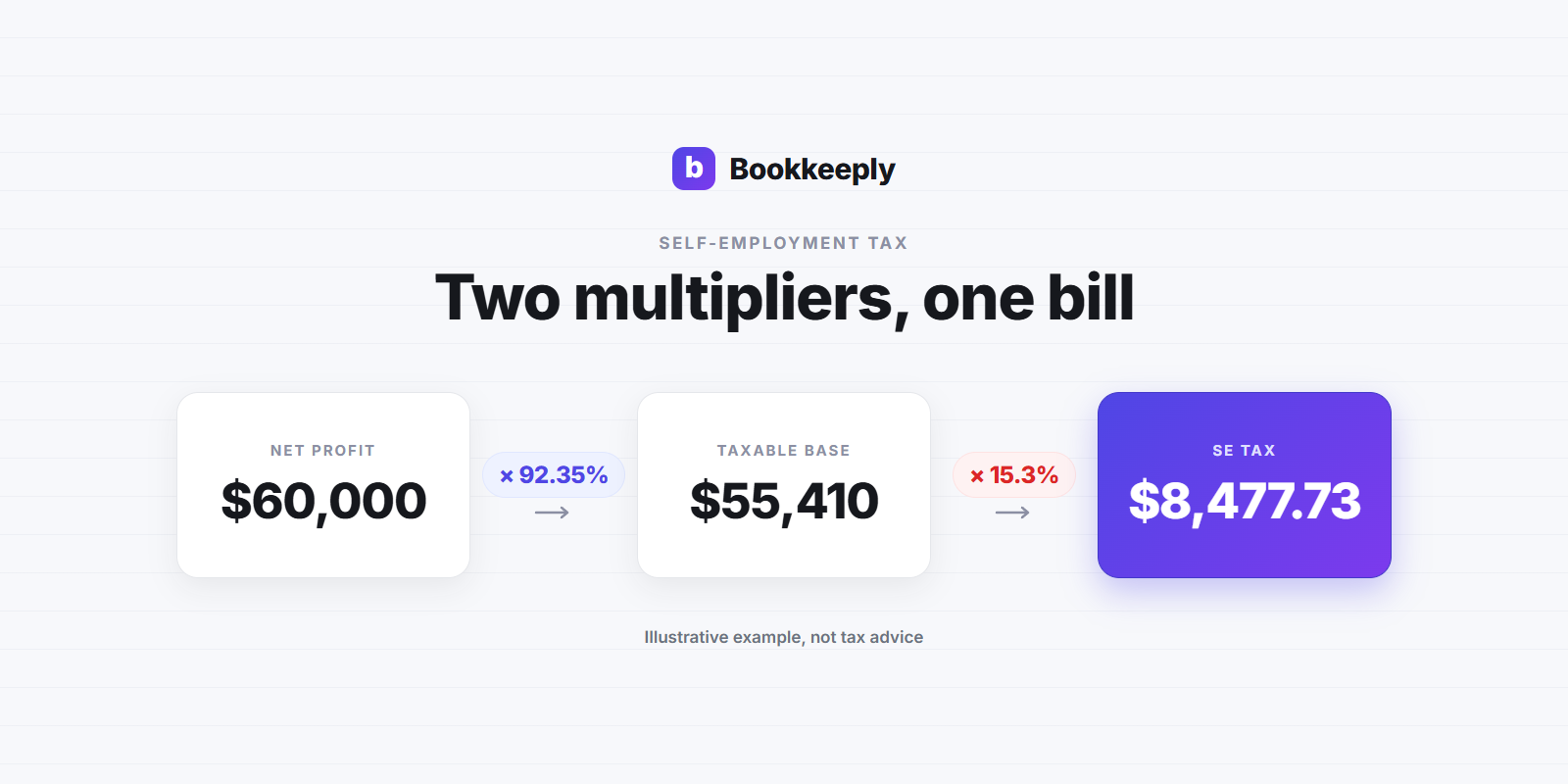
Step 2: Multiply by 92.35%
The IRS states that, generally, the amount subject to self-employment tax is 92.35% of your net earnings from self-employment. In other words, you do not pay the 15.3% on every dollar of profit, only on 92.35% of it.
Step 3: Apply the rates, watching the Social Security cap
Multiply the Step 2 result by 15.3%. There is one wrinkle: the 12.4% Social Security part only applies up to an annual earnings cap, called the wage base. The Social Security Administration announced that the 2026 maximum taxable earnings amount is $184,500 (up from $176,100). The 2.9% Medicare part has no cap.
So the calculation splits into two pieces:
- Social Security: 12.4% of the Step 2 amount, up to the wage base
- Medicare: 2.9% of the entire Step 2 amount
Also note that the wage base is shared with any W-2 wages you have. If you have a day job and a side business, the IRS counts your combined wages and net self-employment earnings toward the cap.
Step 4: Deduct half of it on your return
The IRS lets you deduct one-half of your self-employment tax when figuring adjusted gross income. This does not reduce the self-employment tax itself. It reduces the income your income tax is based on, so it softens the blow a little.
Worked example 1: a $60,000 net profit
These numbers are an illustration of the method, not a prediction for your situation.
Say a freelance designer has $60,000 of net profit on Schedule C for the year.
- Net earnings: $60,000
- Multiply by 92.35%: $60,000 × 0.9235 = $55,410
- Social Security (12.4%): $55,410 × 0.124 = $6,870.84. This is well below the cap, so the whole amount is subject to it.
- Medicare (2.9%): $55,410 × 0.029 = $1,606.89
- Total self-employment tax: $6,870.84 + $1,606.89 = $8,477.73
- Deduction for half: $8,477.73 ÷ 2 = about $4,238.87 off adjusted gross income
A quick sanity check: $55,410 × 15.3% also equals $8,477.73. When you are under the wage base, you can skip the split and just apply 15.3%. That works out to about 14.1% of the original $60,000 profit.
Worked example 2: when the Social Security cap kicks in
Again, an illustration, using the 2026 wage base of $184,500 cited above.
Now imagine a consultant with $200,000 of net profit and no W-2 wages.
- Multiply by 92.35%: $200,000 × 0.9235 = $184,700
- Social Security: only the first $184,500 counts. $184,500 × 0.124 = $22,878.00
- Medicare: no cap, so $184,700 × 0.029 = $5,356.30
- Total: $22,878.00 + $5,356.30 = $28,234.30
- Deduction for half: about $14,117.15
That is about 14.1% of the $200,000 profit, so the cap barely changes the picture here because the profit sits right at the wage base. The effect grows with higher profits: the Social Security portion stops growing and the blended rate drops. Separately, the IRS notes an additional Medicare tax may apply above certain thresholds ($200,000 for single filers and heads of household, $250,000 for married filing jointly, $125,000 for married filing separately). That is beyond the scope of this basic walkthrough.
How self-employment tax fits with quarterly payments
Because nobody is withholding for you, self-employment tax is normally paid through estimated payments during the year, along with your income tax. To avoid surprises, many freelancers convert the annual figure into a per-quarter amount and set money aside as income arrives. Our posts on how much to set aside for taxes and the IRS safe harbor rule go deeper on both.
Common mistakes to avoid
- Calculating on gross income. The formula starts from net profit after expenses, not revenue.
- Forgetting the 92.35% step. Skipping it overstates the tax.
- Ignoring the deduction for half. It belongs in your income tax calculation.
- Assuming a low income tax bill means no SE tax. They are calculated separately, so you can owe self-employment tax even when income tax is small.
- Mixing personal and business spending. Messy books make Step 1 harder to get right. If your business structure is part of the question, see sole prop vs S-Corp.
FAQ
What is the self-employment tax rate?
The IRS lists it as 15.3%: 12.4% for Social Security and 2.9% for Medicare, applied to 92.35% of your net earnings from self-employment.
Is self-employment tax the same as income tax?
No. It funds Social Security and Medicare and is calculated on Schedule SE. Income tax is calculated separately, though half of your self-employment tax is deductible when figuring it.
Do I owe it if I made less than $400?
Generally not. The IRS says you usually must pay it if your net earnings from self-employment were $400 or more. You may still need to report the income.
Is there a cap on self-employment tax?
Only on the Social Security portion. For 2026 the SSA sets that cap at $184,500 of earnings. The Medicare portion has no cap.
Can a calculator do this for me?
Yes, and it is a good way to check your math. The steps above are what a calculator runs behind the scenes, so knowing them helps you spot bad inputs.
Put it into practice
The formula itself is short. The harder part is having accurate net profit numbers when the quarter ends, which is a bookkeeping habit more than a math problem. Record income and expenses as they happen and the calculation takes minutes.
Want a single place to track income, expenses and tax set-asides? Get started free with Bookkeeply, or browse more guides on the Bookkeeply blog. For official details, see the IRS self-employed individuals tax center.
Tax information is provided for general educational purposes and is not tax, legal, or accounting advice. Your actual tax liability depends on your individual circumstances, and rules change. Consider consulting a qualified tax professional for advice specific to your situation. Bookkeeply is not affiliated with the IRS.
Deja de adivinar cuánto deberás.
Lleva tu contabilidad y mira tu estimación real de impuestos en minutos al día, gratis, sin necesidad de tarjeta de crédito.
Empieza gratis