If you're self-employed, nobody withholds tax from your client payments. The IRS still expects to be paid during the year, so it uses four estimated tax due dates. Miss one, or pay too little by one, and a penalty can start adding up even if you pay everything in full when you file.
This page puts the whole calendar in one place: the four 2026 deadlines, the dates to plan around in 2027, which months each payment covers (they aren't equal), and the few exceptions that can change a date. If you want the step-by-step on actually sending the money, see our guide on how to pay quarterly estimated taxes.
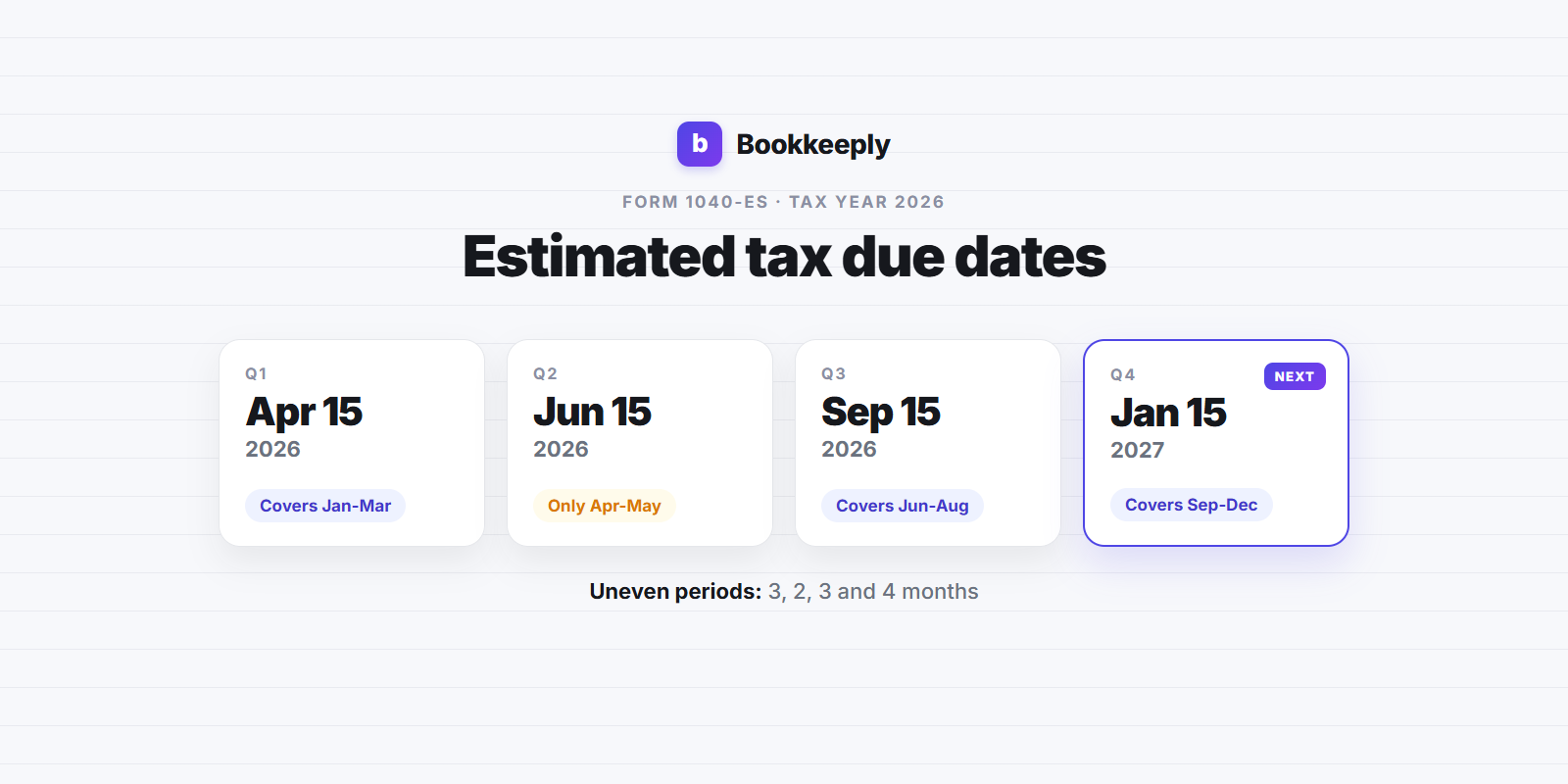
Estimated tax due dates for tax year 2026
These dates come straight from the IRS 2026 Form 1040-ES package:
- 1st payment: April 15, 2026 (Wednesday). Covers income from January 1 to March 31.
- 2nd payment: June 15, 2026 (Monday). Covers income from April 1 to May 31.
- 3rd payment: September 15, 2026 (Tuesday). Covers income from June 1 to August 31.
- 4th payment: January 15, 2027 (Friday). Covers income from September 1 to December 31.
The income periods match the IRS FAQ on estimated tax for individuals. As of mid-October 2026, the first three dates have passed, so the next one on the calendar is January 15, 2027. We cover that payment in detail in Q4 estimated tax payment: deadline and how to calculate it.
Why the "quarters" aren't really quarters
The name suggests four equal three-month blocks. The real periods are 3, 2, 3 and 4 months long. The second payment only covers April and May, and it's due just two months after the first one. The last payment covers four months and lands in January of the next year.
This trips people up in two ways:
- The June payment comes fast. You've barely paid in April and another payment is due. If you budget monthly, it helps to set money aside every month instead of saving up "per quarter".
- The January payment is easy to forget. It falls after the holidays and after your tax year has closed, when many freelancers mentally switch to "tax season" and assume they'll settle up when they file.
Under the regular method, the 1040-ES instructions describe paying your estimated tax in four equal amounts on these dates, even though the periods are uneven. So if your expected tax for the year is $20,000, the regular plan is $5,000 on each date (an illustration, not a recommendation for your numbers).
Planning ahead: the 2027 calendar
The IRS publishes a new Form 1040-ES each year, and the 2027 version isn't out yet. Based on the standard schedule, here is how 2027 is likely to look:
- April 15, 2027 (Thursday): first payment for tax year 2027.
- June 15, 2027 (Tuesday): second payment.
- September 15, 2027 (Wednesday): third payment.
- January 15, 2028 falls on a Saturday, so the weekend rule below moves the fourth payment to a later business day.
Treat these as a planning calendar and confirm them on the 2027 Form 1040-ES once the IRS releases it. Laws and holiday rules can shift a date.
When a due date falls on a weekend or holiday
If a due date lands on a Saturday, Sunday or legal holiday, the IRS FAQ says your payment is on time if you make it on the next day that isn't a weekend or legal holiday. None of the four 2026 dates fall on a weekend, but this matters for January 2028, and it's worth knowing for any year.
If you pay by mail, the 1040-ES says the U.S. postmark date counts as the payment date. The 2026 instructions also add a caution: the postmark is the date the mail is processed at a USPS facility, which may be later than the day you drop it in a mailbox. If you mail checks, send them a few days early, or pay online instead.
Exceptions that change the dates
You can skip the January payment if you file early
According to the 2026 Form 1040-ES, you don't have to make the January 15, 2027 payment if you file your 2026 return by February 1, 2027 and pay the entire balance due with it. That's a real option if your records are clean and your 1099s arrive on time, but it's tight. Most freelancers are still waiting on forms in late January, so for many people the January payment is the safer plan.
Farmers and fishermen
If at least two-thirds of your gross income for 2025 or 2026 is from farming or fishing, the 1040-ES lets you pay all of your estimated tax by January 15, 2027, or file and pay in full by March 1, 2027 instead of making estimated payments.
Fiscal-year taxpayers
If your tax year doesn't end on December 31, your due dates are the 15th day of the 4th, 6th and 9th months of your fiscal year and the 1st month of the next fiscal year. Most freelancers use the calendar year, so this rarely applies.
Paying all at once
The 1040-ES also allows you to pay the whole year's estimated tax by April 15. Few freelancers know their full-year income in April, but it's an option if you had a big payout early in the year.
What if your income started mid-year?
Say you went freelance in July 2026 (an illustration). You had no freelance income in the first two periods, so you probably didn't think about estimated tax in April or June. Your first payment might be September 15, then January 15.
The catch: under the regular method, the required payments are spread equally across all four due dates, which can make it look like you underpaid in April and June even though you hadn't earned the money yet. The 1040-ES points people with a big mid-year change in income to the annualized income installment method in chapter 2 of IRS Publication 505. If you use it, you file Form 2210 with Schedule AI along with your return. It's more paperwork, but it matches your payments to when you actually earned the money.
Do you even need to pay estimated tax?
The 2026 Form 1040-ES says that, in most cases, you must make estimated payments if you expect to owe at least $1,000 after withholding and refundable credits, and your withholding and credits will be less than the smaller of:
- 90% of the tax on your 2026 return, or
- 100% of the tax on your 2025 return (110% if your 2025 AGI was more than $150,000, or $75,000 if married filing separately).
That second test is the basis of the IRS safe harbor rule, and the higher-income version is covered in the 110% safe harbor rule. Remember that your estimate includes self-employment tax, not just income tax. Our self-employment tax guide explains how that part is figured.
What happens if you miss a due date
The underpayment penalty is figured separately for each payment period. Paying a big lump sum in January doesn't erase the fact that you were short in April, June and September. The penalty works like interest on the amount you were short, for the time it was late. We explain how it's calculated in the IRS underpayment penalty, explained.
If you realize you've missed a payment, pay as soon as you can. The penalty is based on how long the shortfall stays unpaid, so paying sooner keeps it smaller.
A simple routine to never miss a date
- Put all four dates in your calendar now, with a reminder a week before each one.
- Move a fixed share of every client payment into a separate tax savings account. Our guide on how much a freelancer should set aside for taxes helps you pick a percentage.
- Re-estimate before each payment. If income jumped or dropped, adjust the next payment instead of waiting until April.
- Pay online and keep the confirmation. IRS Direct Pay, your IRS Online Account and EFTPS are all listed in the 1040-ES as payment options.
- Check your state. Many states have their own estimated tax schedule, and the dates don't always match the federal ones.
FAQ
What are the estimated tax due dates for 2026?
April 15, June 15 and September 15, 2026, and January 15, 2027, per the 2026 Form 1040-ES.
Is the January payment for this year or next year?
The January 15, 2027 payment is the fourth payment for tax year 2026. It covers income earned from September 1 to December 31, 2026.
Is October 15 an estimated tax deadline?
No. October 15 is the extended deadline for filing last year's return if you requested an extension. It isn't one of the estimated tax payment dates.
Can I pay more often than four times a year?
Yes. The 1040-ES says you can make more than four payments. To avoid a penalty, the total you pay within each period needs to be at least what was required by that period's due date.
Do I need to pay estimated tax in my first year freelancing?
Possibly not. The 1040-ES has an exception if you were a U.S. citizen or resident alien for all of 2025 and had no tax liability for the full 12-month 2025 tax year. If you had any tax liability for 2025, the general rule applies.
Disclaimer: This article is for general education and isn't tax or legal advice. Rules depend on your specific facts and can change. For decisions about your own return, check the IRS sources linked above or talk to a qualified tax professional.
Want your income and tax estimates in one place before each due date? You can try Bookkeeply for free, or browse more guides on the Bookkeeply blog.
Stop guessing what you'll owe.
Track your bookkeeping and see your real tax estimate in minutes a day, free, no credit card required.
Get Started Free