If you drive to meet clients, pick up supplies or get to job sites, those miles are a business expense. For many freelancers the mileage deduction ends up among the bigger write-offs of the year. It's also one of the easiest to lose, because the IRS expects records that most people never keep.
This guide covers how the self-employed mileage deduction works in 2026, the two ways to calculate it, which trips count, and what your log needs to show. A worked example compares both methods so you can see how the numbers play out.
The 2026 IRS mileage rate (it changed mid-year)
2026 is unusual because the business rate changed partway through the year. According to the IRS standard mileage rates page:
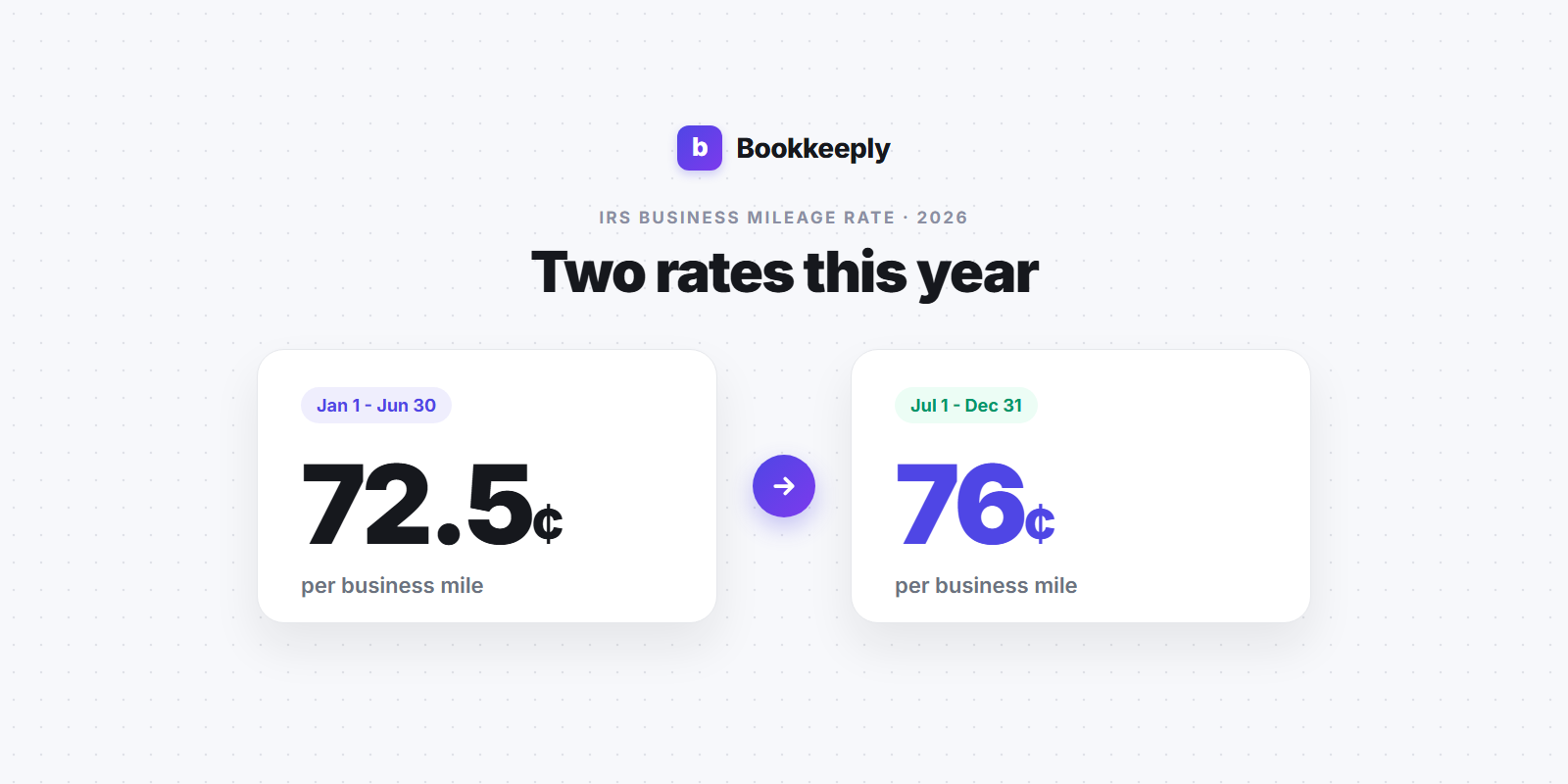
- January 1 to June 30, 2026: 72.5 cents per business mile (IR-2025-128).
- July 1 to December 31, 2026: 76 cents per business mile (IR-2026-29). The IRS raised the rate mid-year, and the new rate applies to expenses paid or incurred on or after July 1.
For comparison, the 2025 rate was 70 cents per mile. In practice this means you can't take your total 2026 business miles and multiply them by one number. Split your log at June 30 and apply each rate to its half of the year. If your mileage app only shows annual totals, export the first half now while it's still easy to separate.
Who can take the mileage deduction
If you're self-employed (a sole proprietor, an independent contractor paid on a 1099, or a single-member LLC taxed as a sole proprietorship), you deduct business car expenses on Schedule C, line 9, "Car and truck expenses." If you're not sure how Schedule C fits together, our guide to Schedule C for freelancers walks through each section.
Employees are in a different situation. A few specific groups (such as Armed Forces reservists and qualified performing artists) claim car expenses on Form 2106, but most employees can't deduct unreimbursed work mileage on a federal return. If you have a W-2 job and a side business, only the miles you drive for the side business count here.
Standard mileage rate vs actual expenses
The IRS gives you two ways to calculate the deduction, and you pick one per vehicle.
Option 1: the standard mileage rate
Multiply your business miles by the IRS rate, then add business parking fees and tolls. That's it. The rate is meant to cover the cost of running the car, so with this method you don't also deduct gas, repairs, depreciation, lease payments or other operating costs.
It's the simpler method, and the one most freelancers with a single car use. The main record you need is a good mileage log.
Option 2: actual expenses
Add up what the car really cost you during the year, then deduct the business share. According to IRS Topic 510, actual expenses include gas, oil, repairs, tires, insurance, registration fees, licenses, and depreciation or lease payments. Your business share is your business miles divided by your total miles for the year.
This method takes more work (you keep every receipt, and depreciation has its own rules and limits). But it can produce a bigger deduction if your car is expensive to own and you drive relatively few total miles.
Rules that lock in your choice
- Owned car: to use the standard rate at all, you have to choose it in the first year the car is available for business use. After that you can choose either method in later years. If you switch to actual expenses, depreciation must use the straight-line method over the car's remaining useful life.
- Leased car: if you choose the standard rate, you have to use it for the entire lease period, including renewals.
- Five or more cars: if you operate five or more cars at the same time (as in a fleet), the standard rate isn't available.
The practical takeaway: in the first year you use an owned car for business, choosing the standard rate keeps both options open later. Starting with actual expenses closes the standard-rate option for that car.
Worked example: comparing both methods
This is an illustration with made-up numbers, not a recommendation for your situation.
Maya is a freelance photographer. In 2026 she drives her own car 14,000 miles in total. Her log shows 7,000 business miles: 4,000 between January and June, and 3,000 between July and December. She also paid $220 in business parking and tolls.
Standard mileage rate:
- 4,000 miles × $0.725 = $2,900
- 3,000 miles × $0.76 = $2,280
- Parking and tolls: $220
- Total: $5,400
Actual expenses: say her car cost $9,000 to own and run for the year (gas, insurance, repairs, registration and an assumed depreciation figure). Her business use is 7,000 ÷ 14,000 = 50%.
- $9,000 × 50% = $4,500
- Parking and tolls: $220 (deductible under either method)
- Total: $4,720
In this illustration, the standard rate comes out $680 ahead. The result can flip when a car is costly to own compared with the miles it covers, for example a newer vehicle with high depreciation and insurance that you drive mostly for work. If you're unsure, run both numbers in your first year before you decide, because that choice affects what you can do later.
Remember that a Schedule C deduction lowers your net profit, which reduces both your income tax and your self-employment tax. So a $5,400 mileage deduction saves you more than its income tax effect alone. Our self-employment tax example shows how profit flows into that calculation.
Which trips count as business miles
This is where most mistakes happen. IRS Publication 463 is clear that commuting is personal: you can't deduct commuting expenses no matter how far your home is from your regular place of work.
Trips that usually count for a freelancer:
- Driving to meet a client or prospect.
- Driving from one work location to another during the day.
- Trips to buy supplies, go to the bank for the business, or ship client work.
- Driving to a temporary work site (one realistically expected to last a year or less), under the rules in Publication 463.
Trips that usually don't count:
- Driving from home to a regular office or coworking space you rent. That's commuting.
- Personal errands, even if you take a work call during the drive.
Your home office matters a lot here. Publication 463 says that if your home office qualifies as your principal place of business, you can deduct daily transportation costs between your home and another work location in the same business. So for a freelancer whose main office is at home, the drive to a client is generally a business trip, not a commute. Our home office deduction guide explains what it takes for a home office to qualify.
What your mileage log needs to show
The IRS requires you to back up car expenses with adequate records, and a log, diary, notebook or other written record kept as you go is the strongest evidence. For each business trip, record:
- The date.
- Where you went (start and destination).
- The business purpose ("client shoot, Smith wedding" is better than "work").
- The miles driven.
Also write down your odometer reading at the start and end of the year, so you can show total miles. You need that for the business-use percentage, and Schedule C asks for your mileage when it asks about the vehicle. Keep parking and toll receipts too, and if you use actual expenses, keep every car-related receipt.
A log rebuilt from memory in April is much weaker than one built during the year. Even a five-minute weekly habit of copying trips from your calendar works far better than a once-a-year scramble.
Where it goes on your return
- Schedule C, line 9: your mileage deduction (business miles times the rate, plus parking and tolls), or the business share of your actual operating costs.
- Schedule C, Part IV: vehicle information. You fill this in if you take the standard rate (or lease the car) and aren't required to file Form 4562 for another reason.
- Form 4562: used instead of Part IV if you claim depreciation on the vehicle. Under the actual expense method, depreciation goes on Schedule C line 13 and lease payments on line 20a.
Mileage is one item on a longer list. For the rest, see the self-employed tax deductions checklist.
FAQ
What is the 2026 mileage rate for self-employed people?
The business rate is 72.5 cents per mile for January 1 to June 30, 2026, and 76 cents per mile from July 1 to December 31, 2026, per the IRS. Apply each rate to the miles driven in its period.
Can I deduct mileage and gas?
Not both. The standard mileage rate already covers gas. If you want to deduct gas, you'd use the actual expense method instead and deduct the business share of all your car costs, not just fuel. Parking and tolls are deductible under either method.
Is driving to my coworking space deductible?
Generally no. If it's your regular place of work, the drive from home is commuting. A drive from the coworking space to a client during the day is a different story.
Do I need a mileage tracking app?
No. The IRS accepts a log, diary, notebook or other written record. An app just makes it easier to record trips as they happen, which is what makes a log credible.
Can I switch methods next year?
For a car you own, yes, as long as you used the standard rate in the first year (with straight-line depreciation if you move to actual expenses). For a leased car, choosing the standard rate commits you for the whole lease.
Disclaimer: This article is for general education and isn't tax or legal advice. Rules depend on your specific facts and can change. For decisions about your own return, check the IRS sources linked above or talk to a qualified tax professional.
Want your business expenses and tax estimates in one place? You can try Bookkeeply for free, or browse more guides on the Bookkeeply blog.
Deja de adivinar cuánto deberás.
Lleva tu contabilidad y mira tu estimación real de impuestos en minutos al día, gratis, sin necesidad de tarjeta de crédito.
Empieza gratis