When you start freelancing, client payments usually land in the same checking account you use for groceries and rent. It works fine for a few months. Then tax season arrives and you're scrolling through a year of mixed transactions, trying to remember which Amazon order was a work purchase and which one wasn't.
A separate business bank account is the simplest fix for that problem. This guide covers whether you actually need one as a freelancer, what changes if you have an LLC, what to look for when you open one, and a simple way to set it up so your bookkeeping mostly takes care of itself.
Do freelancers need a business bank account?
If you're a sole proprietor (the default for most freelancers who haven't formed an entity), there's generally no federal rule that forces you to open a separate account. You can legally run your freelance income through a personal account.
That said, the IRS clearly recommends it. In Publication 583, Starting a Business and Keeping Records, the IRS says that opening a business checking account is one of the first things you should do when you start a business, and that you should keep it separate from your personal checking account.
So the short answer is: not always required, almost always worth it. The real question is how much mixed-up money is costing you in time, missed deductions and stress.
Why a separate account makes freelance bookkeeping easier
Your bank statement becomes your income record
When every client payment goes into one account, your gross income for the year is easy to total. You aren't hunting for a Venmo transfer that got mixed in with a friend paying you back for dinner. That makes filling out Schedule C much faster, and it helps you match what clients report on 1099 forms.
Deductions are easier to find and easier to prove
If business expenses come out of one account (or one card linked to it), you can scan a single statement for software, equipment, travel and fees. That's where most freelancers find the deductions they forgot about. Our self-employed tax deductions checklist is a good list to compare against.
It also helps if you ever need to back up a deduction. Publication 583 explains that you generally need to keep records that support an item of income or deduction until the period of limitations for that return runs out, which is commonly 3 years (longer in some situations). A clean business account makes those records easier to pull together.
You see your real profit
Mixed accounts hide how the business is doing. A separate account shows money in, money out, and what's left. That number is what drives your self-employment tax and your quarterly estimates, so seeing it clearly matters.
It looks more professional
Clients paying an invoice to a business name instead of your personal name is a small thing, but it signals that you run a real operation. Some clients and platforms also prefer paying a business account.
What changes if you have an LLC
If you've formed an LLC, a separate account matters more. An LLC is a separate legal entity, and keeping its money apart from yours is part of treating it that way. Mixing personal and business funds (often called commingling) can make it harder to show that the business and the owner are separate, which is the point of having the LLC in the first place. How that plays out depends on your state's law, so it's worth asking an attorney if liability protection is a big reason you formed the LLC.
On the tax side, a single-member LLC is often taxed the same way as a sole proprietorship by default. Our guide on single-member LLC taxes explains how that works. And once you have a business account, moving money to yourself is a simple transfer. See how to pay yourself from an LLC for the difference between an owner's draw and a salary.
Practically, banks will usually ask for your LLC's formation documents and an Employer Identification Number (EIN) to open an account in the LLC's name. Sole proprietors can often open a business account with their Social Security number, though requirements vary by bank. The EIN application on IRS.gov is free.
A note on deposit insurance
The FDIC insures deposits up to at least $250,000 per depositor, per ownership category, at each FDIC-insured bank, according to the FDIC's deposit insurance overview.
One detail surprises many freelancers: the FDIC explains that a sole proprietorship's accounts are insured together with the owner's personal single accounts at the same bank, not as a separate depositor. Accounts of corporations, partnerships and unincorporated associations are insured separately from their owners' personal accounts (if you have an LLC, your bank can confirm how its account is classified). Most freelancers will never get near the limit, but if your balances are large, it's worth checking your coverage with the FDIC's own tools.
Also note that many online "business banking" apps are fintech companies, not banks. They often hold your money at a partner bank. Read the fine print to see which bank holds the deposits and how insurance applies.
What to look for in a business bank account
- Monthly fees and minimums. Many accounts charge a monthly fee unless you keep a minimum balance. Pick one that fits your typical balance.
- Transaction and deposit limits. Some accounts cap free transactions or cash deposits. Freelancers with lots of small payments should check this.
- How clients will pay you. Make sure the account handles ACH, wires or card payouts from the platforms you use (Stripe, PayPal and similar).
- Sub-accounts or "buckets". The ability to split money into a tax savings bucket is one of the most useful features for freelancers.
- Exports and integrations. You'll want clean CSV exports or a connection to your bookkeeping tool.
- A debit or credit card in the business name. One card for business spending keeps expenses in one place.
A simple three-account setup for freelancers
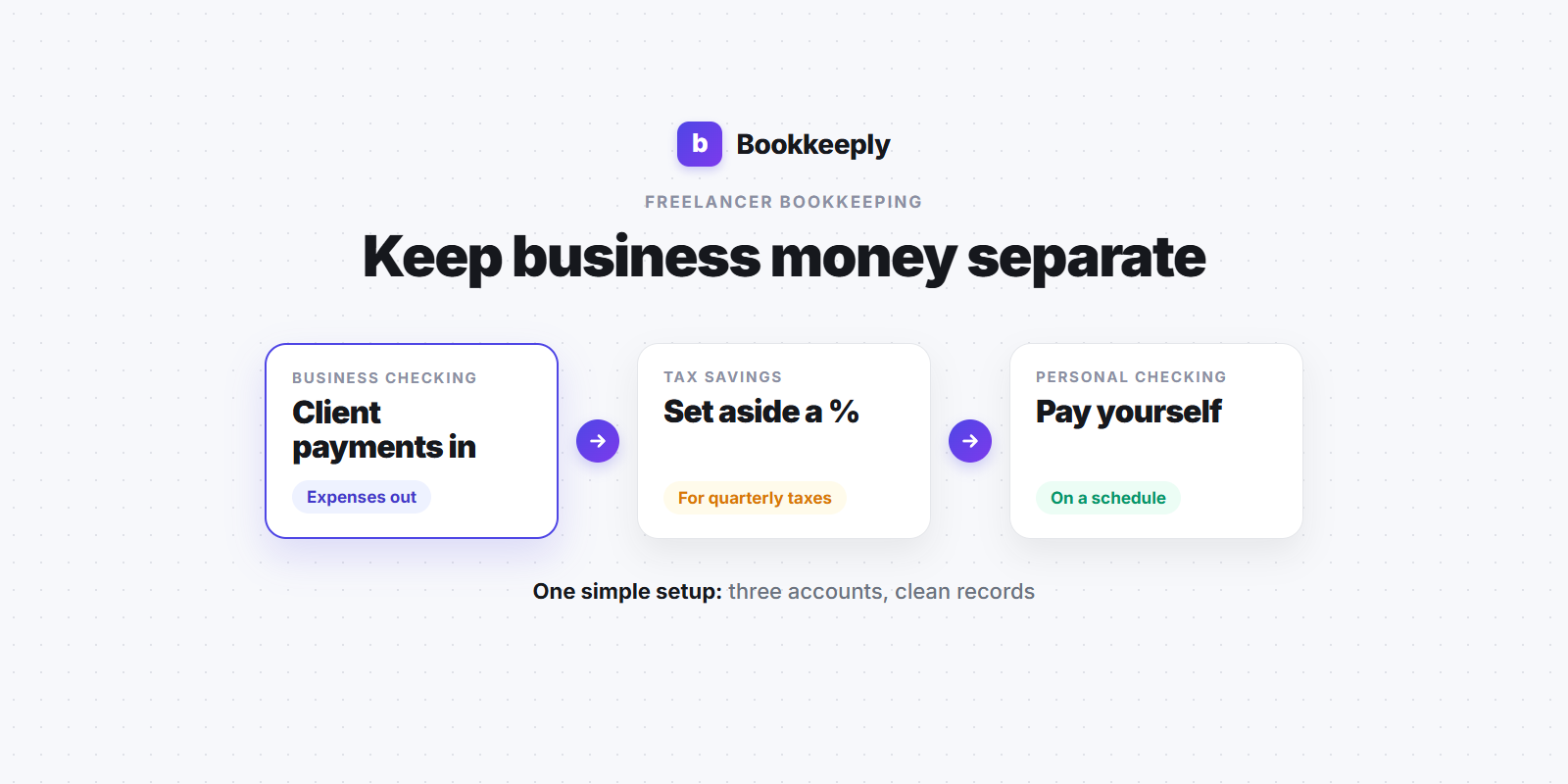
You don't need a complicated system. Most freelancers do well with three places for money:
- Business checking. Every client payment lands here. Every business expense is paid from here or from a card tied to it.
- Tax savings. A business savings account or sub-account where you move a percentage of each payment. This is the money for your quarterly estimated taxes, and you don't touch it for anything else.
- Personal checking. Your pay. You move money here on a regular schedule, like the 1st and 15th, instead of whenever you need it.
Example of the setup in action
Illustration only, with made-up numbers. Say a freelance designer receives $6,000 from clients in a month, and all of it lands in business checking. They set aside 25% for taxes, so $1,500 moves to the tax savings account. They pay $400 in software and contractor costs from business checking. That leaves $4,100, and they transfer $3,500 to personal checking as their pay, keeping $600 as a small buffer for slow months.
The 25% is just an example. The right percentage depends on your income, deductions, state and filing situation. Our guide on how much a freelancer should set aside for taxes walks through how to pick a starting number.
How to switch if your money is already mixed
- Open the business account and pick a start date, such as the first of next month.
- Update payment details on your invoices, payment platforms and client portals.
- Move subscriptions (software, hosting, phone plan share) to the business card.
- Clean up the past. For transactions before the switch, go through your personal statements once and tag business income and expenses. Keep that list with your records.
- If you slip, document it. Paid a business expense personally by accident? Note it and reimburse yourself from the business account so the records stay clear.
If you track things on a cash basis (most freelancers do), your account history lines up closely with your books. See cash vs accrual accounting if you're not sure which method you use.
FAQ
Is it illegal to use a personal account for freelance income?
Generally no, not for a sole proprietor. All the income still has to be reported on your return. The IRS recommends a separate business account in Publication 583, and having one makes your records much easier to keep.
Can I just open a second personal account and use it for business?
Many sole proprietors do this, and it gets you most of the bookkeeping benefits. Some banks don't allow business activity in personal accounts, so check the account terms. If you have an LLC, an account in the LLC's name is the cleaner choice.
Do I need an EIN to open a business bank account?
For an LLC or corporation, banks usually ask for one. Sole proprietors can often use their Social Security number instead, but each bank sets its own requirements.
Does a business bank account change my taxes?
No. Opening an account doesn't change how you're taxed. It just makes it easier to report your income correctly and claim the deductions you're entitled to.
Disclaimer: This article is for general education and isn't tax, legal or financial advice. Bank requirements and rules can change and depend on your situation. For decisions about your own business, check the sources linked above or talk to a qualified professional.
Want your business income and expenses sorted automatically once your accounts are separate? You can try Bookkeeply for free, or browse more guides on the Bookkeeply blog.
Stop guessing what you'll owe.
Track your bookkeeping and see your real tax estimate in minutes a day, free, no credit card required.
Get Started Free