You formed a single-member LLC, got the certificate from your state, and maybe opened a business bank account. Then the obvious question shows up: how does this thing actually get taxed? Does the LLC file its own return? Do you pay tax twice? Do you need to do anything special with the IRS?
For most freelancers, the answer is simpler than they expect. By default, the IRS ignores your single-member LLC for income tax purposes and taxes the profit on your personal return, the same way it taxes a sole proprietor. This guide explains what that means in practice, which forms are involved, where the exceptions are, and when it can make sense to choose a different tax treatment.
The default: a "disregarded entity"
An LLC is created under state law. The IRS doesn't have an "LLC" tax category of its own, so it sorts each LLC into an existing one. According to the IRS page on single-member LLCs, an LLC with one owner is treated as an entity disregarded as separate from its owner unless it files Form 8832 and elects to be treated as a corporation.
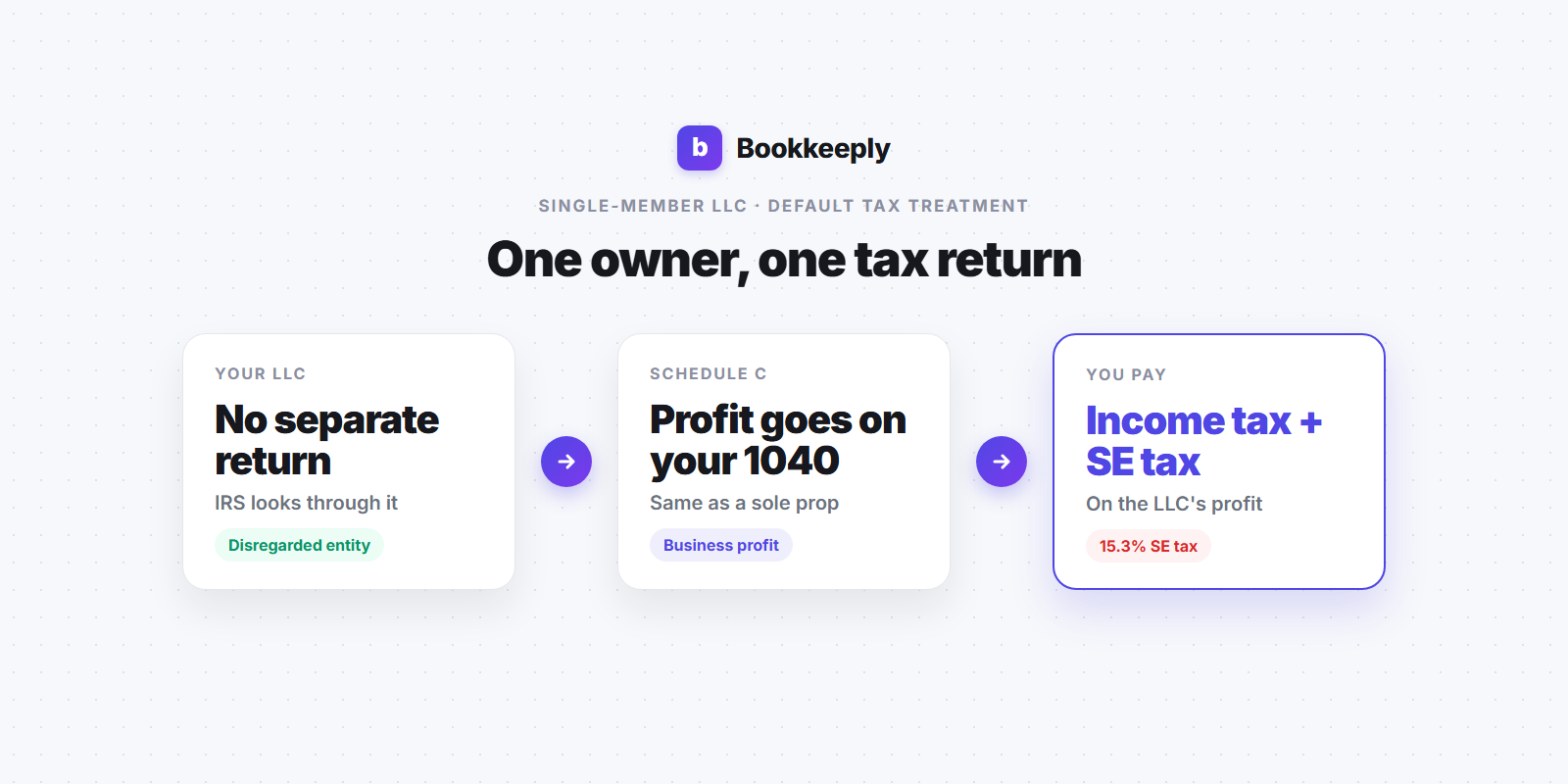
"Disregarded" sounds a little dramatic, but it just means that for federal income tax, the IRS looks straight through the LLC to you. The LLC's income and expenses are treated as yours. There's no separate federal income tax return for the LLC and no separate federal income tax bill at the LLC level.
The legal side is a different story. Your state still sees the LLC as its own legal entity, which is the main reason people form one. The tax treatment and the legal structure are two separate questions, and mixing them up causes most of the confusion around single-member LLC taxes.
Which forms a single-member LLC owner files
If you're an individual who owns the LLC, the IRS says the LLC's activity is reported on your own federal return. Which schedule depends on what the business does:
- Schedule C (Profit or Loss From Business) for most freelancers, consultants, designers, developers, and other service businesses.
- Schedule E for certain rental real estate activity.
- Schedule F for farming.
For a typical freelancer, the flow looks like this. Your LLC's income and expenses go on Schedule C, the net profit from Schedule C flows onto your Form 1040, and that same profit is used to figure your self-employment tax on Schedule SE. If you've filed as a sole proprietor before, nothing about this will feel new. The only visible difference is often the business name on Schedule C.
The two federal taxes on your LLC profit
Because the LLC is disregarded, you pay two kinds of federal tax on its profit, both on your personal return.
1. Income tax
The LLC's net profit is added to any other income you have (a spouse's wages, interest, a part-time W-2 job) and taxed at your regular income tax rates. There's no special "LLC rate."
One related break worth knowing about is the qualified business income (QBI) deduction under Section 199A, which lets many owners of pass-through businesses deduct up to 20% of qualified business income. It was originally set to expire after 2025, but the One Big Beautiful Bill Act, signed July 4, 2025, made it permanent. It has income limits and special rules for some service businesses, so check the IRS instructions for Form 8995 or ask a tax professional whether and how it applies to you.
2. Self-employment tax
The IRS says an individual owner of a single-member LLC is subject to tax on net earnings from self-employment "in the same manner as a sole proprietorship." Self-employment tax is how you pay Social Security and Medicare when there's no employer splitting the bill with you. The combined rate is 15.3% (12.4% Social Security plus 2.9% Medicare), applied to 92.35% of your net profit. The Social Security part stops at the annual wage base, which is $184,500 for 2026. We walk through the full calculation in how to calculate self-employment tax and our self-employment tax guide.
Example: a freelance designer with a single-member LLC
This is an illustration with made-up numbers, not a prediction of anyone's tax bill.
Say Maya runs a design studio as a single-member LLC with default tax treatment. In 2026 her LLC brings in $95,000 from clients and has $25,000 of deductible business expenses (software, a new laptop, a coworking membership, contractor help).
- Net profit on Schedule C: $95,000 minus $25,000 = $70,000.
- Self-employment tax base: $70,000 times 92.35% = $64,645.
- Self-employment tax: $64,645 times 15.3% = about $9,890.69. She's well under the $184,500 wage base, so the full 15.3% applies.
- Deductible half: she can deduct half of that, about $4,945.34, as an adjustment to income on her Form 1040.
- Income tax: the $70,000 profit (less the deductible half of SE tax, her standard deduction, and any QBI deduction she qualifies for) is taxed at her regular income tax rates along with any other income she has.
Notice what's missing: there's no separate LLC tax return and no LLC-level federal income tax. Also notice that it doesn't matter how much money Maya moved from the business account to her personal account. She's taxed on the $70,000 profit either way, which is why how you pay yourself from an LLC doesn't change the tax bill under default treatment.
Where the LLC is NOT disregarded
"Disregarded" applies to federal income tax. There are a few places where the LLC still counts as its own entity.
Employment and excise taxes
The IRS treats a single-member LLC as a separate entity for employment taxes and certain excise taxes. If your LLC hires employees, the IRS says it must use its own name and employer identification number (EIN) to report and pay employment taxes, not your Social Security number.
Do you need an EIN?
Not always. Per the IRS, a single-member LLC that is a disregarded entity with no employees and no excise tax liability doesn't need an EIN for federal tax purposes. In practice, many owners get one anyway (it's free from the IRS) because banks often ask for one, and it lets you give clients an EIN on a Form W-9 instead of your Social Security number. Paying contractors or setting up payroll later is also easier with one.
State taxes and fees
States make their own rules, and some charge LLCs an annual tax or fee even when the IRS ignores the LLC. California is the best-known example: according to the California Franchise Tax Board, LLCs doing business in the state or registered there generally owe an $800 annual LLC tax and file Form 568, including single-member LLCs. Other states have annual report fees instead. Check your state's tax agency and Secretary of State website so you budget for it.
Choosing a different tax treatment
The default isn't your only option. A single-member LLC can elect to be taxed as a corporation.
- C corporation: file Form 8832 (Entity Classification Election). The LLC then files its own corporate return and pays corporate income tax, and money you take out as dividends can be taxed again on your personal return. This is uncommon for solo freelancers.
- S corporation: file Form 2553. The IRS instructions for Form 2553 say an eligible entity that makes a valid S election is treated as a corporation from the election's effective date and doesn't need to file Form 8832 too. The election is generally due no more than 2 months and 15 days after the start of the tax year it should take effect, or any time during the year before.
With an S-corp election, you become an employee of your own company, pay yourself a reasonable salary through payroll, and can take the remaining profit as distributions that aren't subject to self-employment tax. That can save money once profit is high enough, but it adds payroll, a separate business return, and more bookkeeping. We break down when the math works in sole prop or S-corp.
A simple checklist for single-member LLC owners
- Keep a separate business bank account so your Schedule C numbers come from clean records.
- Track income and expenses through the year, not just in April. See our self-employed deductions checklist for what to capture.
- Set money aside for both income tax and self-employment tax. Our post on how much to set aside for taxes gives a starting point.
- Make quarterly estimated tax payments, because nobody is withholding tax from your LLC's income.
- Look up your state's annual LLC tax, fee, or report deadline.
- Revisit the S-corp question once a year as your profit grows.
FAQ
Does a single-member LLC file its own federal tax return?
Not under default treatment. Its income and expenses go on the owner's Form 1040, usually on Schedule C. It only files a separate federal income tax return if it elects to be taxed as a corporation.
Is a single-member LLC taxed differently than a sole proprietorship?
For federal income tax under the default rules, no. The IRS treats it the same way, including self-employment tax. The differences are legal (liability protection) and sometimes state-level (annual fees or taxes).
Do I pay self-employment tax on money I leave in the LLC?
Yes. You're taxed on the LLC's net profit for the year, whether you withdraw it or leave it in the business account.
Can my LLC be taxed as an S-corp?
Yes, if it's eligible and files Form 2553 on time. Whether it saves you money depends on your profit, a reasonable salary for your work, and the added costs of payroll and a separate return.
This article is for educational purposes only and isn't tax, legal, or financial advice. Bookkeeply is not a CPA firm. Tax rules and state fees change, so check IRS.gov and your state's tax agency, or talk to a tax professional about your situation.
If you'd like your LLC's profit and tax estimate kept up to date as you go, you can try Bookkeeply for free.
Stop guessing what you'll owe.
Track your bookkeeping and see your real tax estimate in minutes a day, free, no credit card required.
Get Started Free