Every January, freelancers start getting a small IRS form in their inbox or mailbox: Form 1099-NEC. If you've never received one, it can look like a bill or a warning. It's neither. It's a record of what a client paid you, and the IRS gets a copy too.
This guide explains what Form 1099-NEC is, who has to send one, what changed for 2026 payments, and what to do when the forms you receive don't match your own records. It also covers the other side: when you, as a freelancer, might have to send 1099-NECs to people you hire.
If you're still sorting out how contractor income differs from a paycheck, start with 1099 vs W-2: what changes for your taxes.
What is Form 1099-NEC?
Form 1099-NEC is an information return. "NEC" stands for nonemployee compensation, and the IRS describes the form simply: use it "to report nonemployee compensation." In practice, that means fees, commissions and other payments a business makes to someone who isn't its employee, in exchange for services.
The business that paid you (the payer) fills it out. You get one copy, and the IRS gets another. The form shows the payer's details, your name and taxpayer identification number (your SSN or EIN), and the total nonemployee compensation they paid you during the calendar year.
The key point: a 1099-NEC doesn't create a tax. It reports income you already earned. You owe tax on that income whether or not a form ever shows up.
The 2026 change: the threshold is now $2,000
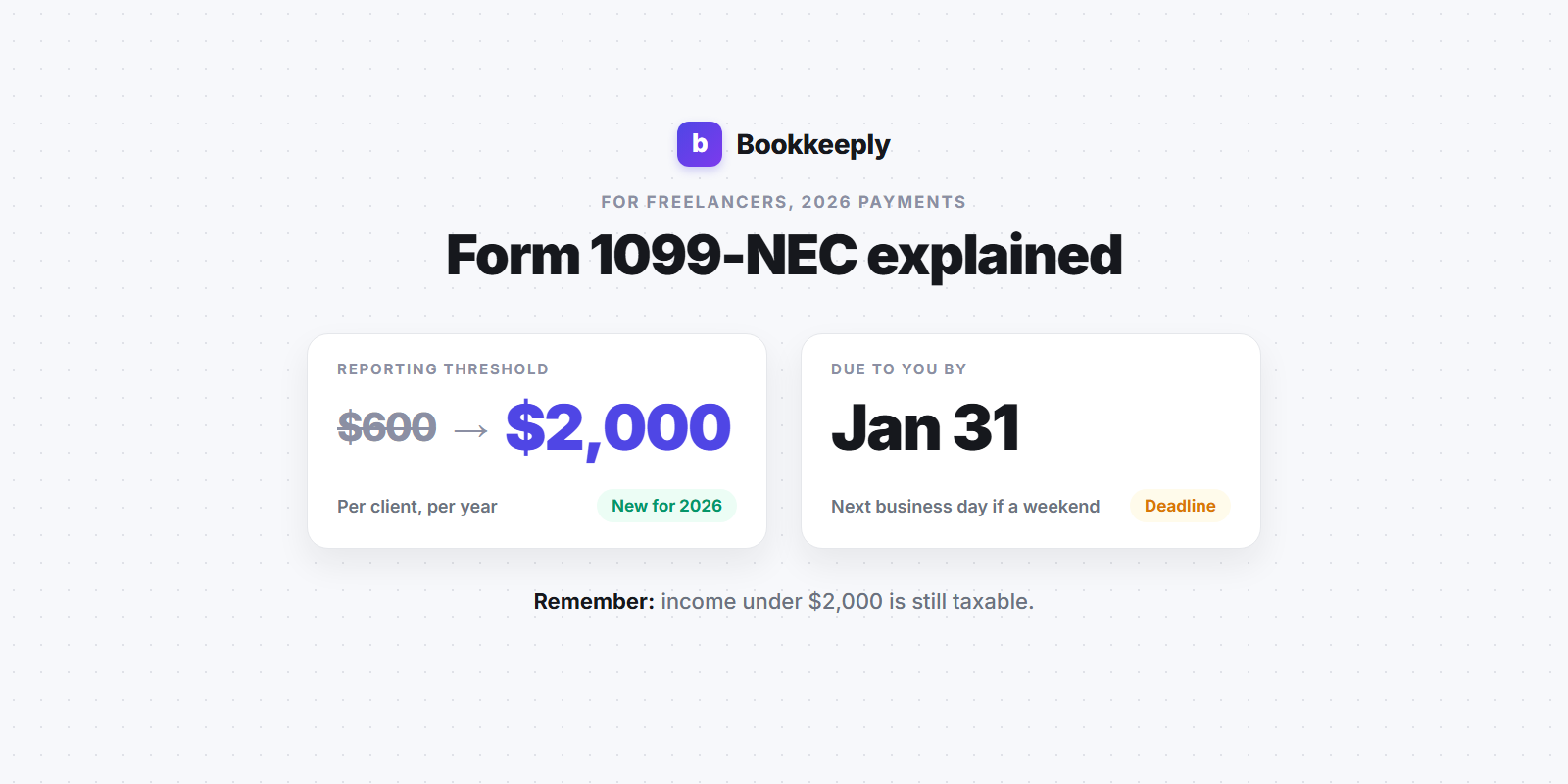
For years, a business had to file a 1099-NEC once it paid a contractor $600 or more in a year. That changed with the 2025 tax law. According to the IRS instructions for Forms 1099-MISC and 1099-NEC (December 2026 revision), for tax years beginning after 2025 the minimum reporting threshold increased to $2,000, and it may be adjusted for inflation starting in 2027.
What that means for timing:
- Forms you received in early 2026 covered payments made in 2025, so the old $600 threshold applied.
- Forms you'll receive in early 2027 cover payments made in 2026, so the $2,000 threshold applies.
Expect fewer forms next January, especially from clients who hired you for one small project. That doesn't change anything about what you owe. The IRS still expects you to report all of your business income, including payments below the threshold.
Who sends a 1099-NEC (and who doesn't get one)
Generally, a business files a 1099-NEC for each person it paid at least $2,000 for services during the year, when that person isn't an employee. A few common situations where you usually won't get one:
- Personal clients. The form is for payments made in the course of a trade or business. Someone who hires you for a personal project (say, a family portrait) generally doesn't file one.
- You operate as a corporation. The IRS instructions say payments to a corporation, including an LLC treated as a C or S corporation, are generally not reportable. (Attorneys' fees are an exception.) A single-member LLC taxed as a sole proprietorship is not a corporation for this purpose. See how your single-member LLC is taxed.
- The client paid by card or through a payment app. The IRS instructions say payments made by credit or debit card or through a third-party network are reported on Form 1099-K, not on 1099-NEC. Whether a 1099-K is issued depends on that form's own thresholds, which our Form 1099-K guide explains.
Key dates for Form 1099-NEC
The IRS instructions say payers must furnish the recipient's copy and file with the IRS by January 31. Unlike many other information returns, there is no later IRS filing date for 1099-NEC.
When January 31 lands on a weekend, the IRS General Instructions for Certain Information Returns move the due date to the next business day. January 31, 2027 is a Sunday, so forms for 2026 payments are due by Monday, February 1, 2027.
If a client's form hasn't arrived by mid-February, a polite email is usually enough. Either way, you don't need the form to file your return. Your own records are what count.
How freelancers use a 1099-NEC at tax time
You don't attach a 1099-NEC to your return. Instead, you report your business income on Schedule C, subtract your business expenses, and pay self-employment tax on the profit through Schedule SE.
The 1099s are a cross-check. The IRS matches the forms it receives against your return, so the income on your Schedule C should be at least the total of your 1099-NEC forms. It will often be higher, because not every payment gets a form.
Example: three clients, one form
Illustration only, with made-up numbers. Say a freelance designer had three business clients in 2026:
- Client A paid $12,000 by bank transfer. That's over $2,000, so Client A should send a 1099-NEC showing $12,000.
- Client B paid $1,500 by check. That's under $2,000, so no 1099-NEC is required.
- Client C paid $5,000 by credit card through an invoicing tool. Card payments belong on a 1099-K, not a 1099-NEC, and a 1099-K only comes if that form's thresholds are met.
The designer receives one 1099-NEC for $12,000, but their gross business income is $12,000 + $1,500 + $5,000 = $18,500. That $18,500 is what goes on Schedule C, before expenses. Reporting only the $12,000 shown on paper would understate income by $6,500.
This is why a simple system for tracking freelance income and expenses matters more than waiting for forms. When you record each payment as it arrives, January becomes a quick check instead of a scramble.
What to do if a 1099-NEC is wrong
Mistakes happen. A client might type the wrong amount, include a payment you received the following January, or issue a 1099-NEC for money that was actually paid by card. Here's a sensible order of operations:
- Compare it with your records. Match the form to your invoices and bank deposits for that client for the calendar year.
- Ask the client for a corrected form. Explain the difference and share your numbers. Payers can file a corrected 1099-NEC with the IRS.
- Keep your documentation. Save the email thread, invoices and deposit records in case the IRS asks later.
- Watch for double counting. If the same payment shows up on both a 1099-NEC and a 1099-K, count it once on Schedule C, and keep records showing why.
If a corrected form doesn't arrive before you file, report the income you actually received and keep your records. A tax professional can help if the gap is large.
The W-9 comes first
Most clients ask for a Form W-9 before they pay you. That's how they get your legal name and taxpayer identification number for the 1099-NEC. Many freelancers use an EIN on their W-9 instead of their Social Security number, which keeps the SSN off a stack of client paperwork. An EIN is free from the IRS.
Don't ignore the request. According to the IRS, if you fail to give a payer a correct taxpayer identification number, the payer may have to apply backup withholding at the current rate of 24% on future payments. That's money held back from your invoices until you sort it out at tax time.
When freelancers have to send 1099-NECs
If you hire other contractors for your business, such as a subcontractor, a virtual assistant or a developer, the same rules apply to you as the payer. For 2026 payments, that generally means:
- Collect a W-9 from each contractor before you pay them.
- Track what you pay each one during the year, and note how you paid (card and payment-app payments go on 1099-K instead).
- File a 1099-NEC for each one you paid $2,000 or more for services, and send their copy by the January 31 deadline (February 1, 2027 for 2026 payments).
Payments to corporations generally don't need a form, and payments for personal (non-business) work don't either.
FAQ
Do I have to report income if I didn't get a 1099-NEC?
Yes. A 1099-NEC is only a report of what a client paid. Your business income is taxable whether or not you receive one, including payments under the $2,000 threshold.
Is 1099-NEC income taxed differently from other freelance income?
No. It all goes on Schedule C as business income. After expenses, the profit is subject to income tax and self-employment tax. To plan ahead, see how much a freelancer should set aside for taxes.
What's the difference between 1099-NEC and 1099-MISC?
1099-NEC is for payments for services by non-employees. 1099-MISC covers other kinds of payments, such as rents and royalties. Most freelancers who bill for their work will see 1099-NEC.
Can I deduct expenses against 1099-NEC income?
Yes. The form shows gross payments, but you're taxed on profit. Ordinary and necessary business expenses reduce that profit. Our self-employed tax deductions checklist covers the common ones.
Do 1099-NEC payments include tax withholding?
Usually not. Clients normally don't withhold tax from contractor payments (backup withholding is the exception). That's why freelancers often make quarterly estimated tax payments.
Want more guides like this? Browse the Bookkeeply blog.
This article is for educational purposes only and is not tax, legal or financial advice. Bookkeeply is not a CPA firm. Tax rules change and your situation may differ, so check IRS guidance or talk to a qualified tax professional before making decisions.
If you'd like your income organized before the forms arrive, you can try Bookkeeply for free.
Stop guessing what you'll owe.
Track your bookkeeping and see your real tax estimate in minutes a day, free, no credit card required.
Get Started Free