When you work for an employer, health insurance usually comes out of your paycheck before tax and you never think about it again. When you work for yourself, you pay the full premium out of pocket. The good news is that the tax code has a deduction built for exactly this situation: the self-employed health insurance deduction.
It can be one of the more valuable write-offs a freelancer has, but it comes with a few rules that trip people up. This guide covers who qualifies, what premiums count, the month-by-month employer plan rule, the profit limit, where the deduction goes on your return, and a worked example with real numbers.
What the self-employed health insurance deduction is
The self-employed health insurance deduction lets eligible self-employed people deduct premiums they pay for medical, dental, and vision coverage (plus qualified long-term care insurance, within limits) for themselves, their spouse, and their dependents. The IRS calculates it on Form 7206, and the result goes on Schedule 1 (Form 1040), line 17.
Two details make it different from most business deductions:
- It's an "above the line" adjustment, not a Schedule C expense. You don't list health insurance on Schedule C. It reduces your adjusted gross income on Schedule 1 instead, so you get it whether or not you itemize.
- It doesn't reduce self-employment tax. The Form 7206 instructions say you can't subtract this deduction when figuring net earnings for self-employment tax. It lowers your income tax, but your self-employment tax is still figured on your full net profit.
Who qualifies
According to the IRS instructions for Form 7206, you may be able to take the deduction if one of these applies to you:
- You were self-employed and had a net profit for the year on Schedule C or Schedule F.
- You were a partner with net earnings from self-employment reported on Schedule K-1.
- You used one of the optional methods to figure net earnings on Schedule SE.
- You received wages from an S corporation in which you were a more-than-2% shareholder.
The key word for most freelancers is profit. If your business had a loss for the year, you can't take this deduction for that business, because the deduction can't be larger than the income it's tied to (more on that limit below).
The plan has to be "established under" your business
Form 7206 asks for premiums paid for coverage established under your business. For sole proprietors and single-member LLC owners filing Schedule C, the instructions say the policy can be in the name of the business or in your own name. So a plan you bought yourself on the Marketplace or directly from an insurer can count. If you run more than one business, the form says to use a separate Form 7206 for each business under which a plan is established.
The month-by-month employer plan rule
This is the rule that catches people. You can't count premiums for any month you were eligible to participate in a health plan subsidized by:
- your own employer (for example, if you also have a part-time W-2 job with benefits),
- your spouse's employer, or
- the employer of your dependent or of your child who was under age 27 at the end of the year.
It doesn't matter whether you actually enrolled. If your spouse's job offered a subsidized family plan and you could have joined it, those months are out. The test is applied month by month, so a change in the middle of the year (a spouse leaving a job, or you quitting a W-2 role to freelance full time) can make some months count and others not.
Which premiums count
Per the Form 7206 instructions, qualifying coverage includes:
- Medical, dental, and vision insurance for you, your spouse, and your dependents.
- Coverage for your child who was under age 27 at the end of the year, even if the child wasn't your dependent.
- Medicare premiums you voluntarily pay to get coverage in your name that is similar to qualifying private health insurance.
- Qualified long-term care insurance, but only up to an age-based cap per person.
For the 2025 tax year, the long-term care caps printed on Form 7206 are $480 (age 40 or younger), $900 (41 to 50), $1,800 (51 to 60), $4,810 (61 to 70), and $6,020 (71 or older). These amounts are adjusted each year, so check the current form when you file.
If you bought coverage through the Marketplace and received advance payments of the premium tax credit, the two calculations affect each other. The IRS points people in that situation to Publication 974, and tax software or a tax professional can help here.
The profit limit
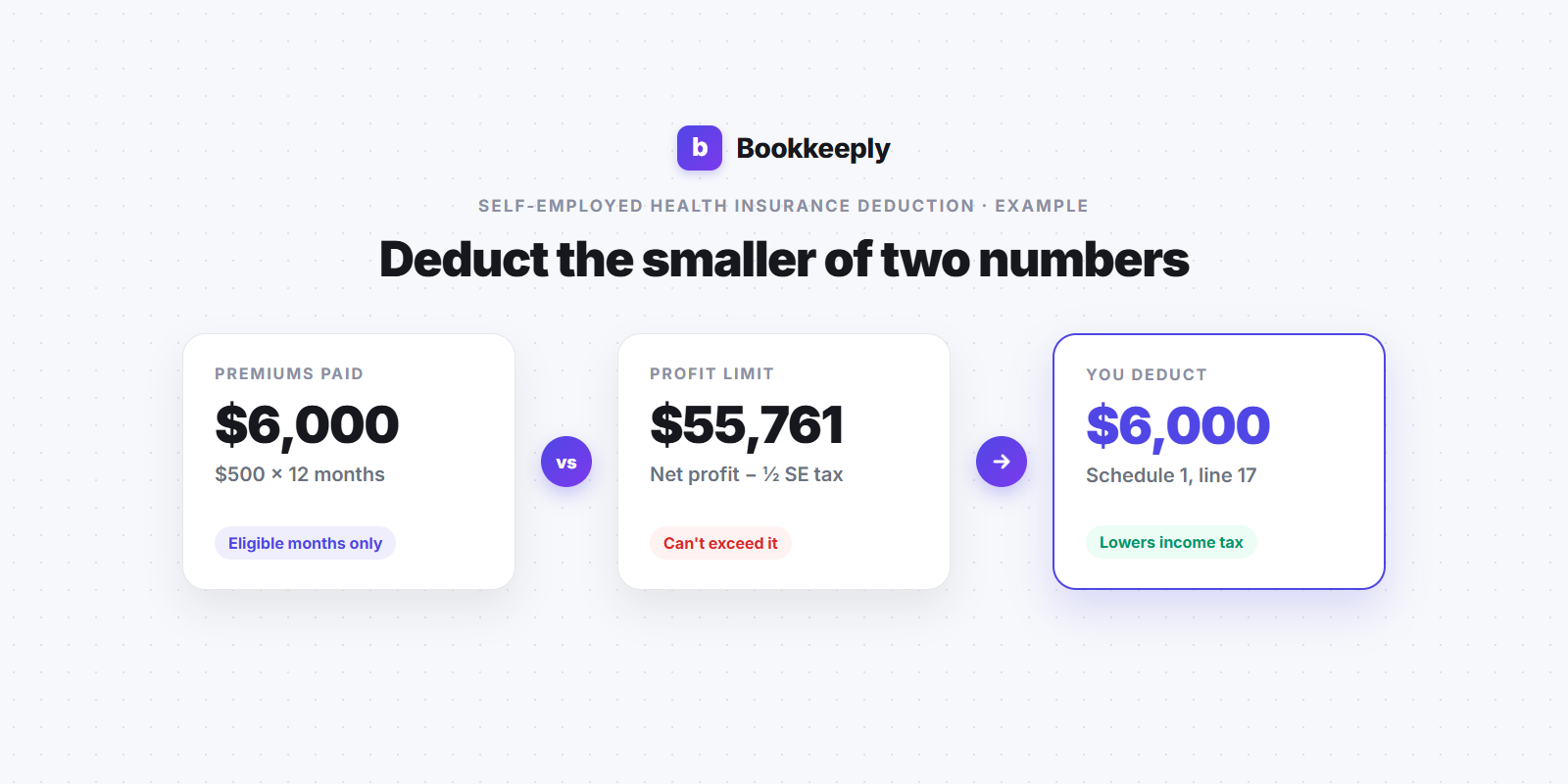
Your deduction is the smaller of two numbers: the premiums you paid for eligible months, or the earned income from the business the plan is established under. Form 7206 figures that income limit roughly like this for a Schedule C filer with one business:
- Start with the net profit from the business.
- Subtract the deductible half of your self-employment tax (Schedule 1, line 15) that belongs to that business.
- Subtract any SEP, SIMPLE, or qualified plan contributions for that business (Schedule 1, line 16).
For most full-time freelancers with a healthy profit, the cap is far above their premiums, so the whole premium is deductible. The limit matters most for people with a small side business or a low-profit year. It's also worth knowing if you make large SEP IRA or Solo 401(k) contributions, since those reduce the cap.
Worked example: a full-time freelancer
Illustration only. Numbers are simplified and assume one business, no retirement contributions, no long-term care insurance, and no premium tax credit.
Maya is a freelance designer filing Schedule C. Her net profit for the year is $60,000. She pays $500 a month for an individual health plan, $6,000 for the year, and she has no access to an employer plan through a job or a spouse.
- Self-employment tax: $60,000 × 92.35% = $55,410. Then $55,410 × 15.3% = $8,477.73. (Our self-employment tax walkthrough explains each step.)
- Deductible half of SE tax: $8,477.73 ÷ 2 = $4,238.87.
- Profit limit: $60,000 − $4,238.87 = $55,761.13.
- Deduction: the smaller of $6,000 (premiums) and $55,761.13 (limit) = $6,000.
Maya's adjusted gross income drops by $6,000. What that saves her depends on her tax bracket. As a rough illustration, $6,000 taxed at a 12% marginal rate is $720 of federal income tax, and at 22% it's $1,320. Her self-employment tax stays at $8,477.73, because this deduction doesn't touch it.
Two more examples where the rules bite
A small side business
Illustration only. Jordan has a side business with $3,000 of net profit and pays $4,800 a year for health coverage, with no employer plan available. Self-employment tax is $3,000 × 92.35% × 15.3% = $423.89, so the deductible half is about $211.94. The limit is $3,000 − $211.94 = $2,788.06. Jordan can deduct $2,788.06 on Schedule 1, not the full $4,800. The IRS instructions say premiums that aren't deductible on Schedule 1, line 17 can be included as medical expenses on Schedule A if you itemize, where the usual medical expense rules apply.
A spouse with employer coverage for part of the year
Illustration only. Sam freelances full time and pays $500 a month for an individual plan. Sam's spouse had a job offering a subsidized family plan from January through March, then left that job. Because Sam was eligible for a subsidized plan in those three months, only April through December count: 9 × $500 = $4,500, assuming Sam's profit limit is higher than that.
How to claim it
- Keep your premium records. Save the insurer's statements and any Form 1095 you receive, and track which months you paid.
- Note any months you were eligible for an employer plan, including through a spouse.
- Finish Schedule C and Schedule SE first, since the limit uses your net profit and the deductible half of SE tax.
- Complete Form 7206 (or the worksheet in the Form 1040 instructions where the IRS allows it). The instructions say to use Form 7206 if, among other things, you have more than one source of income subject to self-employment tax, you file Form 2555, or you're including long-term care premiums.
- Enter the result on Schedule 1, line 17, and don't count the same premiums again as a medical expense on Schedule A.
Since the deduction lowers your income tax for the year, factor it into your quarterly estimated payments too. Leaving it out can mean you set aside more than you need.
Common mistakes to avoid
- Putting your own health insurance on Schedule C. For a sole proprietor's own coverage, it belongs on Schedule 1, not as a business expense.
- Ignoring a spouse's employer plan. Eligibility, not enrollment, is what counts.
- Claiming it in a loss year. No profit from the business means no deduction tied to that business.
- Expecting it to cut self-employment tax. It only reduces income tax.
- Double-dipping. Premiums deducted on Schedule 1 can't also go on Schedule A.
If you're building out your full list of write-offs, our self-employed tax deductions checklist covers the rest, and the guide to single-member LLC taxes explains why LLC owners under default treatment follow the same rules as sole proprietors here.
FAQ
Can I deduct health insurance as a 1099 contractor?
Yes, if you have a net profit from your self-employment and you weren't eligible for a subsidized employer plan (yours, your spouse's, or your dependent's) during the months you're counting. The deduction is limited to your business's earned income.
Does the self-employed health insurance deduction reduce self-employment tax?
No. The IRS instructions say you can't subtract it when figuring net earnings for self-employment tax. It reduces income tax only.
Can I deduct my spouse's and kids' premiums?
Yes. Premiums for your spouse, your dependents, and your child under age 27 at year end can count, as long as the employer plan rule doesn't exclude those months.
What if my premiums are more than my profit?
The deduction is capped at the limit figured on Form 7206. Premiums above it may be included as medical expenses on Schedule A if you itemize.
Do S corporation owners get this deduction?
More-than-2% shareholders can, but the premiums must be reported as wages on their Form W-2 from the S corporation, and the limit is based on those wages. If you're weighing an S-corp election, see sole prop vs S-corp.
This article is for educational purposes only and isn't tax, legal, or financial advice. Bookkeeply is not a CPA firm. Figures come from the 2025 Form 7206 and its instructions on IRS.gov and can change each year, so check the current IRS guidance or talk to a tax professional about your situation.
If you'd like your profit and tax estimate kept current as you go, you can try Bookkeeply for free.
Stop guessing what you'll owe.
Track your bookkeeping and see your real tax estimate in minutes a day, free, no credit card required.
Get Started Free