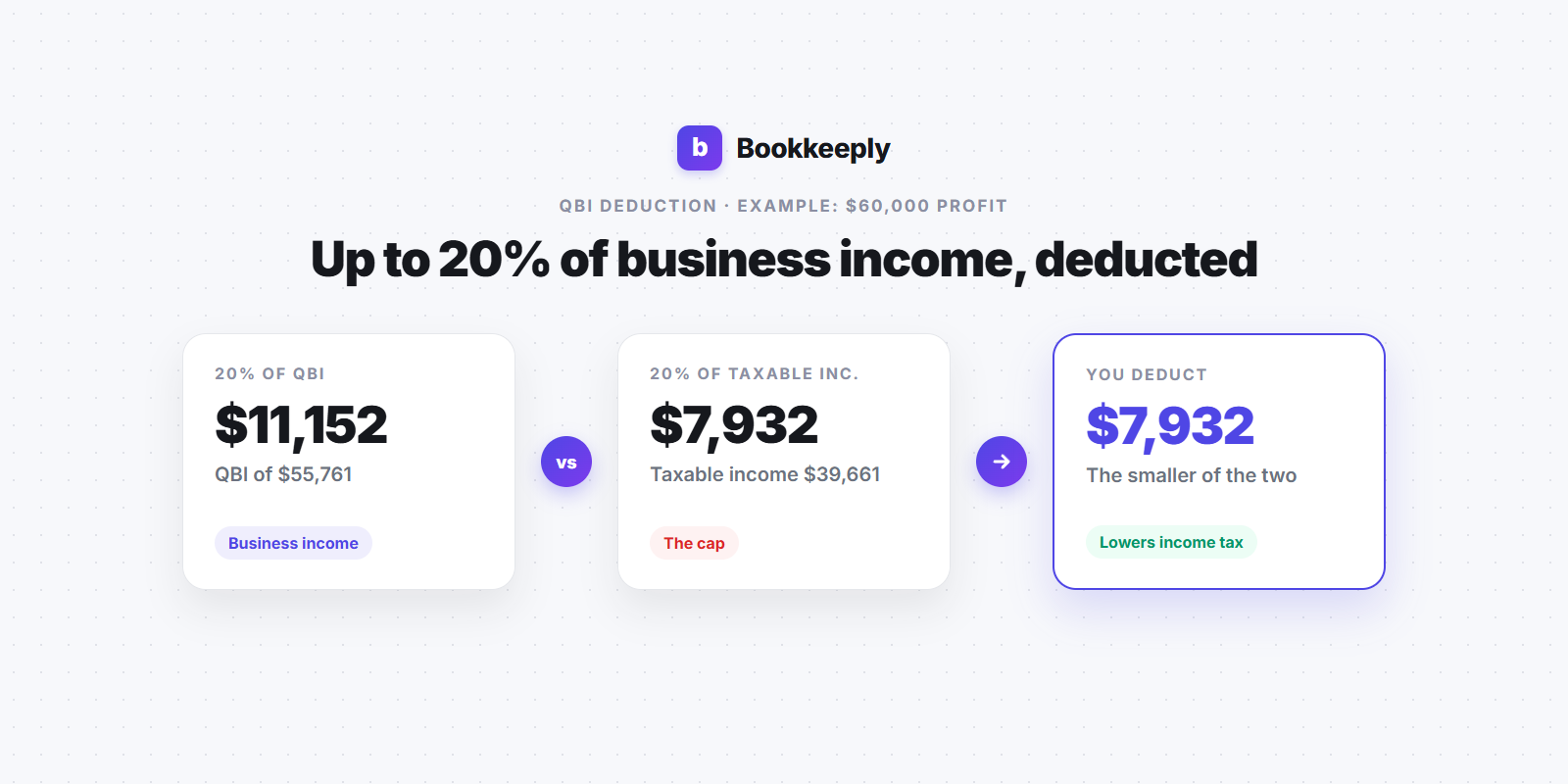
Most tax breaks for freelancers come from spending money: software, a home office, health insurance. The qualified business income deduction is different. You don't have to buy anything to get it. If you run a profitable sole proprietorship or single-member LLC, the tax code may let you deduct up to 20% of that profit from your taxable income, simply because it's business income.
It's often called the QBI deduction or the Section 199A deduction, and plenty of freelancers get it without ever knowing it was there, because tax software fills it in. This guide explains how the QBI deduction works for freelancers, which numbers feed into it, the limits that can shrink it, and two worked examples so you can see the math.
What the QBI deduction is
According to the IRS, many owners of sole proprietorships, partnerships, S corporations, and some trusts and estates can deduct up to 20% of their qualified business income (QBI), plus 20% of certain REIT dividends and publicly traded partnership income. Employees and C corporation owners don't qualify.
For a typical freelancer, "qualified business income" is roughly your Schedule C net profit, minus a few business-related deductions you take elsewhere on your return (more on that below). It does not include W-2 wages from a job, capital gains, dividends, or interest that isn't part of the business.
Three features make it unusual:
- You get it whether or not you itemize. It's taken after your standard or itemized deductions, as its own line on Form 1040.
- It doesn't lower your adjusted gross income. It reduces taxable income only.
- It doesn't reduce self-employment tax. Your self-employment tax is still figured on your full net earnings. The QBI deduction lowers income tax only.
The deduction was created by the 2017 tax law and was originally set to expire after 2025. The One Big Beautiful Bill Act (signed July 2025) made it permanent, and Rev. Proc. 2025-32 notes the changes it made starting with the 2026 tax year, which we cover below.
How the QBI deduction is calculated
For most freelancers below the income threshold, the deduction is the smaller of two numbers:
- 20% of your qualified business income, and
- 20% of your taxable income before the QBI deduction, minus any net capital gain.
That second limit matters more than people expect. If most of your income is business income, your standard deduction pulls taxable income below QBI, so the taxable income limit usually ends up being the one that applies.
What reduces your QBI
Your QBI isn't just the bottom line of Schedule C. The Form 8995 instructions say QBI is reduced by deductions attributable to the business that you take elsewhere, including:
- The deductible half of self-employment tax (see Schedule SE explained)
- The self-employed health insurance deduction
- Contributions to self-employed retirement plans, such as a SEP IRA or Solo 401(k)
So if you fund a retirement account or pay your own health premiums, your QBI is a bit lower than your net profit. Those deductions are usually still well worth taking. They simply trim the base the 20% is applied to.
Example 1: a full-time freelancer
Illustration only, using 2026 figures and simplified assumptions. Maya is a single freelance designer with $60,000 of Schedule C net profit and no other income, retirement contributions, or health insurance deduction. She takes the 2026 standard deduction for single filers, which Rev. Proc. 2025-32 sets at $16,100.
- Self-employment tax: $60,000 × 92.35% × 15.3% = $8,477.73 (the same example as our self-employment tax calculation guide)
- Deductible half of SE tax: $4,238.87
- QBI: $60,000 − $4,238.87 = $55,761.13
- AGI: $55,761.13 (no other income or adjustments)
- Taxable income before QBI: $55,761.13 − $16,100 = $39,661.13
Now compare the two numbers:
- 20% of QBI: $55,761.13 × 20% = $11,152.23
- 20% of taxable income: $39,661.13 × 20% = $7,932.23
Maya's QBI deduction is the smaller figure, $7,932.23, and her taxable income drops to $31,728.90. Notice that the taxable income limit, not the 20% of QBI, decided the result. That's typical when business income is all or most of what you earn.
Example 2: a side business on top of a W-2 job
Illustration only, same simplified assumptions. Jordan is single, earns $70,000 in W-2 wages, and has $20,000 of net profit from freelance writing on the side.
- Self-employment tax on the side business: $20,000 × 92.35% × 15.3% = $2,825.91, so the deductible half is $1,412.96
- QBI: $20,000 − $1,412.96 = $18,587.04 (the W-2 wages don't count)
- AGI: $70,000 + $20,000 − $1,412.96 = $88,587.04
- Taxable income before QBI: $88,587.04 − $16,100 = $72,487.04
The comparison:
- 20% of QBI: $3,717.41
- 20% of taxable income: $14,497.41
Here the 20% of QBI is smaller, so Jordan's deduction is $3,717.41. Wage income raises taxable income without adding to QBI, so for side hustlers the 20%-of-QBI number is usually the one that binds.
The income threshold and service businesses
The simple "smaller of two numbers" math applies when your taxable income before the QBI deduction is at or below the annual threshold. For 2026, Rev. Proc. 2025-32 lists these amounts:
- Single and most other filers: threshold $201,750, phase-in range ends at $276,750
- Married filing jointly: threshold $403,500, phase-in range ends at $553,500
- Married filing separately: threshold $201,775, phase-in range ends at $276,775
The phase-in range is $75,000 wide for single filers and $150,000 for joint filers in 2026, wider than the $50,000 and $100,000 ranges used before.
Above the threshold, two extra rules start to apply:
The W-2 wage and property limit
For higher earners, the deduction can be limited based on the W-2 wages your business pays and the original cost of certain business property it holds. A solo freelancer with no employees and little equipment can see the deduction shrink as income moves through the phase-in range.
Specified service trades or businesses (SSTBs)
The Form 8995 instructions list fields such as health, law, accounting, actuarial science, performing arts, consulting, athletics, financial services, and brokerage services as specified service trades or businesses. For an SSTB, the deduction phases out across the range and disappears entirely above the top of it.
The key point for most freelancers: if your taxable income is below the threshold, being an SSTB doesn't matter. A consultant earning $90,000 calculates the deduction the same way as a web developer earning $90,000.
The new $400 minimum deduction
Starting with tax years beginning after December 31, 2025, the One Big Beautiful Bill Act added a minimum QBI deduction of $400. Per Rev. Proc. 2025-32, you need at least $1,000 of qualified business income from active businesses to be eligible for it, and both amounts will be adjusted for inflation after 2026. This mainly helps people with small side businesses, where 20% of QBI would otherwise come out below $400.
How to claim it
Most freelancers claim the deduction on Form 8995, the simplified version. The 2025 instructions say to use Form 8995 if your taxable income before the QBI deduction is at or below the threshold for that year and you aren't a patron of an agricultural or horticultural cooperative. Everyone else uses Form 8995-A. The result goes on your Form 1040 (line 13a on the 2025 form).
If your business had a net loss, you don't get a QBI deduction for that year, and the loss carries forward to reduce QBI in later years.
Bookkeeping tips that protect the deduction
- Keep business and personal money separate. Clean records make your net profit, and therefore your QBI, easy to support.
- Track the "elsewhere" deductions. Retirement contributions and health premiums reduce QBI, so log them as you pay them.
- Don't count on QBI when setting aside money. It lowers income tax, not SE tax. When you work out how much to set aside for taxes or your quarterly estimated payments, remember SE tax applies to the full profit.
- Revisit it if your income jumps. If you're getting close to the threshold, or weighing an S-corp election, the QBI math changes and is worth reviewing with a professional.
FAQ
Do 1099 contractors get the QBI deduction?
Often, yes. If you report your freelance income on Schedule C as a sole proprietor or single-member LLC and have a net profit, you're generally in the group the deduction was designed for, subject to the limits above.
Is the QBI deduction the same as a business expense?
No. Business expenses reduce your Schedule C profit. The QBI deduction is figured after that, from the profit itself, and only reduces taxable income for income tax.
Does the QBI deduction reduce self-employment tax?
No. Self-employment tax is figured on Schedule SE before the QBI deduction comes into play.
Can I take the QBI deduction and the standard deduction?
Yes. You get the QBI deduction whether you take the standard deduction or itemize.
Do I need to do anything to get it?
Mostly you need accurate records. Tax software and preparers figure it from your return, but the numbers are only as good as your bookkeeping. Browse more guides on the Bookkeeply blog.
This article is for educational purposes only and isn't tax, legal, or financial advice. Bookkeeply is not a CPA firm. Figures come from IRS Rev. Proc. 2025-32, the 2025 Instructions for Form 8995, and IRS.gov, and they can change. Check current IRS guidance or talk to a tax professional about your situation.
If you'd like your profit and tax estimate kept up to date as you go, you can try Bookkeeply for free.
Stop guessing what you'll owe.
Track your bookkeeping and see your real tax estimate in minutes a day, free, no credit card required.
Get Started Free