You land a new client, agree on a rate, and before the first invoice is paid their accounts team sends a short request: "Please fill out a W-9." Form W-9 is a one-page form that tells a client who you are for tax reporting purposes, and filling it out correctly takes about five minutes.
This guide walks through what Form W-9 is, why clients ask for it, how to fill it out line by line as a freelancer, and how to send it without putting your personal information at risk.
What is a W-9 form?
Form W-9 is titled "Request for Taxpayer Identification Number and Certification." According to the IRS, you use it to give your correct taxpayer identification number (TIN) to a person or business that has to file an information return about payments made to you. The current version is dated March 2024 (Rev. March 2024), and the IRS publishes it at irs.gov/FormW9.
For a freelancer, the most common information return is Form 1099-NEC, which reports nonemployee compensation. Your client can't file a 1099-NEC for you without your name, address and TIN. The W-9 is how they collect that information.
It's not a tax return (you don't calculate or pay anything on it), and it doesn't go to the IRS. The form itself says to give it to the requester, not the IRS. If you want the bigger picture on contractor income, see 1099 vs W-2: what changes for your taxes.
Why clients ask freelancers for a W-9
Businesses that pay contractors need to know two things: whether they'll have to file a 1099 for you, and whether they need to hold back part of your payment. The W-9 answers both.
To file your 1099-NEC
Under the IRS instructions for Forms 1099-MISC and 1099-NEC, the reporting threshold for nonemployee compensation rose to $2,000 for tax years beginning after 2025. Many clients still request a W-9 from every contractor up front, even for small jobs, because they don't know in January how much they'll end up paying you by December.
To avoid backup withholding
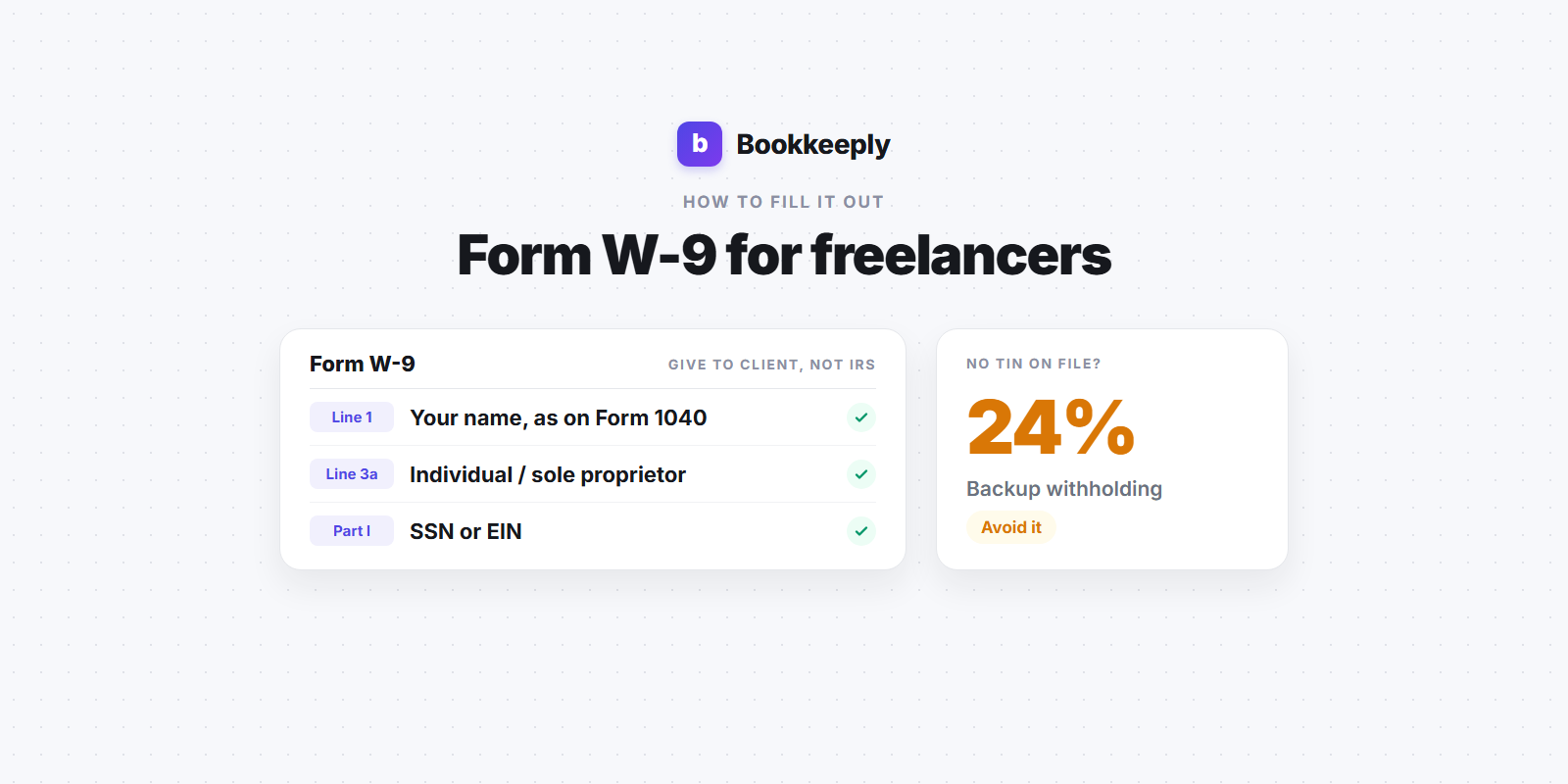
If a payee doesn't provide a TIN, the IRS instructions for requesters say the payer must generally withhold 24% of reportable payments and send it to the IRS. This is called backup withholding. It also applies in a few other cases, for example when the IRS notifies the payer that the TIN you gave is incorrect. For a freelancer, that means a missing or wrong W-9 can turn a $1,000 invoice into a $760 deposit (an illustration using the 24% rate). The withheld amount isn't lost, since it counts as tax paid when you file, but it's a cash flow hit you don't need.
How to fill out a W-9 as a freelancer
The form has a short top section (lines 1 through 7; line 7, account numbers, is optional), Part I for your TIN and Part II for your signature. Here's how each part usually works for a freelancer.
Line 1: Name
If you're a sole proprietor (the default for most freelancers who haven't formed an entity), enter your individual name exactly as it appears on your Form 1040. If you have a single-member LLC that is disregarded for tax purposes, the IRS says to put the owner's name (your name) on line 1, not the LLC's name.
Line 2: Business name
Enter your business, trade or "doing business as" (DBA) name if you have one. A single-member LLC that's disregarded goes here. If you just freelance under your own name, leave it blank.
Line 3a: Federal tax classification
Check one box only. Most freelancers check Individual/sole proprietor. Under the March 2024 instructions, a single-member LLC that is disregarded also checks the box for its owner's classification, which for an individual owner is usually Individual/sole proprietor. If your LLC has elected to be taxed as an S corporation or C corporation, or it's a multi-member LLC taxed as a partnership, you'd check the LLC box and enter S, C or P. Not sure how your LLC is taxed? Our guide to single-member LLC taxes explains the defaults.
Line 3b: Foreign partners
This box was added in the 2024 revision. It applies to partnerships, trusts and estates with foreign partners, owners or beneficiaries that are giving the form to a flow-through entity they own an interest in. A typical solo freelancer leaves it blank.
Line 4: Exemptions
The W-9 instructions state that individuals, including sole proprietors, are generally not exempt from backup withholding. So most freelancers leave the exempt payee code and the FATCA exemption code blank.
Lines 5 and 6: Address
Enter the mailing address where you want your 1099 sent. If you move, it's worth sending your clients an updated W-9 so January's forms don't go to an old address.
Part I: Your TIN (SSN or EIN)
This is the part people hesitate over. The W-9 instructions say a sole proprietor who has an EIN may enter either their Social Security number or their EIN. The table at the end of the form adds that the IRS encourages sole proprietors to use their SSN, while still allowing the EIN. For a disregarded single-member LLC, you enter the owner's SSN, or the owner's EIN if you have one. An LLC taxed as a corporation or partnership uses the entity's EIN.
Many freelancers get a free EIN from the IRS so they can put it on W-9s instead of their SSN. Whichever number you choose, make sure the name on line 1 matches it. A name and number that don't match IRS records is one of the most common reasons a client gets a notice and starts backup withholding.
Part II: Certification and signature
By signing, you certify under penalties of perjury that your TIN is correct, that you aren't subject to backup withholding, that you're a U.S. person, and that any FATCA code you entered is correct. If the IRS has told you that you're currently subject to backup withholding, the instructions say to cross out item 2 before signing.
Technically, the instructions say that for "other payments" (which include payments to a nonemployee for services) you must give your correct TIN but don't have to sign unless you've been told you previously gave an incorrect one. In practice, most clients ask for a signed and dated form anyway, and signing it is simple.
A quick example
Here's an illustration, not a real taxpayer. Maya is a freelance designer. She works under her own name, has no LLC, and got an EIN last year. A new agency client asks for a W-9.
- Line 1: Maya Lopez (her name as it appears on her Form 1040)
- Line 2: Blank (no DBA)
- Line 3a: Individual/sole proprietor
- Lines 3b and 4: Blank
- Lines 5 and 6: Her mailing address
- Part I: Her EIN (she could also use her SSN)
- Part II: Signed and dated
She sends it through the client's secure vendor portal and logs the client in her income records so she can match their 1099-NEC against her invoices in January.
How to send a W-9 safely
A completed W-9 contains your name, address and TIN, which is exactly what identity thieves want. The IRS itself warns on the form that it doesn't request detailed personal information through email. A few habits help:
- Verify the request. If a W-9 request comes from an address you don't recognize, confirm it with your contact at the client before sending anything.
- Prefer a secure upload. Many clients use vendor portals or e-signature tools. Use those over a plain email attachment when you can.
- Use an EIN if you have one. As noted above, the IRS allows sole proprietors to use either number.
Penalties and mistakes to avoid
The W-9 lists the penalties for payees directly. If you fail to give your correct TIN to a requester, you can face a $50 penalty for each failure, unless it's due to reasonable cause and not willful neglect. Making a false statement with no reasonable basis that results in no backup withholding carries a $500 civil penalty, and willfully falsifying the certification can bring criminal penalties.
The everyday mistakes are simpler:
- Putting your LLC's name on line 1 when it's a disregarded entity (it goes on line 2).
- Entering an EIN with a name that doesn't match the name the EIN was issued to.
- Forgetting to send a new W-9 after a name change or a new TIN. The instructions say you must furnish a new form if the name or TIN for the account changes.
What happens after you send it
Your client files the W-9 and uses it at year end. If they paid you enough to cross the reporting threshold, you'll get a 1099-NEC by early the following year. Whether or not a form arrives, all of your freelance income is taxable, and it goes on Schedule C. Since clients don't withhold tax from contractor payments in the normal case, this is also a good moment to make sure you're setting aside enough for taxes and planning your quarterly estimated payments.
FAQ
Do I have to fill out a W-9 to get paid?
Payment terms are up to you and your client, but if you don't provide a TIN, a payer generally has to apply 24% backup withholding to reportable payments. Filling out the form avoids that.
Should I use my SSN or EIN on a W-9?
If you're a sole proprietor with an EIN, the IRS lets you use either. It says it encourages the SSN, but many freelancers choose the EIN to limit how widely their SSN is shared. Just make sure the name on line 1 matches the number.
Do I send my W-9 to the IRS?
No. You give it to the client who asked for it. The IRS sees your information later, when the client files any required 1099.
Is a W-9 the same as a 1099?
No. The W-9 is what you give the client at the start. The 1099-NEC is what the client may send you (and the IRS) after the year ends.
Want more guides like this? Browse the Bookkeeply blog.
This article is for educational purposes only and is not tax, legal or financial advice. Bookkeeply is not a CPA firm. Sources: IRS Form W-9 (Rev. March 2024) and its instructions, and the IRS Instructions for the Requester of Form W-9. Tax rules change and your situation may differ, so check IRS guidance or talk to a qualified tax professional before making decisions.
If you'd like every client and payment in one tidy place before the 1099s arrive, you can try Bookkeeply for free.
Deja de adivinar cuánto deberás.
Lleva tu contabilidad y mira tu estimación real de impuestos en minutos al día, gratis, sin necesidad de tarjeta de crédito.
Empieza gratis