Fifty thousand dollars a year is a common income for freelancers in their first few years, and a common goal for people thinking about leaving a job. It's also a number that feels different once you're self-employed, because nobody takes taxes out before the money lands in your account. You pay them yourself, usually during the year.
So what's your take-home pay on $50,000 of self-employed income after taxes? This guide works through a full 2026 example for a single filer, step by step, using the published IRS and Social Security figures. You'll see exactly where the tax comes from, why most of it isn't income tax at all, and how to turn the result into a simple savings plan.
This is part of a series. If you earn more, see $75,000 self-employed: how much do you keep after taxes? and You made $100,000. How much of it is actually yours?
Start with profit, not what you invoiced
Every tax in this article is based on your net profit: what clients paid you minus your business expenses. If you billed $58,000 and spent $8,000 on software, equipment, a phone plan and a part of your internet bill, your profit is $50,000. That's the figure the example below starts from.
This is the single biggest lever you control. Each legitimate expense you track lowers both of the federal taxes below. The self-employed tax deductions checklist covers the common ones, and Schedule C for freelancers shows where profit is calculated on your return.
The two federal taxes you pay
- Self-employment tax. Social Security (12.4%) plus Medicare (2.9%), so 15.3% in total, charged on 92.35% of your net earnings. Employees pay half of this (7.65%) and their employer pays the rest. When you work for yourself, you pay both halves. Our self-employment tax guide explains it in detail. The Social Security part stops at the wage base, which the Social Security Administration set at $184,500 for 2026, so at $50,000 every dollar is subject to it.
- Federal income tax. The normal progressive brackets, applied to taxable income after your deductions.
State and local income tax may come on top, depending on where you live. We'll cover that after the example.
A $50,000 example, step by step (2026)
Illustration only. Assumptions: single filer, $50,000 of Schedule C net profit, no other income, no retirement contributions, no health insurance deduction, standard deduction, no credits. Figures use the 2026 amounts the IRS published in Rev. Proc. 2025-32 and the SSA's 2026 wage base. Amounts are rounded to the cent.
Step 1: Self-employment tax
- Net earnings from self-employment: $50,000 × 92.35% = $46,175.00
- Self-employment tax: $46,175.00 × 15.3% = $7,064.78
This is the amount you'd see on Schedule SE. It doesn't depend on your income tax bracket at all.
Step 2: Deduct half of the self-employment tax
Half of your self-employment tax is an adjustment to income. Half of $7,064.78 is $3,532.39, so your adjusted gross income (AGI) is:
- $50,000 − $3,532.39 = $46,467.61
Step 3: Subtract the standard deduction
For 2026 the standard deduction for a single filer is $16,100.
- $46,467.61 − $16,100 = $30,367.61 of taxable income before the QBI deduction
Step 4: Take the QBI deduction
The qualified business income (QBI) deduction is generally the smaller of 20% of your qualified business income or 20% of your taxable income before the deduction:
- 20% of QBI ($46,467.61, which is profit minus the deductible half of SE tax): $9,293.52
- 20% of taxable income ($30,367.61): $6,073.52
The smaller one applies, so the deduction is $6,073.52 and taxable income falls to $24,294.09. Our QBI deduction guide explains why the taxable income limit is usually the one that decides it.
Step 5: Federal income tax
The 2026 single brackets are 10% on the first $12,400 and 12% from $12,400 to $50,400. Taxable income of $24,294.09 falls into those two:
- 10% of the first $12,400 = $1,240.00
- 12% of the next $11,894.09 = $1,427.29
- Federal income tax: $2,667.29
Step 6: Add it up
- Self-employment tax: $7,064.78
- Federal income tax: $2,667.29
- Total federal tax: $9,732.07
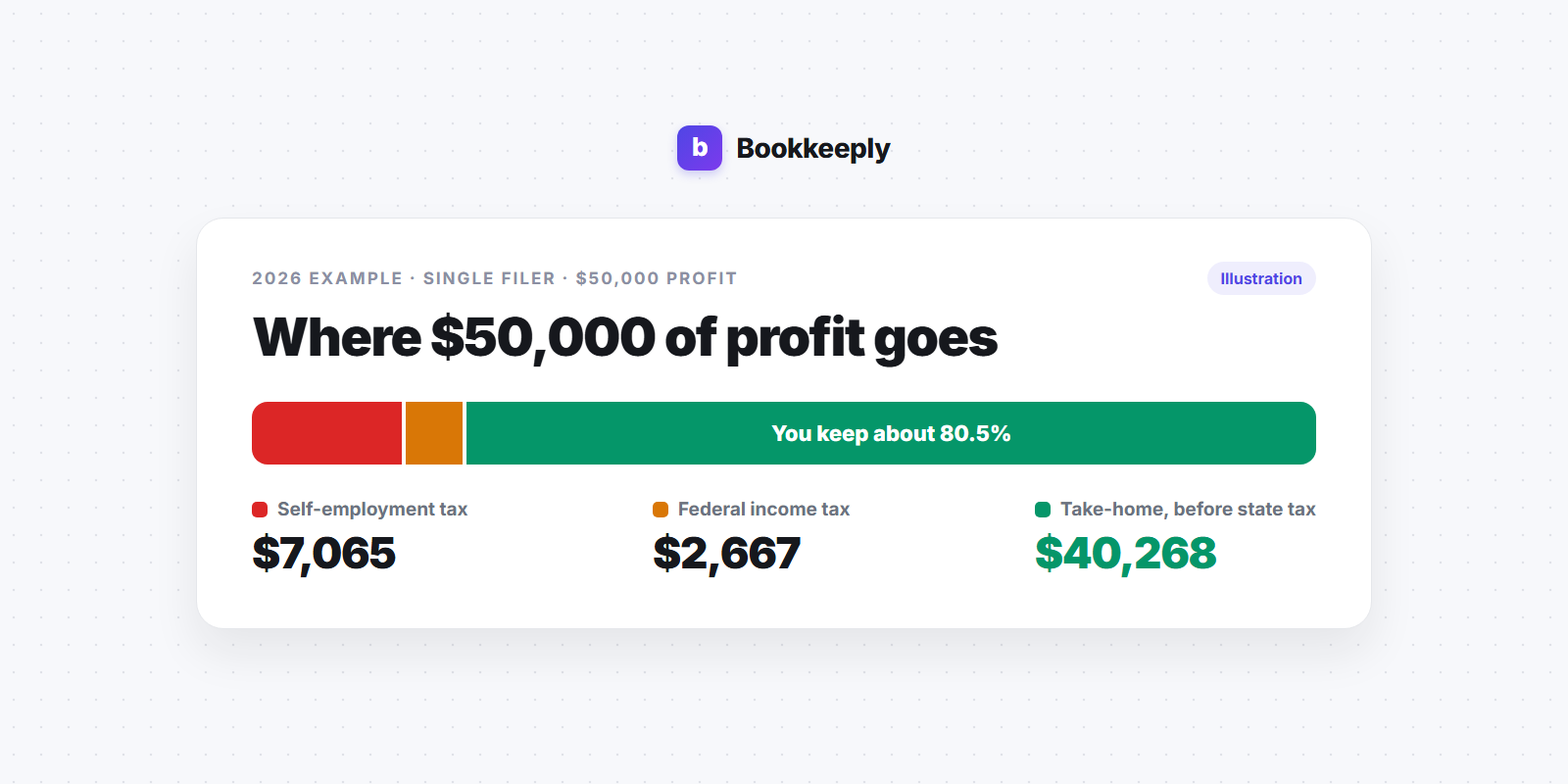
- Take-home before state tax: $40,267.93
In this illustration, federal taxes take about 19.5% of the $50,000 profit, and you keep about 80.5%, or roughly $3,356 a month.
Most of the bill is self-employment tax
At this income, self-employment tax is about 73% of the total federal bill ($7,065 of $9,732). Income tax is relatively small because the standard deduction, the deductible half of SE tax and the QBI deduction together shield almost half of your profit from it, and what's left is taxed at 10% and 12%.
Self-employment tax gets none of those breaks. It applies once your net earnings from self-employment reach $400, which is the IRS filing threshold for it, and it takes about 14.1 cents (15.3% × 92.35%) of every dollar of profit from there up to the wage base.
That's why "I'm only in the 12% bracket" is a risky way to plan. On an extra $1,000 of profit in this example, SE tax alone is about $141, and income tax adds roughly $90 more (12% of what's left after the half-SE-tax and QBI deductions). Together that's about 23% of each extra dollar, which is more than the overall 19.5% average.
How it compares with a $50,000 salary
Illustration only, same 2026 figures. An employee earning a $50,000 salary pays 7.65% in Social Security and Medicare ($3,825) and, after the $16,100 standard deduction, about $2,580 of income tax. That's roughly $6,405 in total, against $9,732 for the freelancer.
The gap is mostly the employer half of payroll tax, which the freelancer pays directly. Two caveats keep this fair: the employer's half is a real cost of employing someone, and a freelancer who earns $50,000 of profit has already covered expenses an employee may pay out of pocket. Our 1099 vs W-2 guide goes deeper on the differences.
What about state income tax?
This is where results vary most. Some states, such as Texas and Florida, have no state income tax on wages and self-employment income. Others use flat or graduated rates, and some cities add their own.
As a rough illustration only: a flat 5% state tax on income close to your federal AGI of about $46,500 would add around $2,300, taking the total to roughly $12,000 and your take-home to about $38,000. Check your state tax agency for its actual rate and rules.
What changes your number
- More tracked expenses. Lower profit means lower SE tax and income tax. The home office deduction is a common one people miss.
- Health insurance. The self-employed health insurance deduction can cut income tax if you pay your own premiums.
- Retirement savings. A SEP IRA or Solo 401(k) lowers income tax, though not SE tax.
- Filing status. Married filing jointly has a larger standard deduction and wider brackets, and a spouse's income changes the result.
- A W-2 job as well. Wages fill the lower brackets first, so freelance profit is taxed at a higher marginal rate.
- Credits. Credits such as the child tax credit reduce income tax directly.
Turning it into a savings plan
Using the illustration above:
- $9,732.07 ÷ 4 = about $2,433 per quarterly estimated payment
- $9,732.07 ÷ 12 = about $811 a month into a separate tax savings account
- Or about 20% of every client payment, plus your state's share
Because no tax is withheld from freelance income, the IRS generally expects estimated payments during the year. See how to pay quarterly estimated taxes, the IRS safe harbor rule for avoiding a penalty, and how much a freelancer should set aside for taxes.
FAQ
How much tax do I pay on $50,000 of self-employed income?
In our 2026 illustration for a single filer with no other income, federal taxes are about $9,732: roughly $7,065 of self-employment tax and $2,667 of income tax. State tax, if any, is extra, and your own deductions and filing status will change the result.
What is the take-home pay on $50,000 self-employed?
About $40,268 a year before state tax in our example, or roughly $3,356 a month. That assumes $50,000 is profit after business expenses, not gross revenue.
What tax bracket is $50,000 self-employed income in?
After the deductions in our example, taxable income is about $24,300, which is in the 12% bracket for a single filer in 2026. Self-employment tax is charged separately on top.
Do I have to make quarterly payments on $50,000?
Generally, the IRS expects estimated payments if you'll owe $1,000 or more when you file, and at $50,000 of profit most freelancers with no withholding will. The safe harbor rule linked above explains how to avoid a penalty.
This article is for general educational purposes and is not tax, legal or accounting advice. The example is a simplified illustration using 2026 federal figures. Your actual tax depends on your full situation, so consider a qualified tax professional for advice specific to you.
If you'd like to track your own numbers as the year goes, you can try Bookkeeply for free, or browse more guides on the Bookkeeply blog.
Stop guessing what you'll owe.
Track your bookkeeping and see your real tax estimate in minutes a day, free, no credit card required.
Get Started Free