Form 1040-ES is the IRS package freelancers use to figure out, and pay, their quarterly estimated taxes. Most people only see the payment vouchers, but the useful part is the worksheet behind them. It turns "I think I owe something?" into a specific dollar amount you can pay each quarter.
This guide walks through the 2026 Estimated Tax Worksheet line by line, explains the separate self-employment tax worksheet that feeds into it, and then runs one complete example for a single freelancer. Every line name and rate below comes from the 2026 Form 1040-ES published by the IRS.
What Form 1040-ES is (and isn't)
Form 1040-ES isn't a return you file. It's a package with instructions, a worksheet you keep for your records, a record of payments and four payment vouchers. You only send the IRS a voucher if you pay by check or money order. If you pay online, you don't mail anything. Our guide on how to pay quarterly estimated taxes covers the payment options step by step.
According to the form's general rule, you usually have to pay estimated tax for 2026 if both of these apply:
- You expect to owe at least $1,000 in tax for 2026 after subtracting withholding and refundable credits.
- Your withholding and refundable credits will be less than the smaller of 90% of your 2026 tax or 100% of the tax shown on your 2025 return (110% if your 2025 AGI was over $150,000, or $75,000 if married filing separately).
Most full-time freelancers with no paycheck meet both tests, which is why the worksheet matters.
Before you start: the self-employment tax worksheet
The main worksheet needs two numbers it can't calculate on its own: your self-employment tax and the deduction for half of it. Both come from the 2026 Self-Employment Tax and Deduction Worksheet for Lines 1 and 9, which is printed inside the package. Here is what it does:
- Line 1a: your expected net profit subject to self-employment tax (for most freelancers, the profit you expect on Schedule C, line 31).
- Line 3: multiply that profit by 92.35%. Only this portion is subject to SE tax.
- Line 4: multiply line 3 by 2.9% for the Medicare part.
- Lines 5 to 8: the Social Security part only applies up to the 2026 maximum of $184,500, reduced by any W-2 wages you also earn.
- Line 9: multiply the amount from line 8 by 12.4% for the Social Security part.
- Line 10: add lines 4 and 9. This is your expected self-employment tax, and it goes on line 9 of the main worksheet.
- Line 11: half of line 10. This is your expected deduction for self-employment tax, which you subtract when estimating your AGI.
Our Schedule SE line-by-line guide and the self-employment tax page go deeper on the same math.
The 2026 Estimated Tax Worksheet, line by line
Line 1: Expected adjusted gross income
Estimate your total 2026 income (business profit plus any wages, interest and other income) minus adjustments. For freelancers, the big adjustment is the SE tax deduction from line 11 of the worksheet above. Other adjustments, like retirement contributions, also reduce AGI.
Lines 2a to 2d: Deductions
Line 2a is either your estimated itemized deductions or your standard deduction. For 2026 the form lists a standard deduction of $16,100 for single filers or married filing separately, $24,150 for head of household and $32,200 for married filing jointly. If you don't itemize, the worksheet also lets you add up to $1,000 ($2,000 if married filing jointly) for charitable contributions made by cash or check.
Line 2b is your estimated qualified business income deduction, which many freelancers can take. See our QBI deduction guide for how it's figured. Line 2c is for any additional deduction you expect to claim on Schedule 1-A (Form 1040). Line 2d adds them up.
Line 3: Expected taxable income
Line 1 minus line 2d.
Lines 4 to 8: Income tax after credits
Line 4 is the income tax on line 3, figured with the 2026 Tax Rate Schedules printed in the package (not last year's brackets). If you expect qualified dividends or capital gains, the form points you to Pub. 505 instead. Line 5 is alternative minimum tax, which most freelancers leave at zero. Line 6 adds lines 4 and 5. Line 7 is the credits you expect, such as the child tax credit (not withholding). Line 8 is line 6 minus line 7, never below zero.
Lines 9 and 10: Self-employment tax and other taxes
Line 9 is the self-employment tax from line 10 of the SE worksheet. Line 10 covers other taxes, such as the Additional Medicare Tax or, in certain cases, household employment taxes. The instructions list which ones to include.
Lines 11a to 11c: Total estimated tax
Line 11a adds lines 8, 9 and 10. Line 11b subtracts refundable credits like the earned income credit or the net premium tax credit. Line 11c is your total 2026 estimated tax.
Lines 12a to 12c: The safe harbor amount
This is the part most people skip, and it's the most useful. Line 12a is 90% of line 11c. Line 12b is your required payment based on last year: 100% of your 2025 tax, or 110% if your 2025 AGI was over $150,000. Line 12c is the smaller of the two, and it's the amount you need to prepay to avoid an underpayment penalty.
The worksheet adds a fair warning: paying the line 12c amount protects you from the penalty, but you may still owe tax when you file. Our guides to the IRS safe harbor rule, the 110% rule for higher earners and the underpayment penalty explain the trade-off.
Lines 13 to 15: Withholding and your quarterly payment
Line 13 is federal income tax you expect to have withheld during 2026, for example from a part-time job. Line 14a is line 12c minus line 13. If it's zero or less, you don't need to make estimated payments. Line 14b is line 11c minus line 13. If that's under $1,000, you also don't need to make them. Otherwise, line 15 is one quarter of line 14a (minus any 2025 overpayment you apply), which is your payment per quarter if the first one is due April 15.
Worked example: a single freelancer earning $80,000
Illustration only. The numbers are made up to show how the worksheet flows. They're rounded to whole dollars and skip anything that doesn't apply to this simple case.
Alex is single, has no W-2 job, expects $80,000 of Schedule C profit in 2026, takes the standard deduction and has no credits. Alex's total tax on the 2025 return was $14,000, and their 2025 AGI was under $150,000.
SE tax worksheet
- Line 3: $80,000 × 92.35% = $73,880
- Line 4 (Medicare): $73,880 × 2.9% = $2,143
- Line 9 (Social Security): $73,880 × 12.4% = $9,161 (under the $184,500 maximum)
- Line 10 (SE tax): $2,143 + $9,161 = $11,304
- Line 11 (deduction): half of $11,304 = $5,652
Estimated Tax Worksheet
- Line 1 (AGI): $80,000 − $5,652 = $74,348
- Line 2a (standard deduction): $16,100
- Line 2b (QBI deduction, simplified): 20% of taxable income before QBI, which is 20% × ($74,348 − $16,100) = $11,650. That's smaller than 20% of the business income, so it's the limit that applies here.
- Line 2d: $16,100 + $11,650 = $27,750
- Line 3 (taxable income): $74,348 − $27,750 = $46,598
- Line 4 (income tax, single schedule): $1,240 + 12% × ($46,598 − $12,400) = $5,344
- Lines 5 to 8: no AMT and no credits, so line 8 = $5,344
- Line 9 (SE tax): $11,304
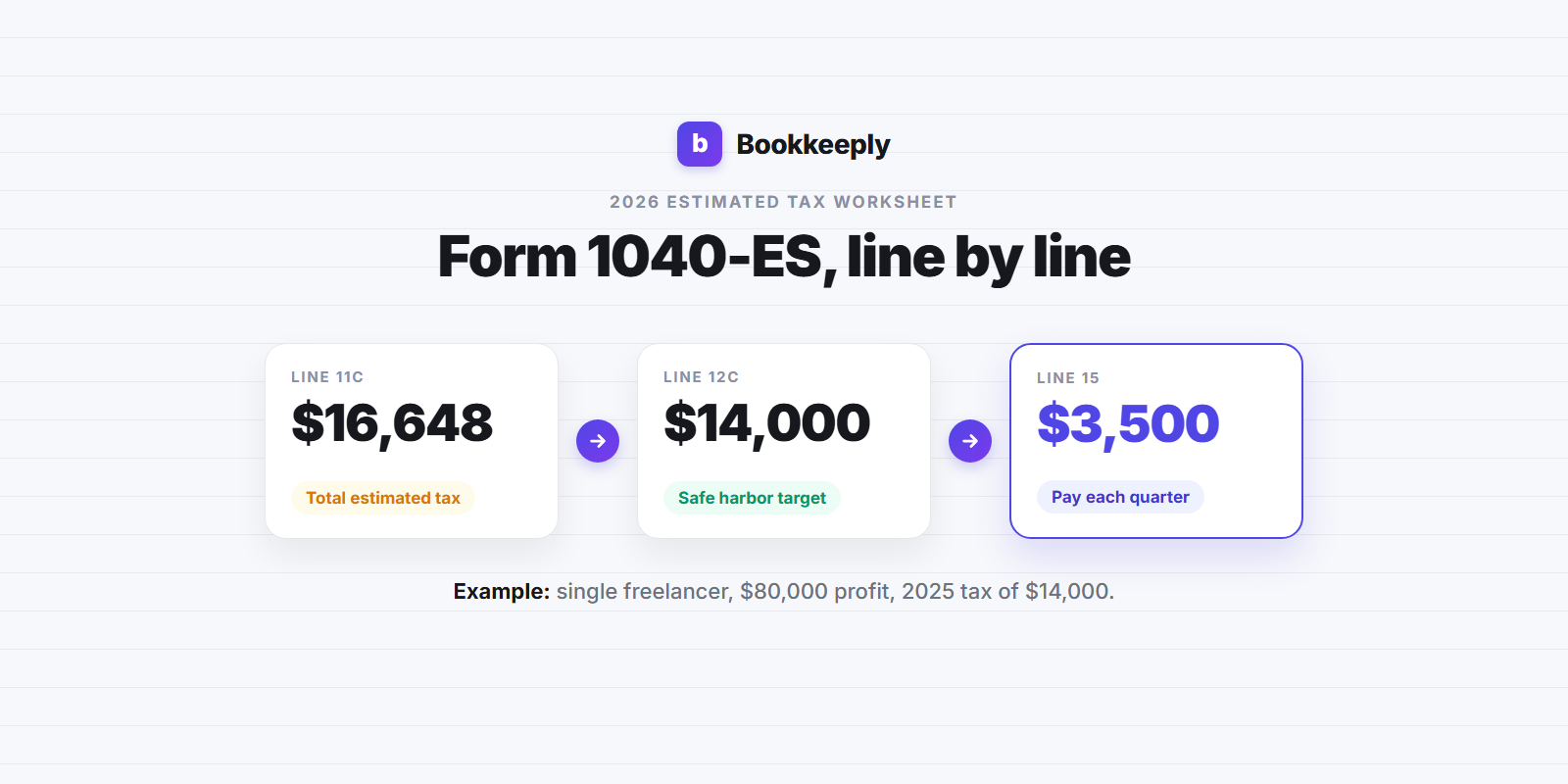
- Line 11c (total estimated tax): $5,344 + $11,304 = $16,648
- Line 12a: 90% × $16,648 = $14,983
- Line 12b: 100% of 2025 tax = $14,000
- Line 12c (required annual payment): the smaller one, $14,000
- Lines 13 to 14b: no withholding, so line 14a = $14,000 and line 14b = $16,648 (over $1,000)
- Line 15: $14,000 ÷ 4 = $3,500 per quarter
If Alex pays $3,500 on each 2026 due date, the safe harbor is met and there's no underpayment penalty, even though about $2,648 ($16,648 − $14,000) would still be due with the return. Alex could instead pay a quarter of line 11c ($4,162) each time to get closer to zero at filing. One protects cash flow during the year, the other avoids a bill in April.
When to redo the worksheet
The worksheet is an estimate, not a contract. Redo it when your income changes meaningfully, for example after landing or losing a big client. The record of payments in the package lists the 2026 due dates as April 15, June 15 and September 15, 2026, and January 15, 2027. The form also notes that you don't have to make the January payment if you file your 2026 return by February 1, 2027 and pay the entire balance with it. See our full list of estimated tax due dates for 2026-2027.
If your income is lumpy (a slow first half and a strong fall, for example), equal payments may not fit. The form points to the annualized income installment method in Pub. 505, chapter 2, which can lower earlier payments when the income actually arrived later in the year.
FAQ
Do I have to file Form 1040-ES with the IRS?
No. The worksheet stays in your records. You only mail a payment voucher if you pay by check or money order.
Can I just use last year's tax instead of the whole worksheet?
For the penalty test, often yes. Line 12b is based on your prior-year tax, so paying 100% (or 110%) of last year's tax in four equal, on-time installments generally avoids the penalty. You still need a realistic estimate to know what you'll owe at filing.
What if this is my first year freelancing?
If you didn't file a 2025 return, or your 2025 tax year was shorter than 12 full months, the instructions say to skip line 12b and enter the line 12a amount on line 12c. In that case your target is 90% of this year's estimated tax.
How much should I set aside if I don't want to redo the worksheet every quarter?
Many freelancers set aside a fixed percentage of each payment and check it against the worksheet once or twice a year. Our guide on how much a freelancer should set aside for taxes covers how to pick that percentage.
This article is for educational purposes only and isn't tax or legal advice. Bookkeeply isn't a CPA firm. Tax rules change and depend on your situation, so check the current IRS instructions or talk to a qualified tax professional before making decisions.
If you'd like your quarterly estimate to update as you log income and expenses, you can try Bookkeeply for free.
Stop guessing what you'll owe.
Track your bookkeeping and see your real tax estimate in minutes a day, free, no credit card required.
Get Started Free