You've been offered a $100,000 salary, or you're thinking about leaving one to freelance and bill about the same. On paper the two numbers look identical. In practice they are taxed differently, and they come with very different extras attached.
This guide compares a $100,000 W-2 salary with $100,000 of self-employed profit for 2026, step by step, using published IRS figures. You'll see where the two paths split, why the gap is smaller than many people expect, and what really decides which one leaves you better off.
If you want the freelance side on its own, our post You Made $100,000. How Much of It Is Actually Yours? walks through revenue vs profit vs take-home. For the general differences between the two kinds of work, see 1099 vs W-2: what changes for your taxes.
The short answer
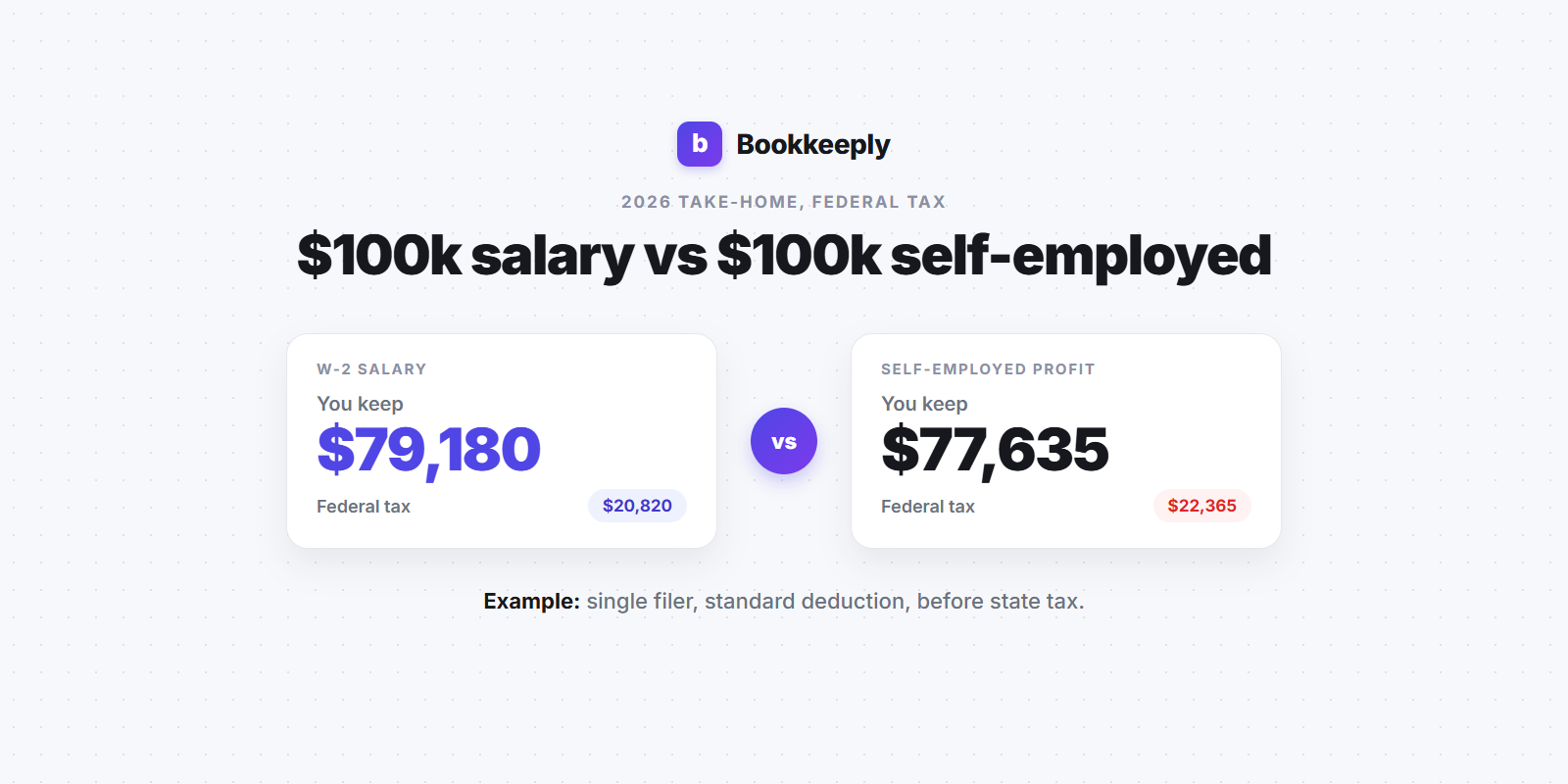
In the simple 2026 example below (single filer, standard deduction, federal taxes only), the employee keeps about $79,180 and the freelancer keeps about $77,635. That's a difference of roughly $1,545 a year in federal tax.
The tax gap is real but modest. The bigger difference usually comes from everything a salary includes that a freelance income doesn't: an employer's share of payroll tax, health coverage, retirement matching, and paid time off. We'll get to those after the math.
Assumptions for the example
Illustration only. Both people are single, have no other income, take the standard deduction, make no retirement contributions, and claim no credits. The freelancer's $100,000 is net profit after business expenses, not gross revenue. Figures use the 2026 amounts from IRS Rev. Proc. 2025-32 (brackets and the $16,100 standard deduction for single filers) and the Social Security Administration's 2026 wage base of $184,500. State and local taxes are left out because they vary so much.
Path 1: a $100,000 W-2 salary
Payroll taxes (FICA)
An employee pays 7.65% of wages: 6.2% for Social Security and 1.45% for Medicare. The employer pays a matching 7.65% that never shows up on the paycheck.
- $100,000 × 7.65% = $7,650
Federal income tax
- Taxable income: $100,000 − $16,100 standard deduction = $83,900
- 10% of the first $12,400 = $1,240
- 12% from $12,400 to $50,400 = $4,560
- 22% from $50,400 to $83,900 = $7,370
- Federal income tax: $13,170
Total
- Federal tax: $7,650 + $13,170 = $20,820
- Take-home before state tax: $79,180
Path 2: $100,000 of self-employed profit
Self-employment tax
Self-employed people pay both halves of Social Security and Medicare, 15.3% in total, but only on 92.35% of net earnings. Our self-employment tax guide explains why, and Schedule SE explained line by line shows where it lands on the return.
- Net earnings: $100,000 × 92.35% = $92,350
- Self-employment tax: $92,350 × 15.3% = $14,129.55
Adjusted gross income
Half of self-employment tax is deductible as an adjustment to income:
- $100,000 − $7,064.78 = $92,935.22 AGI
- Minus the $16,100 standard deduction = $76,835.22
The QBI deduction
Here is where the freelancer catches up. Most sole proprietors can take the qualified business income (QBI) deduction, which is generally the smaller of 20% of qualified business income or 20% of taxable income before the deduction.
- 20% of QBI ($92,935.22) = $18,587.04
- 20% of taxable income ($76,835.22) = $15,367.04
- Taxable income after QBI: $61,468.18
Our QBI deduction guide covers the rules and limits in more detail.
Federal income tax
- 10% of the first $12,400 = $1,240
- 12% from $12,400 to $50,400 = $4,560
- 22% from $50,400 to $61,468.18 = $2,435
- Federal income tax: $8,235
Total
- Federal tax: $14,129.55 + $8,235 = $22,364.55
- Take-home before state tax: $77,635.45
Side by side
- Payroll tax: employee $7,650 vs freelancer $14,129.55 (about $6,480 more for the freelancer)
- Federal income tax: employee $13,170 vs freelancer $8,235 (about $4,935 less for the freelancer)
- Total federal tax: employee $20,820 vs freelancer $22,364.55
- Kept before state tax: employee $79,180 vs freelancer $77,635.45
The freelancer pays almost twice the payroll tax, but a lot of that is clawed back on the income tax side. Two things do the work: the deduction for half of self-employment tax, and the QBI deduction, which employees can't take on wages. In this illustration, a freelancer would need about $102,222 of profit to keep the same $79,180 as the employee, federal taxes only.
What the tax math leaves out
A $100,000 salary is usually worth more than $100,000 to the employee, because the employer pays for things the freelancer has to buy alone. None of these show up in the example above, but they often matter more than the tax gap:
- The employer's half of FICA. The company pays another $7,650 on top of the salary. As a freelancer, that cost is already inside your self-employment tax.
- Health insurance. Employers often pay a large share of premiums. If you buy your own coverage, the self-employed health insurance deduction can lower your income tax, but you still pay the premiums.
- Retirement matching. A 401(k) match is extra money. Freelancers can save on their own through a SEP IRA or Solo 401(k), sometimes with higher limits, but nobody matches it.
- Paid time off and holidays. When a freelancer takes two weeks off, revenue usually stops. Your annual profit has to cover the weeks you don't bill.
- Unbillable time and expenses. Sales, admin, software and equipment are paid by the employer for an employee. For you, they come out of revenue before you ever reach $100,000 of profit.
A simple way to compare: write down what the salaried job's benefits would cost you to replace, add that to the salary, and see how much revenue you'd need to bill to match it after business expenses and tax.
Where freelancing can come out ahead
The comparison isn't one-sided. A self-employed person has a few levers an employee doesn't:
- Business deductions. Real expenses like a home office, business mileage and equipment reduce profit, which lowers both self-employment tax and income tax. Most employees can't deduct unreimbursed work costs on their federal return. The self-employed deductions checklist is a good starting point.
- Retirement plans with room to grow. Solo 401(k) and SEP IRA contributions lower income tax and can go well beyond what many workplace plans allow for the employee alone.
- Pricing. Your income isn't capped by a salary band. If you set rates with taxes and benefits in mind, $100,000 of profit can be a floor, not a ceiling.
The cash-flow difference
Even if the totals were identical, the experience isn't. An employee's taxes are withheld from every paycheck. A freelancer receives the full amount and has to set the tax aside and send it in. Using the example above, $22,364.55 ÷ 4 is about $5,591 per quarter in estimated payments, or roughly 22% of every client payment, plus your state's share.
If that's new to you, start with how much a freelancer should set aside for taxes, then check the 2026-2027 estimated tax due dates and the IRS safe harbor rule so you don't face an underpayment penalty.
FAQ
Do self-employed people pay more tax than employees on the same income?
Usually a bit more in federal tax, because they pay both halves of Social Security and Medicare. In the 2026 illustration above, the gap at $100,000 was about $1,545, since the half-SE-tax deduction and the QBI deduction offset much of the extra payroll tax.
Is $100,000 of revenue the same as $100,000 of profit?
No. Taxes are figured on profit after business expenses. If you bill $100,000 and spend $15,000 running the business, the comparison should start at $85,000. See Schedule C for freelancers for how profit is calculated.
Would an S-Corp change the comparison?
It can, at higher profit levels, because an S-Corp owner pays payroll tax only on a reasonable salary. It also adds payroll and filing costs. Our guide on sole prop vs S-Corp explains when it tends to make sense.
Does state tax change the result?
State income tax applies to both paths, so it moves both take-home numbers down. The exact effect depends on your state's rules, including whether it follows the federal QBI deduction, so check your state tax agency.
This article is for educational purposes only and is not tax, legal or financial advice. Bookkeeply is not a CPA firm. Tax rules change and your situation may differ, so check IRS guidance or talk to a qualified tax professional before making decisions.
Want to see your own numbers instead of an example? You can try Bookkeeply for free to track income, expenses and estimated taxes in one place.
Stop guessing what you'll owe.
Track your bookkeeping and see your real tax estimate in minutes a day, free, no credit card required.
Get Started Free